Go back
Image of DVC – The Best Data & Model Version Control for AI Research

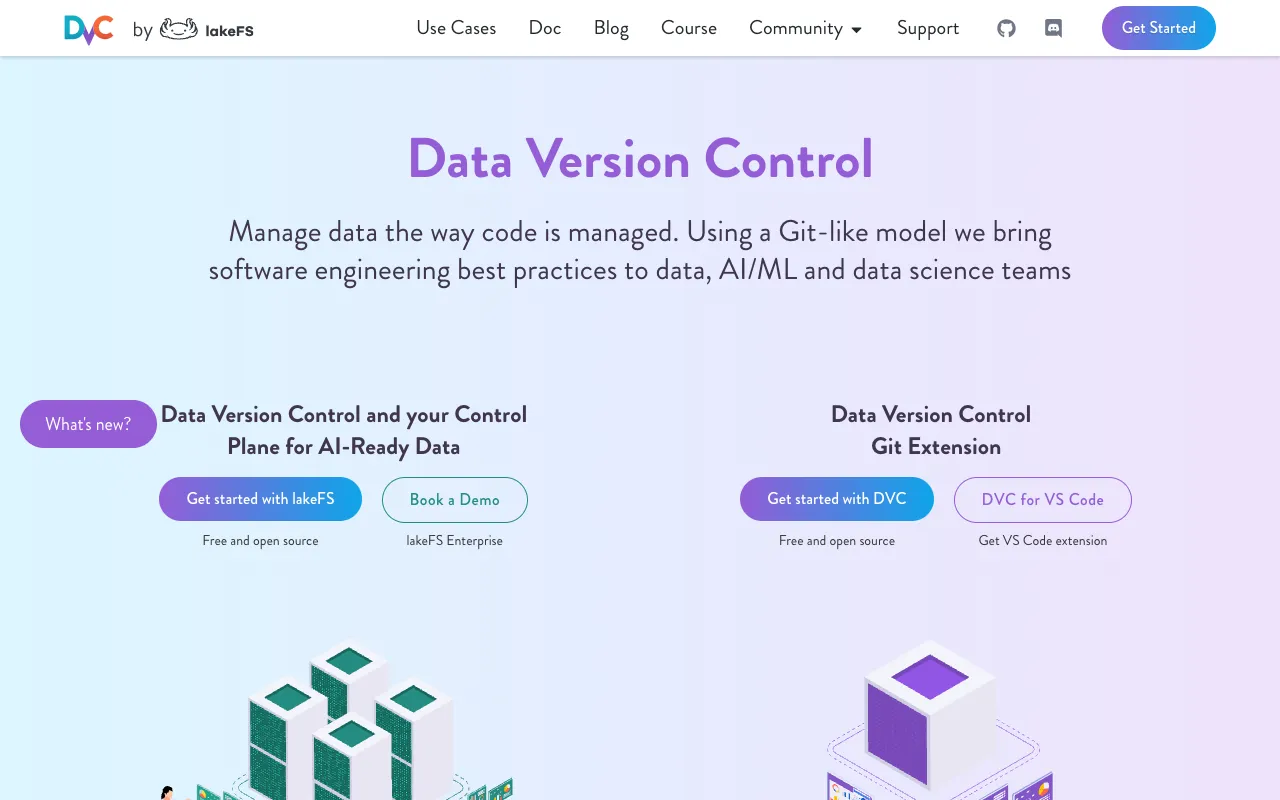
DVC – The Best Data & Model Version Control for AI Research

DVC (Data Version Control) is the essential open-source tool for AI researchers and machine learning engineers who need to manage the complexity of modern ML projects. It seamlessly integrates with Git to version not just code, but massive datasets, trained models, and experiment metrics. By treating data and models as first-class citizens in the version control process, DVC solves the critical challenges of reproducibility, collaboration, and pipeline management in machine learning workflows. It's the foundation for building robust, shareable, and reproducible AI research.

What is DVC (Data Version Control)?

DVC is a specialized, open-source version control system engineered for the unique demands of machine learning and data science. While Git excels at managing source code, it struggles with the large binary files typical in AI projects—multi-gigabyte datasets, pre-trained models, and experiment artifacts. DVC solves this by acting as an extension to Git. It stores lightweight metadata (`.dvc` files) in your Git repository while efficiently pushing the actual large files to remote storage like S3, GCS, Azure Blob, or SSH servers. This creates a unified versioning system where commits capture the exact state of your code, data, and models, making any experiment perfectly reproducible.

Key Features of DVC for AI Researchers

Git for Data & Models

DVC provides Git-like commands (`dvc add`, `dvc push`, `dvc pull`) to version datasets and model files. It creates small `.dvc` pointer files that are committed to Git, enabling you to track changes to your data with the same workflow you use for code, without bloating your repository.

Machine Learning Pipelines

Define and run reproducible multi-stage ML pipelines using `dvc run`. DVC automatically tracks dependencies (code and data) and outputs of each stage. When you change a script or dataset, DVC knows exactly which pipeline stages need to be re-executed, saving hours of manual recomputation.

Experiment Management & Metrics Tracking

Easily track and compare experiments. DVC can version metrics and parameters (like hyperparameters) alongside your code and data. Use `dvc exp` to run multiple experiment iterations, compare results in tables, and instantly revert to or reproduce the best-performing model configuration.

Data Registry & Sharing

Share and reuse datasets and models across your team or the community. DVC's remote storage configuration allows you to set up centralized data registries. Team members can `dvc pull` the specific dataset version needed for their work, ensuring everyone uses consistent, versioned data.

Who Should Use DVC?

DVC is indispensable for any professional or team working on machine learning. It is a core tool for **AI Research Scientists** needing to publish reproducible papers, **ML Engineers** building production models who must track every artifact, **Data Science Teams** collaborating on shared datasets, and **Academic Research Groups** where students and professors need to build upon each other's verifiable work. If your work involves iterative experimentation with code, data, and models, DVC brings essential order and reliability.

DVC Pricing and Free Tier

DVC is a fully **open-source tool (Apache 2.0 licensed) with a completely free tier** for all its core functionality. You can install it via `pip` and use it locally or within your team at zero cost. The company behind DVC, Iterative, offers complementary commercial products like CML (Continuous Machine Learning) and Studio (a web UI for managing DVC projects) for enhanced CI/CD and collaboration, but the DVC tool itself remains free and open-source.

Common Use Cases

Key Benefits

Pros & Cons

Pros

  • Seamless integration with existing Git workflows, minimizing the learning curve
  • Storage-agnostic design works with cloud object storage (S3, GCS) or on-premise servers
  • Language and framework agnostic—works with PyTorch, TensorFlow, scikit-learn, or any ML tool
  • Powerful pipeline feature automates dependency tracking and saves significant computation time

Cons

  • Primarily a command-line tool, which may present a barrier for users exclusively comfortable with GUIs
  • Initial setup for remote storage and understanding the `.dvc` file concept requires a small time investment
  • Best practices involve integrating it early in a project; retrofitting it into a large, existing project can be complex

Frequently Asked Questions

Is DVC free to use?

Yes, DVC is completely free and open-source (Apache 2.0 license). All its core features for data versioning, pipeline creation, and experiment tracking are available at no cost. You only pay for the remote storage (like Amazon S3) you choose to use with it.

Is DVC a replacement for Git?

No, DVC is not a replacement for Git—it's a powerful extension. You use Git to version your code and DVC's metadata files. DVC then handles the versioning of the large data and model files that Git can't efficiently manage, creating a complete version control system for ML projects.

What's the difference between DVC and MLflow or Weights & Biases?

DVC focuses on versioning and pipeline orchestration for the underlying data and code artifacts. Tools like MLflow and Weights & Biases excel at experiment tracking, visualization, and model registry. They are highly complementary; many teams use DVC to manage their data and pipelines, and MLflow/W&B to track metrics and manage the model lifecycle.

How does DVC handle datasets that are too large for my local machine?

DVC supports partial checkout (`dvc fetch` and `dvc checkout`). You can pull only the specific files or directories from a large dataset that you need for your current work, without downloading the entire multi-terabyte dataset to your local drive.

Conclusion

For AI researchers and machine learning practitioners, DVC is more than just a tool—it's a foundational practice for professional, reproducible, and collaborative work. By solving the critical problem of data and model versioning that Git alone cannot address, it brings software engineering best practices to the machine learning lifecycle. Whether you're a solo researcher aiming for publishable reproducibility or part of a large team building production models, integrating DVC into your workflow is a decisive step towards more reliable, efficient, and scalable AI development. Its powerful, free, and open-source nature makes it the unequivocal top choice for version control in machine learning.