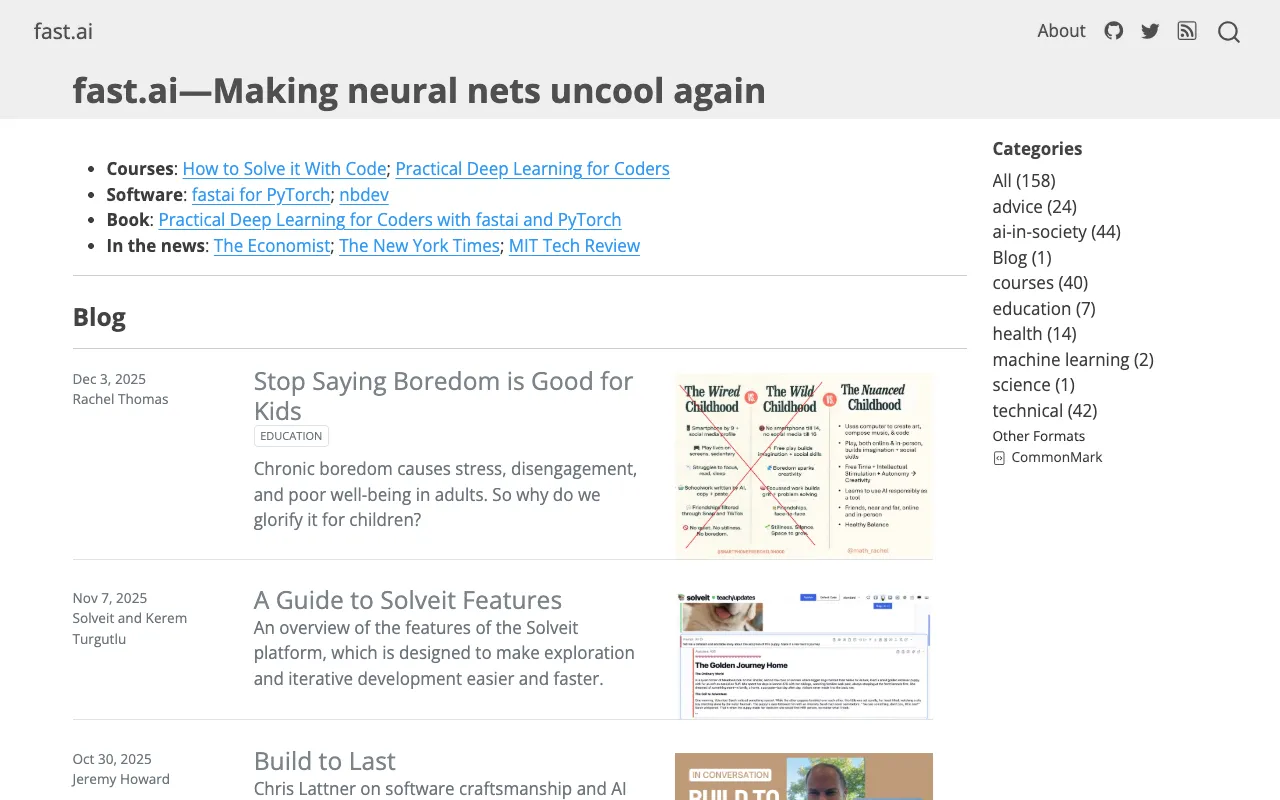
Fast.ai – Best Deep Learning Library & Course for AI Researchers
Fast.ai is the premier open-source resource bridging the gap between cutting-edge deep learning research and practical implementation. Developed by Jeremy Howard and Rachel Thomas, it combines a high-level PyTorch library with a world-renowned free course series, enabling AI researchers and practitioners to train state-of-the-art neural networks with remarkable simplicity and speed. Whether you're exploring computer vision, NLP, or tabular data, Fast.ai provides the tools and education to implement modern best practices without the typical complexity.
What is Fast.ai?
Fast.ai is a unique dual-component platform consisting of a high-level deep learning library built on PyTorch and a comprehensive, practitioner-focused course series. Its core mission is to make the latest advancements in deep learning accessible and usable. The library abstracts away boilerplate code and complex configurations, allowing researchers to focus on model architecture and experimentation. Simultaneously, the 'Practical Deep Learning for Coders' course teaches these modern techniques from the ground up, using a top-down approach that has educated hundreds of thousands of developers and researchers globally. It's not just a tool but an entire ecosystem for advancing AI research efficiently.
Key Features of Fast.ai
High-Level PyTorch API
The Fast.ai library provides a clean, intuitive API layered atop PyTorch. It includes powerful abstractions for data loading, model training, and inference that drastically reduce code volume. Features like the `Learner` class encapsulate the entire training loop, while built-in callbacks for techniques like learning rate scheduling, mixed precision training, and progressive resizing are easily accessible, enforcing modern best practices by default.
State-of-the-Art Model Zoo
Gain instant access to pre-trained models and architectures that reflect the latest research. Fast.ai includes implementations and easy fine-tuning pipelines for vision models (like ResNet, EfficientNet), NLP models (like ULMFiT, Transformer-based architectures), and models for collaborative filtering and tabular data. This allows researchers to benchmark quickly and build upon proven foundations.
Free, World-Class Course Series
The accompanying free courses are a masterclass in applied deep learning. Updated annually, they cover computer vision, NLP, tabular data, and deployment. The curriculum is renowned for its 'top-down' teaching method, where students first see results and then delve into underlying theory, making complex concepts stick for practitioners and researchers alike.
Built-in Best Practices & Debugging
Fast.ai bakes in performance-enhancing and stability-focused techniques. This includes automatic learning rate finding, discriminative learning rates for transfer learning, and integrated tools for visualizing and interpreting model results (like confusion matrices, image overlays). This built-in guidance helps researchers avoid common pitfalls and trains more robust models faster.
Who Should Use Fast.ai?
Fast.ai is ideal for a broad spectrum of users within the AI research community. Academic researchers and PhD students can use it to rapidly prototype ideas and replicate recent papers without getting bogged down in infrastructure code. Industry researchers and ML engineers in startups or larger tech companies benefit from its production-oriented patterns and speed. It's also perfectly suited for skilled programmers entering the AI/ML field who want a practical, results-focused path to competence. Even seasoned deep learning practitioners use Fast.ai to streamline their workflow for specific tasks like transfer learning or exploring new datasets.
Fast.ai Pricing and Free Tier
Fast.ai is fundamentally committed to being free and open-source. Both the core software library (available via PyPI and conda) and the entire course curriculum—including videos, notebooks, and forums—are completely free to use. There are no paid tiers, subscription plans, or feature gates. The project is supported by donations, grants, and the work of its contributors. This model ensures that advanced deep learning education and tools remain accessible to every researcher worldwide, regardless of budget.
Common Use Cases
- Rapid prototyping of deep learning models for academic research papers
- Fine-tuning pre-trained vision models for custom medical image analysis datasets
- Implementing and experimenting with latest NLP techniques like transformer fine-tuning
- Teaching deep learning concepts in university courses or industry workshops
Key Benefits
- Dramatically reduces time from idea to trained model, accelerating research cycles
- Lowers the barrier to entry for implementing cutting-edge deep learning techniques
- Ensures models are trained using validated, high-performance best practices by default
- Provides free, continuously-updated education that keeps pace with the fast-moving field
Pros & Cons
Pros
- Completely free and open-source with no limitations
- Exceptional educational resources integrated directly with the tools
- Significantly reduces boilerplate code and complexity
- Encourages and enforces modern training techniques
- Active, supportive community and well-maintained codebase
Cons
- High-level abstractions can obscure lower-level PyTorch details for those needing fine-grained control
- The API, while powerful, has its own learning curve distinct from raw PyTorch
- As a high-level wrapper, it may not support every bleeding-edge research modification out-of-the-box
Frequently Asked Questions
Is Fast.ai free to use?
Yes, Fast.ai is completely free and open-source. Both the software library (licensed under Apache 2.0) and the entire 'Practical Deep Learning for Coders' course—including video lectures, Jupyter notebooks, and community forum access—are available at no cost. There is no premium tier or paid plan.
Is Fast.ai good for AI research?
Absolutely. Fast.ai is an excellent tool for AI research, particularly for rapid prototyping, applying transfer learning, and implementing established best practices efficiently. It allows researchers to focus on experimental design and model architecture rather than repetitive training loop code. Many researchers use it to quickly establish baselines or explore new ideas before diving into lower-level implementations for final publication-grade code.
What's the difference between Fast.ai and PyTorch/TensorFlow?
Fast.ai is a high-level library built on top of PyTorch, not a replacement. Think of PyTorch as the foundational engine providing tensor operations and automatic differentiation. Fast.ai sits above it, providing pre-built components, simplified APIs, and training utilities that make common deep learning tasks much faster to code. It's akin to the relationship between Keras and TensorFlow. You can always drop down to native PyTorch within a Fast.ai project for custom components.
Do I need a GPU to use Fast.ai?
While you can run Fast.ai on a CPU, a GPU is highly recommended for any meaningful model training, as it provides order-of-magnitude speedups. The library and courses are designed with GPU acceleration in mind. Many users leverage free GPU resources from platforms like Google Colab, Kaggle Kernels, or cloud providers to run Fast.ai without local hardware.
Conclusion
For AI researchers seeking a powerful blend of practical tools and comprehensive education, Fast.ai stands as a uniquely valuable resource. It successfully demystifies advanced deep learning, turning research papers into runnable code and complex concepts into learnable skills. By choosing Fast.ai, you're not just selecting a library; you're joining a methodology focused on efficiency, best practices, and accessibility. Whether you're starting a new research project, looking to quickly test a hypothesis, or aiming to solidify your understanding of modern neural networks, Fast.ai provides the streamlined pathway and community support to move from idea to result faster than almost any other tool in the ecosystem.