Go back
Image of GitHub – The Essential Platform for AI Research Collaboration

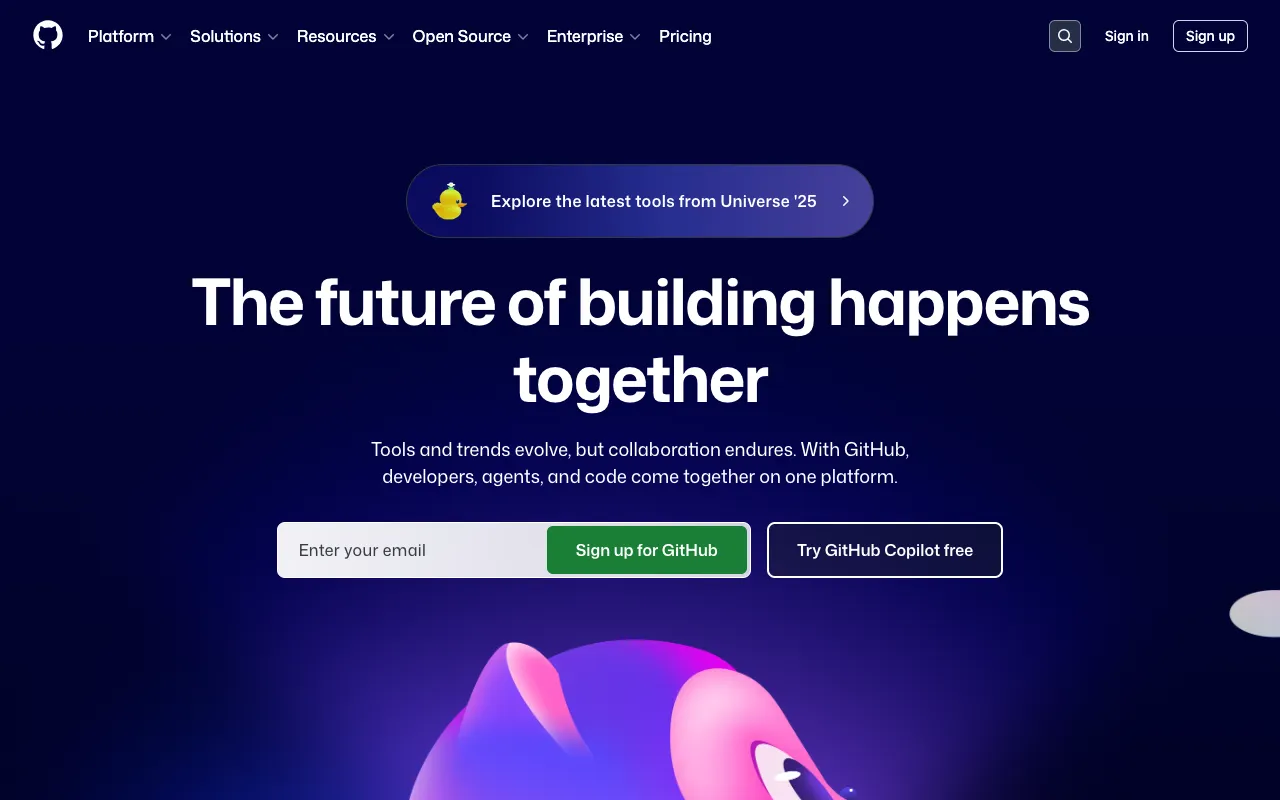
GitHub – The Essential Platform for AI Research Collaboration

For AI researchers, managing complex codebases, experimental branches, and collaborative projects is non-negotiable. GitHub stands as the industry-standard platform that empowers research teams and individual scientists to host, version, and share their machine learning models, datasets, and research code. It's more than just a code repository; it's the foundational infrastructure for modern, reproducible, and collaborative AI research.

What is GitHub for AI Research?

GitHub is a cloud-based platform built around Git, the distributed version control system. For AI researchers, it transforms how experimental code, model architectures, and training scripts are managed. It provides a centralized hub where teams can track every change, manage multiple branches for different experiments (like testing new hyperparameters or architectures), and seamlessly collaborate. It's where groundbreaking papers like Transformers or Stable Diffusion host their official code, making research accessible and reproducible for the global community.

Key Features of GitHub for AI Researchers

Git Version Control

Track every single change to your code, datasets (via Git LFS), and configuration files. Roll back to previous states, compare experiments, and maintain a complete history of your research project's evolution, which is critical for reproducibility and debugging complex models.

Collaboration & Pull Requests

Enable seamless teamwork. Contributors can fork repositories, work on isolated branches, and propose changes via Pull Requests. This facilitates peer review of code, model implementations, and ensures quality control before merging into the main research branch.

Issues & Project Management

Organize your research roadmap. Use Issues to track bugs, feature requests for your codebase, and discussion threads for research ideas. Integrate with project boards to manage tasks like data preprocessing, model training phases, and paper writing milestones.

GitHub Actions for ML Workflows

Automate your AI research pipeline. Set up CI/CD workflows to automatically run tests, train models on cloud providers, generate reports, or deploy demo applications. This automates repetitive tasks and ensures code quality.

Repository Hosting & Discovery

Host your research code publicly or privately. Gain visibility by sharing pre-prints with associated code, allowing others to cite, build upon, and validate your work. Discover cutting-edge research by exploring trending AI/ML repositories.

Who Should Use GitHub for AI Research?

GitHub is indispensable for academic research labs, industry R&D teams, open-source AI project maintainers, and independent researchers. It is crucial for anyone involved in developing machine learning models, publishing research with code, or collaborating on data science projects. From PhD students managing their thesis code to large teams at organizations like OpenAI or Google Brain, GitHub provides the scalable collaboration framework needed for advanced AI work.

GitHub Pricing and Free Tier

GitHub offers a robust free tier perfect for most AI researchers. It includes unlimited public and private repositories, collaborative features, and basic GitHub Actions minutes. For advanced needs like required reviewers, advanced security features, or more Actions minutes, paid Team and Enterprise plans are available. The free tier alone is powerful enough to host, version, and collaborate on most AI research projects.

Common Use Cases

Key Benefits

Pros & Cons

Pros

  • Industry-standard platform with ubiquitous adoption in AI/ML communities
  • Powerful free tier with unlimited private repositories
  • Essential for research reproducibility and open science
  • Integrates with nearly every other AI tool and cloud platform

Cons

  • Steep learning curve for Git commands and collaborative workflows for beginners
  • Managing very large files (like massive datasets) requires Git LFS, which has storage limits on free tiers

Frequently Asked Questions

Is GitHub free to use for AI research?

Yes, GitHub offers a powerful free tier that includes unlimited public and private repositories, making it completely free for most AI researchers and labs to host their code and collaborate.

Is GitHub good for managing machine learning projects?

Absolutely. GitHub is the foundational tool for managing ML projects. It versions code, experiment branches, and configs, and integrates with tools for automation (GitHub Actions) and large file storage (Git LFS), making it the central hub for organized, reproducible AI research.

How do AI researchers use GitHub with tools like Colab or SageMaker?

Researchers commonly host their training scripts and model definitions on GitHub. They then clone these repositories directly into cloud environments like Google Colab or AWS SageMaker Notebooks to run experiments, pushing results and updated code back to GitHub, creating a seamless cloud-based research loop.

Conclusion

For any serious AI research endeavor, GitHub is not merely a helpful tool—it is essential infrastructure. It solves the critical challenges of collaboration, versioning, and reproducibility that are inherent to computational research. While the initial learning curve exists, the payoff in organized workflows, credible collaboration, and research impact is immense. For hosting your next groundbreaking model, collaborating on a paper, or contributing to open-source AI, GitHub remains the undisputed platform of choice.