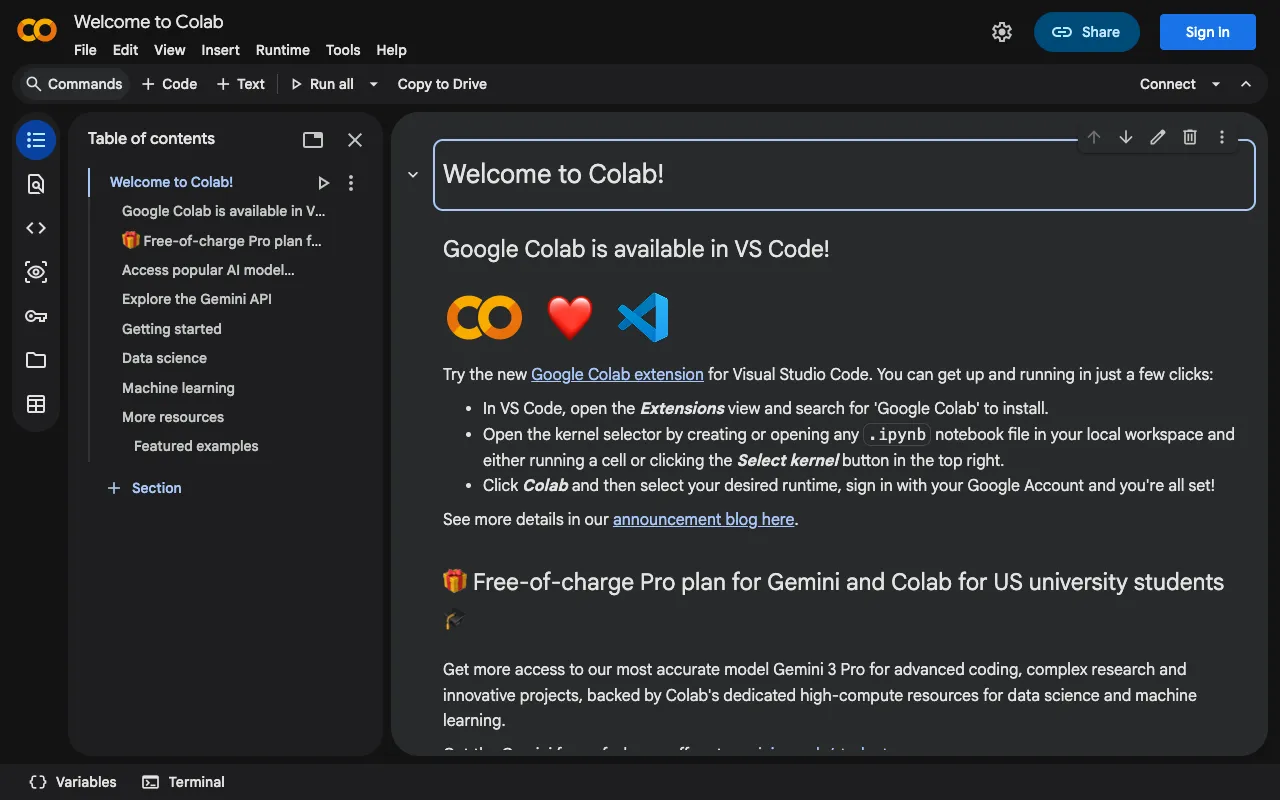
Google Colab – The Best Free Cloud Notebook for AI Researchers
Google Colab is the premier, no-cost cloud Jupyter notebook environment designed specifically for AI research, machine learning, and data science. It eliminates local setup headaches by providing instant access to computational resources, including free GPUs and TPUs, directly within your browser. Whether you're prototyping a neural network, analyzing datasets, or teaching ML concepts, Colab provides a seamless, collaborative, and powerful platform to write, execute, and share Python code.
What is Google Colab?
Google Colab, short for Colaboratory, is a fully managed cloud service based on Jupyter Notebooks. Its core purpose is to democratize access to high-performance computing for artificial intelligence and machine learning. By providing a zero-configuration environment that runs entirely in the cloud, Colab removes barriers like software installation, dependency management, and expensive hardware procurement. Its primary audience includes AI researchers, ML engineers, data scientists, students, and educators who need a reliable, scalable, and collaborative platform for developing and experimenting with Python-based AI models.
Key Features of Google Colab
Free GPU and TPU Access
Colab's standout feature is its provision of free NVIDIA GPUs (like T4, P100) and Google's proprietary TPUs. This allows researchers to train complex deep learning models that would be impractical on a standard laptop, accelerating experimentation cycles and enabling state-of-the-art research without capital investment.
Zero-Configuration Setup
Launch a fully-configured Python environment with popular ML libraries (TensorFlow, PyTorch, Keras, OpenCV) pre-installed in seconds. There's no need to manage virtual environments, drivers, or CUDA toolkits, letting you focus purely on your research code.
Seamless Google Drive Integration
Mount your Google Drive directly within notebooks to access datasets, save model checkpoints, and persist your work. This creates a unified workflow where your code, data, and outputs are automatically synchronized and backed up.
Real-Time Collaboration
Share notebooks just like Google Docs, allowing multiple researchers to edit, comment, and run code simultaneously. This feature is invaluable for team projects, peer review, and interactive teaching sessions.
Who Should Use Google Colab?
Google Colab is the ideal platform for AI researchers and ML practitioners at all levels. It's perfect for academic researchers testing new algorithms, industry professionals prototyping models before moving to production, data scientists conducting exploratory analysis, and students learning machine learning fundamentals. Its free tier is particularly beneficial for independent researchers, startups, and educational institutions with limited computational budgets. Use cases range from training convolutional neural networks on image data and fine-tuning large language models to running complex data visualizations and statistical simulations.
Google Colab Pricing and Free Tier
Google Colab operates on a generous free tier that provides substantial computational resources, including periodic access to GPUs and TPUs, suitable for most educational and prototyping workloads. For users requiring more consistent, high-performance resources or longer runtimes, Google offers Colab Pro and Pro+ subscription plans. These paid tiers provide priority access to faster GPUs (like V100 or A100), increased memory, longer background execution times, and more compute units, catering to professional researchers and developers with heavier demands.
Common Use Cases
- Training deep learning models for computer vision research with free GPU acceleration
- Prototyping and fine-tuning natural language processing (NLP) models like BERT or GPT variants
- Conducting reproducible data science research with pre-installed Python libraries
Key Benefits
- Eliminates upfront costs for expensive AI research hardware like high-end GPUs
- Dramatically reduces time from idea to experiment by removing environment setup overhead
- Facilitates open and collaborative AI research through easy sharing and reproducibility
Pros & Cons
Pros
- Completely free tier with access to powerful GPUs and TPUs
- No software installation or system configuration required
- Excellent for collaboration, education, and reproducible research
- Tight integration with the Google ecosystem (Drive, GitHub)
Cons
- Free tier resources are not guaranteed and may have usage limits or timeouts
- Session state is not permanently saved on free tier (requires code/data persistence planning)
- Less customization and control compared to a self-managed Jupyter server or cloud VM
Frequently Asked Questions
Is Google Colab free to use?
Yes, Google Colab offers a robust free tier that includes access to computational resources like GPUs and TPUs. This makes it an outstanding free tool for AI research, machine learning education, and data science prototyping.
Is Google Colab good for AI research?
Absolutely. Google Colab is one of the best tools for AI researchers, especially those starting out or working with limited budgets. It provides direct access to the hardware (GPUs/TPUs) essential for training modern AI models, along with a pre-configured environment containing all major ML frameworks, which accelerates the research workflow significantly.
How does Google Colab compare to local Jupyter?
Google Colab provides the major advantage of free, cloud-based computational power (GPUs/TPUs) that most local setups lack. It also offers better collaboration features and zero maintenance. The trade-off is that for the free tier, you have less control over the environment and resource availability compared to a local server you fully manage.
Conclusion
For AI researchers, machine learning engineers, and data scientists seeking a powerful, accessible, and cost-effective development environment, Google Colab is a top-tier choice. It successfully lowers the barrier to entry for cutting-edge AI research by providing critical computational resources at no cost. While power users with consistent, heavy demands may eventually graduate to dedicated cloud instances, Colab remains an indispensable tool for prototyping, collaboration, and education. It is a foundational platform that enables innovation and learning in the AI community.