Hugging Face – The Essential Platform for AI & Machine Learning Research
Hugging Face has revolutionized how AI researchers and practitioners collaborate. It's more than a repository; it's a thriving community and platform that democratizes access to state-of-the-art machine learning. By providing a centralized hub for sharing models, datasets, and demos—with an unparalleled focus on Natural Language Processing (NLP)—Hugging Face accelerates research, enables reproducibility, and lowers the barrier to entry for cutting-edge AI development.
What is Hugging Face?
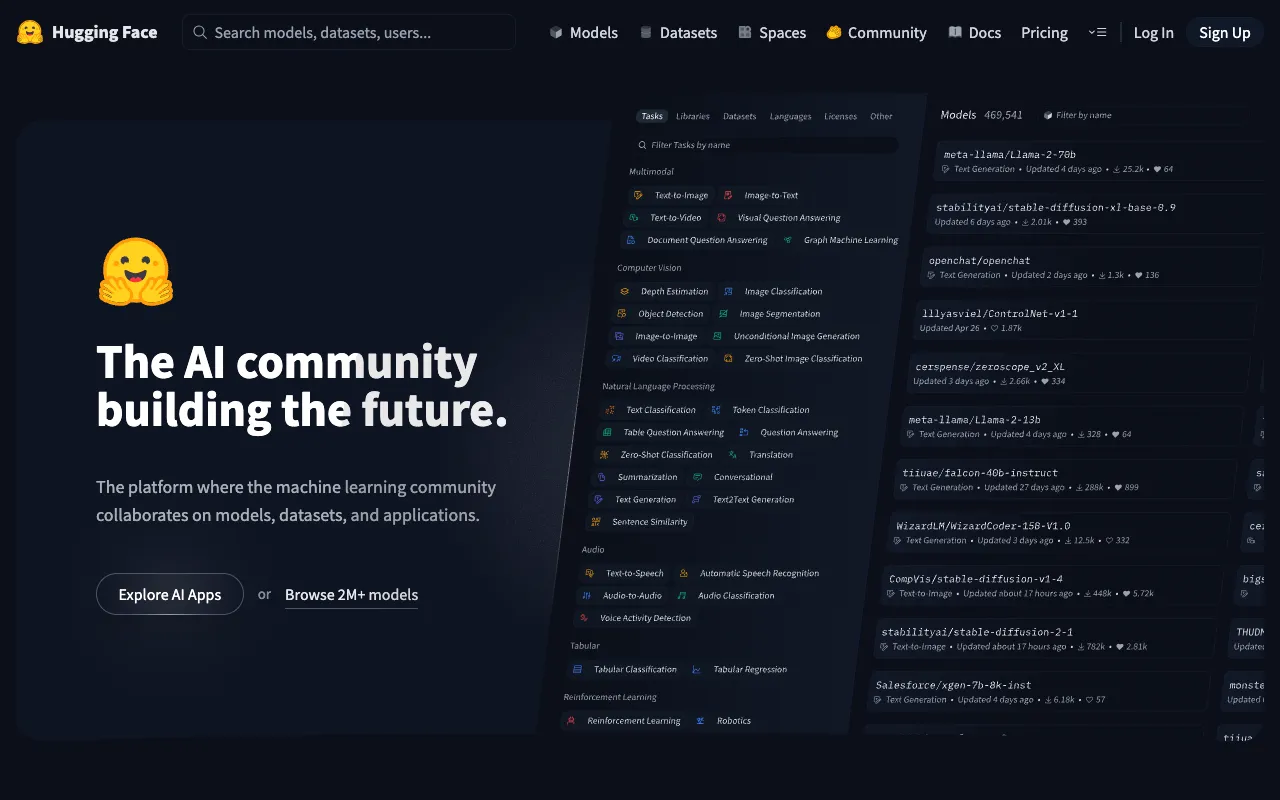
Hugging Face is the definitive collaborative platform for the machine learning ecosystem. At its core, it hosts the 'Hugging Face Hub,' a massive library of open-source pre-trained models, datasets, and interactive demos (Spaces). Originally gaining fame for its transformative work in NLP—most notably through the popular Transformers library—it has expanded to become the go-to destination for sharing and discovering ML artifacts across various domains. It empowers researchers to publish their work, engineers to find production-ready models, and students to learn from real-world examples, all within a unified, version-controlled environment.
Key Features of Hugging Face for AI Researchers
The Model Hub
Access over hundreds of thousands of pre-trained machine learning models for tasks like text classification, translation, image generation, and audio processing. Search, filter, and compare models by framework, license, task, and performance metrics. This feature eliminates the need to train models from scratch for common tasks, saving weeks of computation time and resources.
Dataset Hub
Discover and share curated datasets for training and evaluating ML models. The hub includes everything from massive text corpora and image collections to specialized biomedical or financial datasets. This centralized repository ensures data provenance, provides standardized loading scripts, and fosters collaboration on dataset creation and improvement.
Spaces (ML Demo Apps)
Build, host, and share interactive Gradio or Streamlit demos of your models in minutes. Spaces allow researchers to showcase their work's capabilities without requiring users to install any code. It's an invaluable tool for peer review, collaboration, and demonstrating real-world application potential.
Transformers Library
The flagship open-source library that provides thousands of pre-trained models (BERT, GPT, T5, etc.) with a simple, unified API for PyTorch, TensorFlow, and JAX. It abstracts away complex implementation details, allowing researchers to focus on fine-tuning, evaluation, and innovation rather than model architecture.
Inference API & Endpoints
Test any public model instantly with a free, rate-limited Inference API. For production, Hugging Face offers scalable, secure Inference Endpoints to deploy models as APIs without managing infrastructure. This bridges the gap between research experimentation and real-world deployment.
Who Should Use Hugging Face?
Hugging Face is indispensable for a wide spectrum of professionals in AI. Academic researchers and PhD students use it to benchmark against state-of-the-art models and share their findings. Machine Learning Engineers and MLOps professionals leverage it to find production-ready models and streamline deployment. Data Scientists utilize it for rapid prototyping and accessing diverse datasets. Even startups and enterprises adopt Hugging Face to accelerate their AI initiatives without building everything in-house. If your work involves creating, using, or deploying machine learning models—especially in NLP—Hugging Face is a core tool in your stack.
Hugging Face Pricing and Free Tier
Hugging Face operates on a generous freemium model that makes advanced AI accessible to everyone. The core platform—including access to the Model Hub, Dataset Hub, Community features, Spaces (with basic hardware), and the Inference API—is completely free. This robust free tier supports individual learning, academic research, and small-scale projects. For teams and enterprises requiring more power, privacy, and scale, paid plans offer features like private model/dataset hosting, upgraded Spaces hardware (GPUs), dedicated Inference Endpoints, SSO, and enhanced security controls. This tiered approach ensures that from solo researchers to large corporations, there's a plan that fits.
Common Use Cases
- Fine-tuning a pre-trained BERT model for custom sentiment analysis on product reviews
- Deploying a Stable Diffusion image generation model as a live demo using Hugging Face Spaces
- Finding and loading a specialized dataset for multilingual question-answering research
Key Benefits
- Dramatically accelerates AI research and development by providing instant access to pre-trained models, eliminating months of training time.
- Ensures reproducibility and collaboration in ML projects by offering version-controlled, community-vetted models and datasets.
- Lowers the barrier to entry for state-of-the-art AI, allowing students and small teams to build with the same tools as tech giants.
Pros & Cons
Pros
- Unmatched repository of open-source ML models and datasets, particularly for NLP.
- Powerful, user-friendly libraries (Transformers, Datasets) that standardize complex workflows.
- Vibrant, active community that drives rapid innovation and provides extensive support.
- Excellent free tier that provides immense value for individuals and researchers.
Cons
- The sheer volume of models can be overwhelming for beginners without clear guidance on model selection.
- Free tier resources (e.g., Space hardware, Inference API limits) are constrained, necessitating paid upgrades for heavy usage.
- While expanding, the platform's historical strength and deepest integration remain in NLP compared to other AI subfields.
Frequently Asked Questions
Is Hugging Face free to use?
Yes, Hugging Face offers an extensive and powerful free tier. You can browse, download, and use almost all public models and datasets, run the Transformers library, create basic Spaces demos, and use the Inference API at limited rates without any cost. This makes it exceptionally accessible for students, researchers, and hobbyists.
Is Hugging Face good for AI research?
Absolutely. Hugging Face is considered an essential tool for modern AI research. It provides the foundational infrastructure for reproducibility, allowing researchers to easily share and benchmark their models against others. The access to thousands of pre-trained models enables rapid experimentation and iteration, which is critical for advancing the field, especially in Natural Language Processing.
What is the difference between Hugging Face and GitHub for AI?
While GitHub is a general-purpose code repository, Hugging Face is purpose-built for machine learning artifacts. It provides specialized features that GitHub lacks, such as a unified API to load any model, built-in model inference, interactive demo hosting (Spaces), dataset versioning with streaming, and community features tailored for ML (model cards, dataset cards, metrics). Think of GitHub for ML code and Hugging Face for everything else in the ML lifecycle: models, data, and live applications.
Can I use Hugging Face models commercially?
This depends entirely on the license of each specific model or dataset. Hugging Face hosts models under various open-source licenses (e.g., Apache 2.0, MIT) as well as more restrictive ones. You must check the license card on each model's page before using it in a commercial product. The platform makes license information prominent to ensure proper compliance.
Conclusion
For anyone serious about artificial intelligence and machine learning, Hugging Face has evolved from a useful tool into a fundamental piece of infrastructure. It successfully addresses some of the biggest challenges in AI: collaboration, reproducibility, and accessibility. Whether you're a researcher pushing the boundaries of NLP, an engineer looking to deploy a vision model, or a student building your first AI project, Hugging Face provides the community, resources, and platform to succeed. Its powerful free tier ensures that groundbreaking AI is not locked behind corporate walls, solidifying its position as the best collaborative platform for AI researchers worldwide.