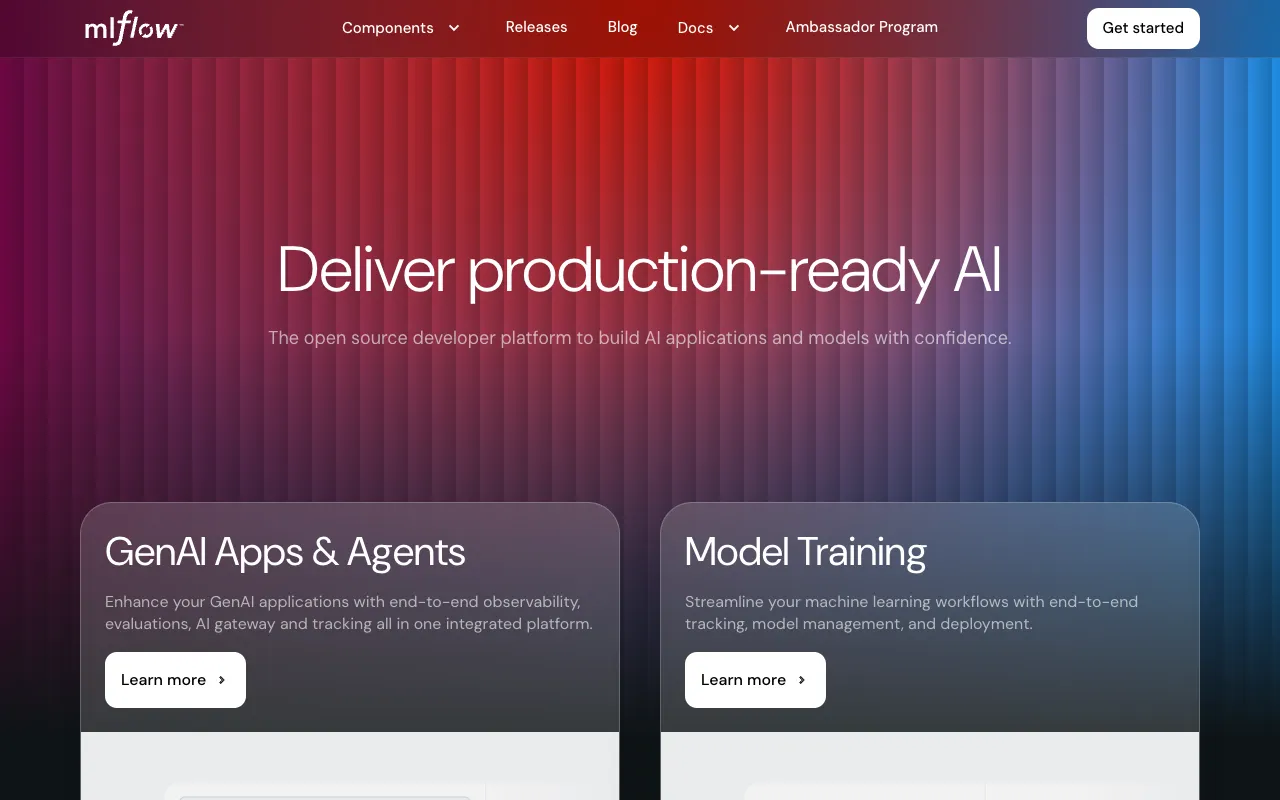
MLflow – The Best Open-Source MLOps Platform for AI Researchers
MLflow is an essential, open-source platform built to manage the complete machine learning lifecycle. Designed for AI researchers and data science teams, it tackles the critical challenges of experiment tracking, reproducibility, and model deployment. By providing a unified framework, MLflow transforms chaotic research workflows into organized, scalable, and collaborative processes, making it a top-tier tool for serious machine learning development.
What is MLflow?
MLflow is a comprehensive, open-source MLOps (Machine Learning Operations) platform created to streamline the entire machine learning lifecycle. Its core purpose is to bring order and reproducibility to the often messy process of developing, training, and deploying ML models. It provides a modular set of components that work with any ML library, making it framework-agnostic. The primary audience includes AI researchers, data scientists, ML engineers, and platform teams who need to track experiments, package code into reproducible runs, share and deploy models, and store models with a central registry.
Key Features of MLflow
MLflow Tracking
Log and query experiments to track parameters, metrics, and output files. This feature allows researchers to systematically record every aspect of a model run, enabling easy comparison between different approaches and preventing the loss of valuable insights from previous experiments.
MLflow Projects
Package data science code in a reusable, reproducible format to share with other researchers or transfer to production. Projects define an environment and entry points, ensuring that code runs the same way anywhere, which is crucial for collaboration and validation.
MLflow Models
Manage and deploy models from a variety of ML libraries to diverse serving environments. This component provides a standard format for packaging models, making them easy to deploy as REST APIs, batch inference, or within Apache Spark.
MLflow Model Registry
A centralized model store to collaboratively manage the full lifecycle of an MLflow Model. It provides model lineage, versioning, stage transitions (like from Staging to Production), and annotations, which is vital for team-based research and deployment workflows.
Who Should Use MLflow?
MLflow is ideally suited for AI research teams in academia and industry, data science departments, and any organization scaling its machine learning efforts. It's perfect for researchers who run numerous experiments and need to track their progress meticulously, for teams that require reproducibility to validate results, and for engineers who need to bridge the gap between research prototypes and production deployment. If your work involves iterative model development with frameworks like TensorFlow, PyTorch, or scikit-learn, MLflow provides the essential infrastructure to manage complexity.
MLflow Pricing and Free Tier
MLflow's core platform is completely free and open-source, licensed under the Apache 2.0 license. You can download, install, and use all its core components (Tracking, Projects, Models, Registry) without any cost. For enterprise teams requiring advanced features like centralized security, access control, and integrated model monitoring, Databricks offers a managed MLflow platform as part of its enterprise Lakehouse Platform. However, for the vast majority of AI researchers and independent teams, the robust, free open-source version provides all the necessary tools for effective MLOps.
Common Use Cases
- Tracking hyperparameter tuning experiments for deep learning models
- Reproducing research paper results by packaging code and dependencies
- Managing model versions and lifecycles for a team of AI researchers
- Deploying a trained scikit-learn model as a REST API for inference
Key Benefits
- Eliminates experiment chaos by providing a single source of truth for all ML runs
- Accelerates the path from research to production with standardized model packaging
- Enhances collaboration and knowledge sharing across data science teams
- Reduces technical debt in ML projects by enforcing reproducibility and organization
Pros & Cons
Pros
- Completely free and open-source with a permissive Apache 2.0 license
- Framework-agnostic, working with all major ML libraries
- Modular design allows adoption of individual components as needed
- Critical for achieving reproducible research and experiment tracking
Cons
- Setting up a production-grade, scalable deployment requires additional infrastructure knowledge
- The open-source UI is functional but may lack some polished enterprise features
- Teams must manage their own deployment, scaling, and security for the backend store
Frequently Asked Questions
Is MLflow free to use?
Yes, MLflow is completely free and open-source. The core platform is licensed under Apache 2.0, meaning you can use, modify, and distribute it for both personal and commercial projects without any licensing fees. Enterprise managed services are available from vendors like Databricks.
Is MLflow good for AI research and academia?
Absolutely. MLflow is exceptionally well-suited for AI research. Its experiment tracking and project packaging features directly address the core needs of reproducibility and organized experimentation that are fundamental to rigorous scientific research in machine learning and AI.
What is the difference between MLflow and TensorBoard?
TensorBoard is a visualization toolkit specifically for TensorFlow, focused on debugging and optimizing models during training. MLflow is a broader MLOps platform that is framework-agnostic. It manages the entire lifecycle, including experiment tracking (similar to TensorBoard), code packaging, model deployment, and a model registry, making it more comprehensive for project management.
Do I need to use Databricks to use MLflow?
No, MLflow is a standalone open-source project. While it was created by Databricks and integrates seamlessly with their platform, you can download, install, and run MLflow on your own infrastructure, such as a local machine, on-premise server, or any cloud platform (AWS, GCP, Azure).
Conclusion
For AI researchers and teams committed to professional, reproducible, and scalable machine learning work, MLflow is not just a tool—it's a foundational component of the modern MLOps stack. Its open-source nature, comprehensive coverage of the ML lifecycle, and framework flexibility make it the de facto standard for managing complexity in ML projects. Whether you're a solo researcher tracking experiments or a large team deploying models to production, implementing MLflow brings essential structure and efficiency to your workflow, solidifying its position as a top choice for anyone serious about machine learning.