Go back
Image of Optuna – The Best Hyperparameter Optimization Framework for AI Researchers

Optuna – The Best Hyperparameter Optimization Framework for AI Researchers

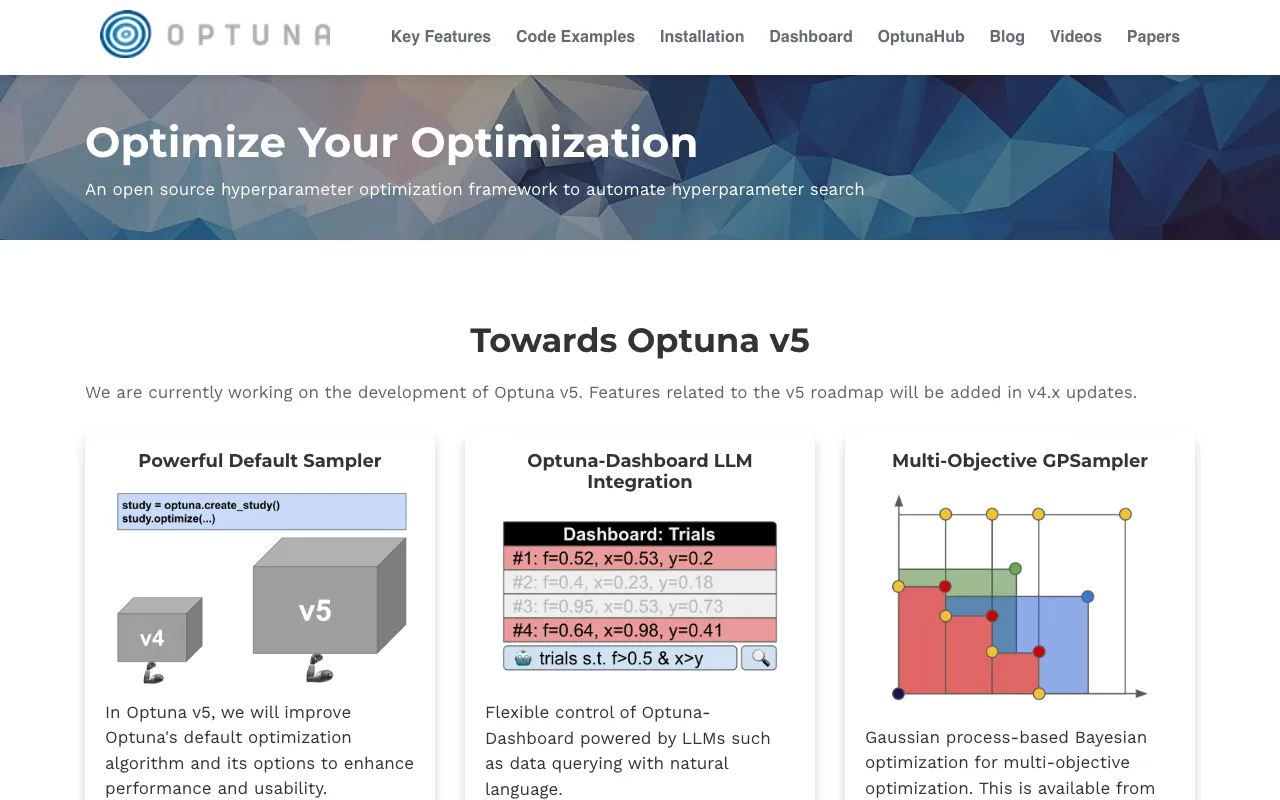
For AI researchers and machine learning engineers, model performance hinges on hyperparameter tuning—a process that can consume weeks of manual effort. Optuna is a next-generation, automatic hyperparameter optimization framework built from the ground up for machine learning. It transforms this tedious, trial-and-error process into an efficient, automated search, enabling you to discover optimal configurations faster, achieve higher model accuracy, and accelerate your research pipeline. As a free, open-source tool with a thriving community, Optuna has become the de facto standard for modern hyperparameter optimization.

What is Optuna?

Optuna is a dedicated, automatic hyperparameter optimization software framework, purpose-built for the machine learning lifecycle. Unlike generic optimization libraries, Optuna understands the unique challenges of ML experimentation, such as expensive function evaluations (model training runs) and complex, high-dimensional parameter spaces. It provides a define-by-run API that allows researchers to dynamically construct the search space, making it incredibly flexible for complex neural architectures, ensemble methods, and cutting-edge research projects. Its core mission is to automate the search for the best hyperparameters—like learning rates, layer sizes, or regularization strengths—freeing researchers to focus on model architecture and innovation.

Key Features of Optuna

Define-by-Run API

Optuna's revolutionary API lets you define the hyperparameter search space dynamically within your trial code. This offers unparalleled flexibility compared to static configuration files, allowing for conditional parameter spaces and complex dependencies between hyperparameters that are common in advanced neural networks.

Efficient Sampling Algorithms

Leverage state-of-the-art algorithms like Tree-structured Parzen Estimator (TPE), CMA-ES, and Grid/Random search. Optuna intelligently prunes unpromising trials early, saving substantial computational resources by halting training runs that are unlikely to yield the best results.

Parallel & Distributed Optimization

Scale your hyperparameter search across multiple GPUs, CPUs, or even clusters with seamless parallelization. Optuna integrates with job scheduling systems, enabling large-scale studies that would be impossible to run manually.

Visualization Dashboard

Gain deep insights into your optimization process with built-in visualization tools. Plot optimization history, parameter importances, slice plots, and parallel coordinates to understand your model's behavior and the impact of each hyperparameter.

Who Should Use Optuna?

Optuna is the essential tool for any professional or team serious about machine learning performance. It is ideally suited for: AI Research Scientists developing novel architectures; Machine Learning Engineers productionizing models and needing reproducible, optimized configurations; Data Scientists competing in Kaggle or building high-stakes predictive models; and Academic Researchers and PhD students conducting rigorous experiments that require robust, statistically sound hyperparameter tuning. If your work involves training models more than once, Optuna will save you time and improve your results.

Optuna Pricing and Free Tier

Optuna is completely free and open-source, released under the MIT license. There is no premium tier, enterprise license, or hidden cost. All features—including efficient samplers, pruning algorithms, visualization, and distributed computing support—are available to everyone. This commitment to accessibility has fueled its widespread adoption across academia and industry.

Common Use Cases

Key Benefits

Pros & Cons

Pros

  • Free, open-source, and backed by a major corporation (Preferred Networks) with strong community support
  • Highly flexible define-by-run API adapts to complex, research-grade ML projects
  • Advanced features like pruning and efficient sampling provide significant speed-ups
  • Excellent visualization tools for interpreting optimization results

Cons

  • Requires basic programming knowledge (Python) to integrate into existing codebases
  • Can have a learning curve for users completely new to hyperparameter optimization concepts
  • Primarily focused on automated search rather than interactive, manual tuning interfaces

Frequently Asked Questions

Is Optuna free to use?

Yes, absolutely. Optuna is 100% free and open-source under the permissive MIT license. All its features are available for commercial and academic use without any cost or restriction.

Is Optuna good for deep learning research?

Optuna is exceptionally well-suited for deep learning research. Its ability to handle high-dimensional spaces, conditional parameters (e.g., layer sizes that depend on architecture choices), and its efficient pruning are critical for tuning complex models like Vision Transformers or large language models, where a single training run can be extremely costly.

How does Optuna compare to manual tuning or Grid Search?

Manual tuning is slow, unreproducible, and often suboptimal. Grid Search is computationally explosive and inefficient. Optuna uses smart sampling algorithms (like TPE) to explore the parameter space strategically, often finding better configurations with 10x fewer trials. It also prunes failing runs early, saving massive amounts of time and money.

Can I use Optuna with PyTorch and TensorFlow?

Yes, Optuna is framework-agnostic. It integrates seamlessly with PyTorch, TensorFlow, Keras, Scikit-learn, XGBoost, LightGBM, and any other Python-based ML library. You simply wrap your training code in an Optuna objective function.

Conclusion

For AI researchers and practitioners, hyperparameter optimization is not a luxury—it's a necessity for achieving state-of-the-art results. Optuna stands out as the most powerful, flexible, and efficient framework dedicated to this task. Its free and open-source nature, combined with its sophisticated algorithms and vibrant community, makes it the unequivocal top choice. If you are manually tuning models or using basic methods, integrating Optuna into your workflow will be one of the highest-return investments you can make in your machine learning capabilities.