Go back
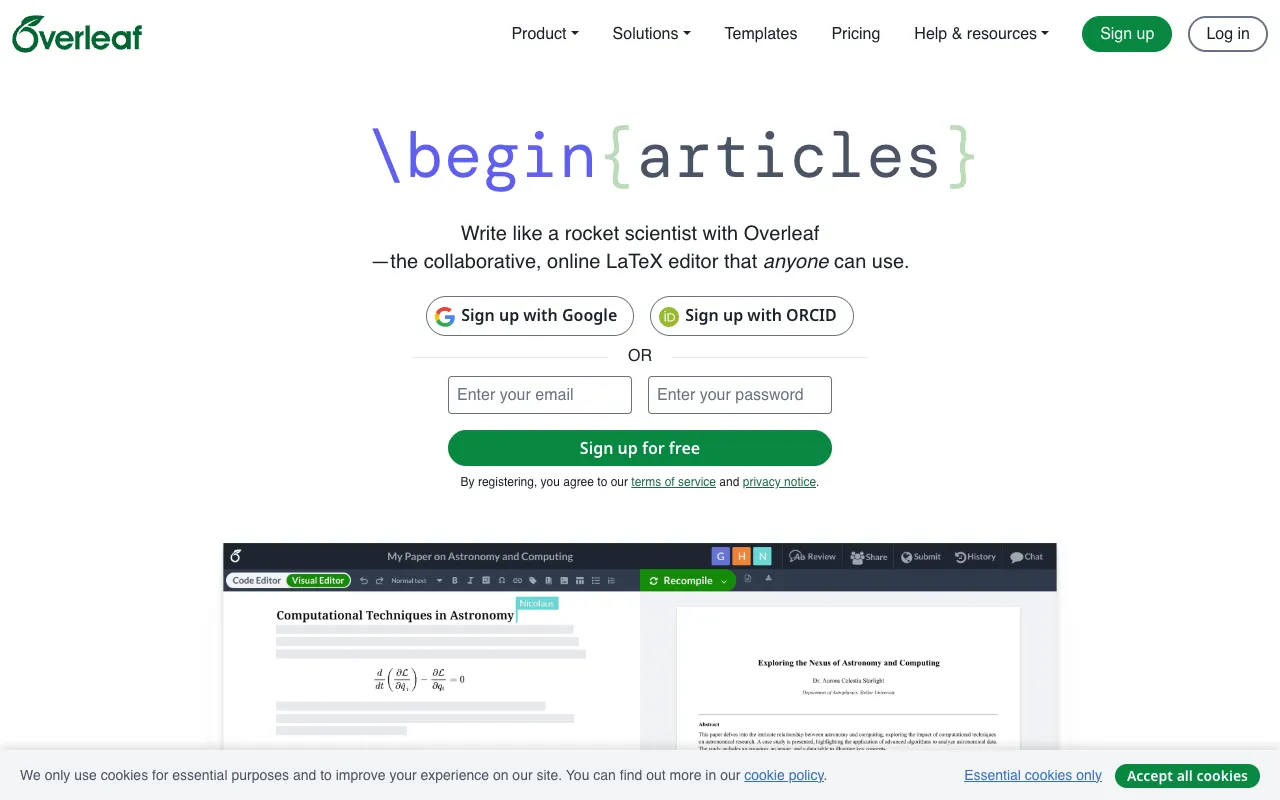
Image of Overleaf – The Premier Collaborative LaTeX Editor for AI Researchers

Overleaf – The Premier Collaborative LaTeX Editor for AI Researchers

Overleaf revolutionizes how AI researchers write and publish papers. This cloud-based LaTeX editor eliminates the friction of local LaTeX installations by providing a seamless, collaborative environment where teams can write complex technical documents, mathematical equations, and research papers in real-time. Trusted by millions of academics, Overleaf simplifies the entire publication workflow—from initial draft to direct journal submission—making it the indispensable tool for modern AI research teams, PhD students, and professors.

What is Overleaf?

Overleaf is a specialized online editor built for the LaTeX typesetting system, which is the global standard for publishing high-quality scientific and technical documents. Unlike traditional word processors, Overleaf is designed specifically for the needs of researchers, providing robust support for complex mathematical notation, bibliographies, cross-referencing, and multi-author collaboration directly in the browser. It bridges the gap between powerful desktop LaTeX distributions and the convenience of modern cloud software, offering an all-in-one platform for writing, reviewing, and submitting AI research.

Key Features of Overleaf for AI Research

Real-Time Collaborative Editing

Multiple authors can work on the same LaTeX document simultaneously, with changes appearing in real-time for all collaborators. This feature is essential for distributed AI research teams, enabling seamless co-authoring, live feedback, and discussion without the chaos of emailing document versions.

Vast Library of Journal & Conference Templates

Jumpstart your paper submission with thousands of pre-formatted templates from major AI conferences (NeurIPS, ICML, CVPR) and top-tier journals (Nature, Science, IEEE). Templates handle all formatting rules automatically, ensuring your paper meets strict submission guidelines from the first draft.

Integrated Reference Manager & BibTeX

Overleaf integrates seamlessly with reference managers like Zotero, Mendeley, and JabRef. You can easily import your BibTeX library and cite papers directly within the editor, with automatic bibliography generation in any required citation style.

Rich Text & Code Editor Modes

Switch between a beginner-friendly rich text editor and a full-featured code editor for LaTeX source. This lowers the barrier for new users while providing full power and customization for LaTeX experts writing complex AI models and algorithms.

Track Changes & Full Version History

Every edit is saved automatically with a complete version history. Review changes side-by-side, revert to any previous version, and see exactly who contributed what—crucial for managing contributions on large, multi-institution AI projects.

Direct Submission Links & Publishing Integrations

Many publishers offer direct 'Submit to Journal' buttons from within Overleaf. This streamlined workflow allows you to compile your final PDF and submit it to platforms like arXiv, IEEE, or Elsevier without ever leaving the editor.

Who Should Use Overleaf?

Overleaf is the definitive tool for anyone involved in creating technical, mathematical, or scientific documents. Its primary audience includes: AI Research Scientists and Engineers writing conference papers; PhD Students and Academics drafting theses and journal articles; University Lecturers preparing course notes and problem sets with complex equations; Corporate R&D Teams documenting algorithms and technical reports; and Collaborative Research Groups working across different institutions who need a unified, version-controlled writing platform.

Overleaf Pricing and Free Tier

Overleaf offers a generous free plan perfect for individuals and small projects, which includes unlimited private projects for a single user, real-time collaboration, and access to all core editor features. Paid plans (Overleaf Pro) unlock advanced capabilities like tracked changes for all collaborators, full document history, priority support, and increased compile time—essential for large research groups and institutions. Many universities also provide institutional licenses, giving students and faculty full Pro features at no personal cost.

Common Use Cases

Key Benefits

Pros & Cons

Pros

  • Unmatched real-time collaboration specifically designed for LaTeX
  • Huge template library removes the pain of conference and journal formatting
  • Lower learning curve for LaTeX with rich text mode and intuitive error prompts
  • Cloud-based access from any device, eliminating compatibility issues
  • Strong institutional adoption provides widespread familiarity in academia

Cons

  • Advanced features and full document history require a paid Pro subscription
  • Being cloud-dependent means you need an internet connection to work
  • Extremely large projects or those with custom LaTeX packages may experience slower compile times

Frequently Asked Questions

Is Overleaf free to use for AI researchers?

Yes, Overleaf has a robust free plan that is more than sufficient for individual AI researchers and students. It includes unlimited private projects, real-time collaboration, and access to all journal templates. For large research groups needing advanced features like full tracked changes history, a paid Pro plan or institutional license is recommended.

Is Overleaf good for writing machine learning papers?

Absolutely. Overleaf is the industry-standard tool for writing machine learning and AI papers. Its support for complex mathematical notation, seamless integration with BibTeX for managing large reference libraries, and pre-built templates for all major AI conferences (NeurIPS, ICML, ICLR, etc.) make it the most efficient and reliable platform for producing publication-ready research.

Can I use Git with Overleaf?

Yes, Overleaf Pro and certain institutional plans include deep integration with GitHub and GitLab. You can sync your LaTeX projects with a Git repository, enabling powerful version control workflows, branching, and code review processes familiar to software developers, which is highly beneficial for AI research codebases.

How does Overleaf compare to local LaTeX editors like TeXShop or TeXworks?

Overleaf provides all the power of local LaTeX distributions but with the added critical advantages of cloud-based collaboration, automatic environment setup, and built-in submission workflows. While local editors offer ultimate customization, Overleaf saves significant time on setup, package management, and collaboration logistics, making it the superior choice for most collaborative AI research projects.

Conclusion

For AI researchers, the choice of a writing tool directly impacts productivity, collaboration quality, and ultimately, research output. Overleaf stands out as the definitive solution, expertly merging the unparalleled typesetting power of LaTeX with the convenience and connectivity of modern cloud software. Whether you are a solo PhD student drafting your first paper or a global research consortium preparing a landmark publication, Overleaf provides the robust, streamlined, and collaborative environment needed to bring complex AI ideas to publication. It's not just an editor; it's an accelerator for the entire scientific communication process.