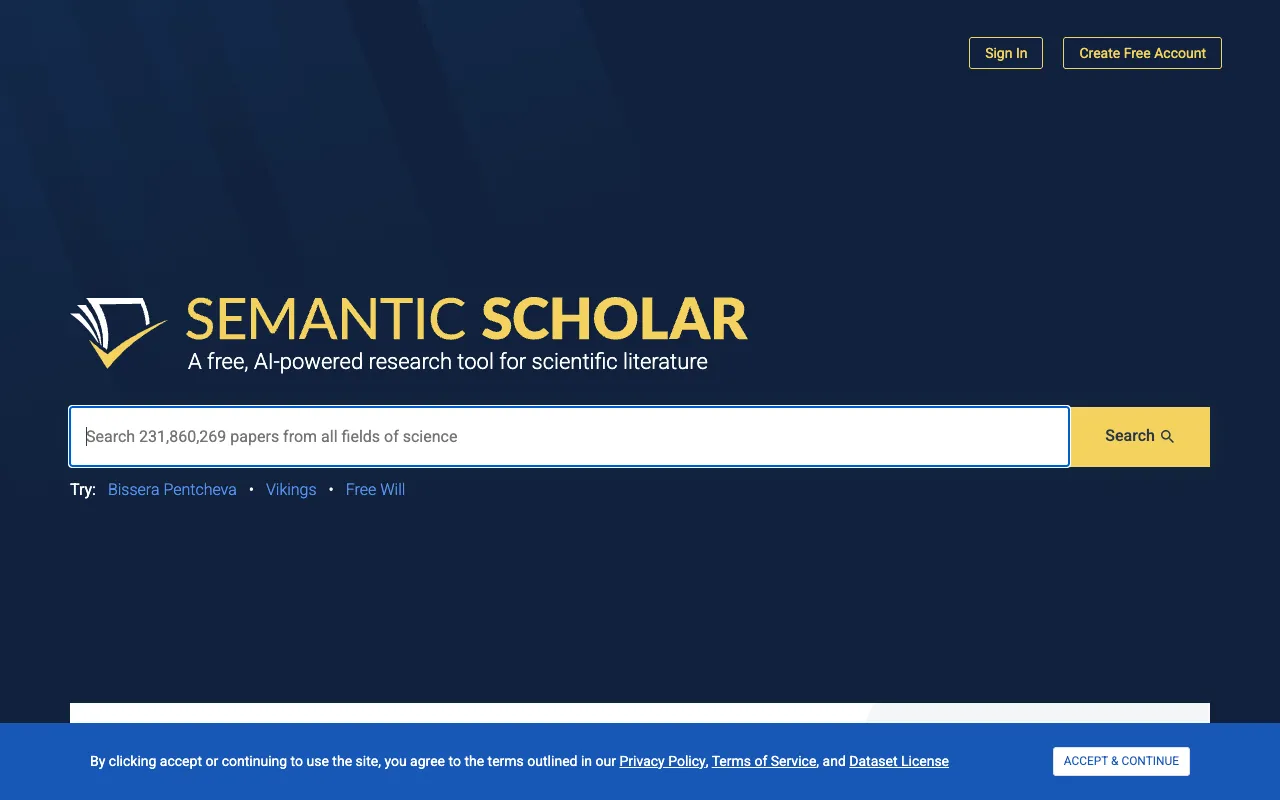
Semantic Scholar – The Best AI Tool for Scientific Literature Research
Semantic Scholar is a free, AI-powered research platform designed specifically for scientists, academics, and AI researchers. It transforms how you navigate the vast ocean of scientific literature by using machine learning to surface the most relevant papers, provide contextual insights, and streamline citation management. Whether you're conducting a systematic literature review, staying current in your field, or exploring interdisciplinary connections, Semantic Scholar acts as your intelligent research assistant.
What is Semantic Scholar?
Semantic Scholar is an academic search engine and research tool developed by the Allen Institute for AI. Unlike traditional keyword-based search engines, it uses advanced natural language processing and machine learning to understand the semantic meaning within scientific papers. It goes beyond simple search to analyze paper content, identify key concepts, and map the intricate web of citations and influences across disciplines like computer science, biomedicine, and neuroscience. Its core mission is to accelerate scientific discovery by helping researchers cut through information overload.
Key Features of Semantic Scholar
AI-Powered Semantic Search
Move beyond keywords. Semantic Scholar's search understands context and concepts, allowing you to find papers based on ideas, methodologies, or research questions, not just matching terms. This dramatically improves the relevance of search results for complex queries.
Smart Citations & Citation Context
See not just *who* cited a paper, but *why* and *how*. The tool extracts and displays the sentence surrounding a citation, providing immediate context about whether the citation supports, contrasts, or merely mentions the work. This saves hours of manual reading.
TL;DR Summaries and Highlights
Get quick, AI-generated summaries of key paper contributions. Semantic Scholar often provides 'TL;DR' (Too Long; Didn't Read) summaries and highlights the most influential sentences, helping you quickly assess a paper's relevance and core findings.
Research Feeds & Paper Recommendations
Stay updated effortlessly. Create personalized research feeds based on authors, topics, or saved papers. Semantic Scholar's recommendation engine suggests new and highly relevant publications you might have otherwise missed.
Author and Institution Profiles
Explore comprehensive profiles for researchers and institutions, showcasing publication history, citation metrics, co-author networks, and research focus areas, all powered by its underlying AI knowledge graph.
Who Should Use Semantic Scholar?
Semantic Scholar is indispensable for AI researchers, data scientists, graduate students, postdocs, and academics across technical fields. It's particularly valuable for: PhD candidates conducting literature reviews; interdisciplinary researchers exploring connections between fields; lab heads staying abreast of their team's niche; and industry R&D teams tracking academic advancements. Its free tier makes it accessible to independent researchers and those at institutions with limited journal subscriptions.
Semantic Scholar Pricing and Free Tier
Semantic Scholar operates on a completely free-to-use model. There are no subscription fees, paywalls, or premium tiers that limit core research functionality. Access to its AI-powered search, paper recommendations, citation context, and author profiles is 100% free. This commitment to open access makes it a powerful equalizer in the research community, providing cutting-edge AI tools to anyone with an internet connection.
Common Use Cases
- Conducting a systematic literature review for a PhD dissertation or grant proposal
- Finding seminal and state-of-the-art papers for a new machine learning research project
- Tracking the publication output and influence of a specific research lab or academic competitor
Key Benefits
- Reduce literature review time by up to 50% with AI-filtered, highly relevant results
- Gain deeper understanding of research landscapes through intelligent citation mapping and context
- Ensure you never miss a key paper with personalized, AI-driven research alerts and feeds
Pros & Cons
Pros
- Completely free with no feature limitations for core research
- Superior semantic search outperforms traditional keyword-based academic engines
- Citation context feature is a massive time-saver for understanding scholarly discourse
- Continuously updated with new papers from arXiv, PubMed, ACL, and major publishers
Cons
- Coverage is strongest in computer science and biomedicine, with other fields still growing
- The interface, while functional, can feel less polished compared to some commercial tools
- Advanced bibliometric analysis features are less comprehensive than dedicated tools like Scopus
Frequently Asked Questions
Is Semantic Scholar free to use?
Yes, Semantic Scholar is completely free. There are no subscription plans, paywalls, or limits on searches, paper views, or core AI features. It's supported by the Allen Institute for AI as a non-profit initiative to accelerate science.
Is Semantic Scholar good for AI and machine learning research?
Absolutely. It is one of the best tools for AI research. Its corpus is exceptionally strong in computer science, with rapid ingestion from arXiv and major conferences. The AI-powered features like semantic search and citation context are particularly effective for navigating fast-moving, concept-dense fields like machine learning and NLP.
How does Semantic Scholar differ from Google Scholar?
While Google Scholar is a comprehensive search index, Semantic Scholar adds an AI layer. It provides semantic understanding of paper content, contextual citation snippets (not just counts), and personalized AI recommendations. Think of Google Scholar as finding papers, and Semantic Scholar as helping you understand their place in the research conversation.
Can I use Semantic Scholar for literature review management?
Yes, you can save papers to private libraries, create topic-based feeds, and export citations. While it's not a full reference manager like Zotero, its AI features for discovery and analysis make it an unparalleled tool for the initial and ongoing phases of a literature review.
Conclusion
For AI researchers and scientists navigating the exponential growth of academic literature, Semantic Scholar is not just another tool—it's a fundamental upgrade to the research workflow. By leveraging machine learning to understand content and connections, it turns the daunting task of literature review into a targeted, efficient, and insightful process. Its powerful, completely free feature set makes it an essential starting point for any serious research project. For discovering, understanding, and contextualizing scientific papers, Semantic Scholar stands as a top-tier AI research assistant.