SpaCy – The Best Python NLP Library for AI Researchers
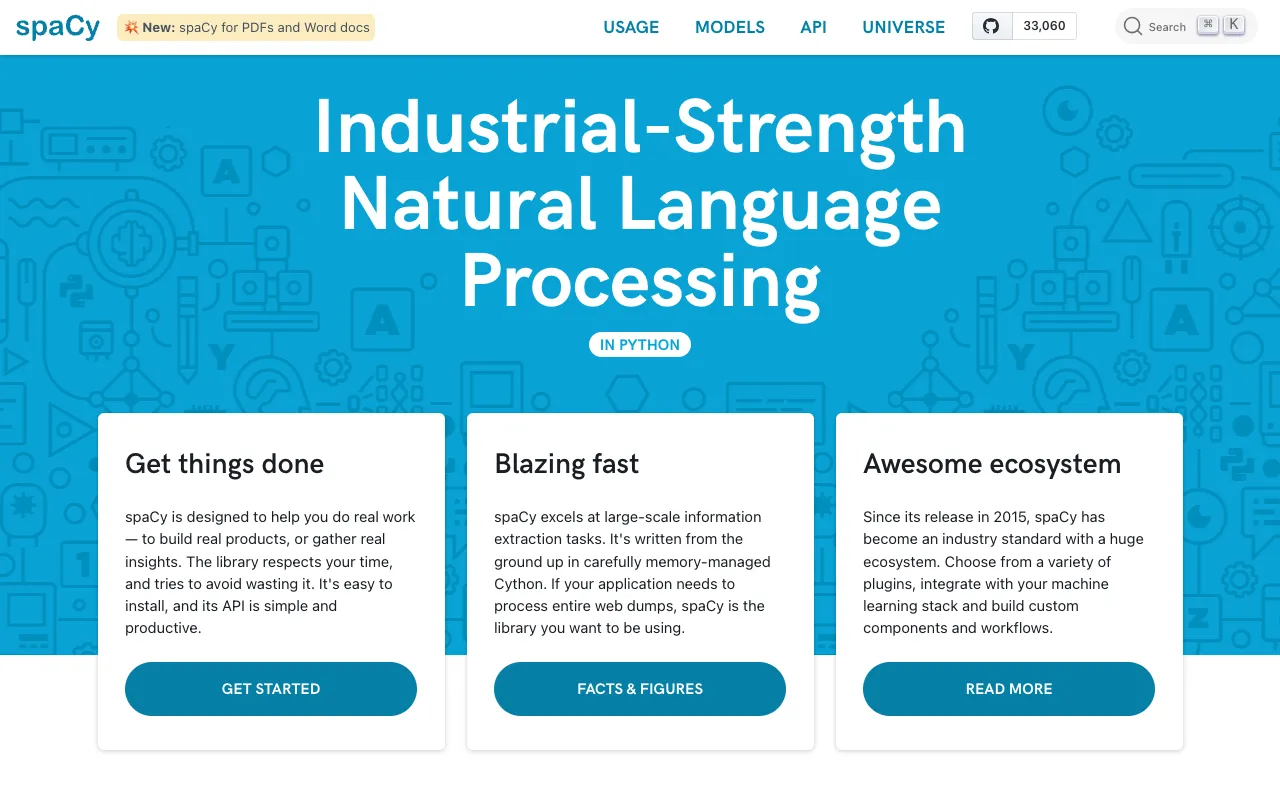
SpaCy is an industrial-strength, open-source Natural Language Processing library for Python, engineered specifically for real-world applications and production environments. Unlike academic-focused toolkits, SpaCy provides AI researchers with optimized pipelines for tokenization, part-of-speech tagging, named entity recognition (NER), dependency parsing, and text classification. Its streamlined API, pre-trained statistical models, and seamless deep learning integration make it the go-to choice for researchers transitioning experiments into deployable AI systems.
What is SpaCy?
SpaCy is a free, open-source library for advanced Natural Language Processing in Python, designed from the ground up for performance, scalability, and practical application. It provides AI researchers with a consistent, production-ready framework for processing and understanding large volumes of text. Beyond basic text analysis, SpaCy offers pre-trained models for multiple languages, enabling researchers to immediately apply state-of-the-art techniques like named entity recognition, dependency parsing, and semantic similarity without building pipelines from scratch. Its architecture prioritizes speed and accuracy, making it ideal for processing datasets at the scale required for modern AI research.
Key Features of SpaCy
Pre-trained Statistical Models
SpaCy comes with a variety of pre-trained models for multiple languages (like English, German, Spanish, etc.) that deliver high-accuracy predictions right out of the box. These models are trained on large, annotated corpora and provide immediate functionality for tokenization, part-of-speech tagging, named entity recognition, and dependency parsing, saving researchers significant time in model development and training.
Industrial-Strength Speed and Efficiency
Built with performance in mind, SpaCy is implemented in Cython and optimized for processing large text volumes efficiently. It's significantly faster than many other Python NLP libraries, allowing AI researchers to iterate quickly on experiments and process massive datasets without computational bottlenecks.
Deep Learning Integration (spaCy-transformers)
Through its `spaCy-transformers` library, SpaCy seamlessly integrates with modern transformer models like BERT, RoBERTa, and XLNet. This allows researchers to leverage cutting-edge deep learning architectures within SpaCy's consistent pipeline, fine-tuning them for specific NLP tasks while maintaining the library's robust production workflow.
Customizable and Extensible Pipeline
Researchers can fully customize SpaCy's processing pipeline. You can train your own models (for NER, text categorization, etc.) on custom datasets, add custom pipeline components, and integrate third-party machine learning libraries like PyTorch and TensorFlow, providing unparalleled flexibility for specialized AI research projects.
Who Should Use SpaCy?
SpaCy is ideal for AI researchers, data scientists, computational linguists, and ML engineers focused on Natural Language Processing. It is particularly valuable for researchers who need to move beyond prototypes to robust, evaluable systems. If your work involves information extraction, sentiment analysis, chatbot development, text summarization, or any task requiring deep linguistic understanding, SpaCy provides the reliable, high-performance foundation. It's also perfect for academic researchers and PhD candidates who require a reproducible, industry-standard toolkit for publishing papers and building demonstrable AI applications.
SpaCy Pricing and Free Tier
SpaCy is completely free and open-source, released under the MIT license. There is no cost for downloading, using, or modifying the library. This includes access to all core features, pre-trained models, and the extensive documentation. For teams requiring advanced project management, dataset curation, and model training tools, the creators offer Explosion AI's commercial products like Prodigy, which integrates directly with SpaCy. However, for the vast majority of AI research purposes, the free, open-source SpaCy library provides all the necessary functionality.
Common Use Cases
- Building custom named entity recognition models for biomedical or legal document analysis
- Creating training data and pipelines for academic research in computational linguistics
- Developing prototype chatbots or question-answering systems with dependency parsing
Key Benefits
- Accelerate AI research with production-ready pipelines, reducing time from experiment to validated result
- Achieve higher accuracy in NLP tasks using optimized, pre-trained models validated on real-world data
- Ensure reproducibility and scalability in research projects with a consistent, well-documented API
Pros & Cons
Pros
- Exceptionally fast processing speeds due to Cython implementation, ideal for large datasets
- Comprehensive, production-tested features for serious NLP work beyond academic prototyping
- Excellent, clear documentation and an active community for researcher support
- Seamless integration with the modern Python data science stack (NumPy, pandas, Jupyter)
Cons
- Less beginner-friendly for those entirely new to NLP compared to some higher-level libraries
- Primarily focused on supervised learning tasks; unsupervised methods may require integration with other libs
- While multi-language support is good, the quality and number of pre-trained models vary by language
Frequently Asked Questions
Is SpaCy free to use?
Yes, SpaCy is completely free and open-source under the permissive MIT license. You can use it for personal, academic, and commercial projects without any cost, including all its core features and pre-trained models.
Is SpaCy good for AI research?
Absolutely. SpaCy is one of the top choices for AI research in natural language processing. Its blend of high performance, robust features, and deep learning integration allows researchers to build sophisticated, evaluable systems. Its design for production also means research prototypes can be more easily transitioned into real-world applications.
How does SpaCy compare to NLTK for research?
While NLTK is excellent for education and exploring algorithms, SpaCy is designed for applied research and building applications. SpaCy is significantly faster, offers more streamlined APIs, and includes pre-trained models, making it more efficient for research projects that require processing large datasets or producing deployable results.
Can I train my own models with SpaCy?
Yes, SpaCy provides powerful and flexible training mechanisms. You can train custom models for named entity recognition, text categorization, dependency parsing, and more on your own annotated datasets, giving you full control over your AI research models.
Conclusion
For AI researchers serious about natural language processing, SpaCy represents the optimal balance between research flexibility and industrial robustness. Its free, open-source nature removes financial barriers, while its performance and comprehensive feature set enable groundbreaking work in information extraction, linguistic analysis, and language model development. Whether you're annotating a novel corpus, fine-tuning a transformer for a specific domain, or building a scalable text processing pipeline, SpaCy provides the reliable, high-performance foundation that accelerates discovery and ensures your research is built on a proven, production-grade toolkit.