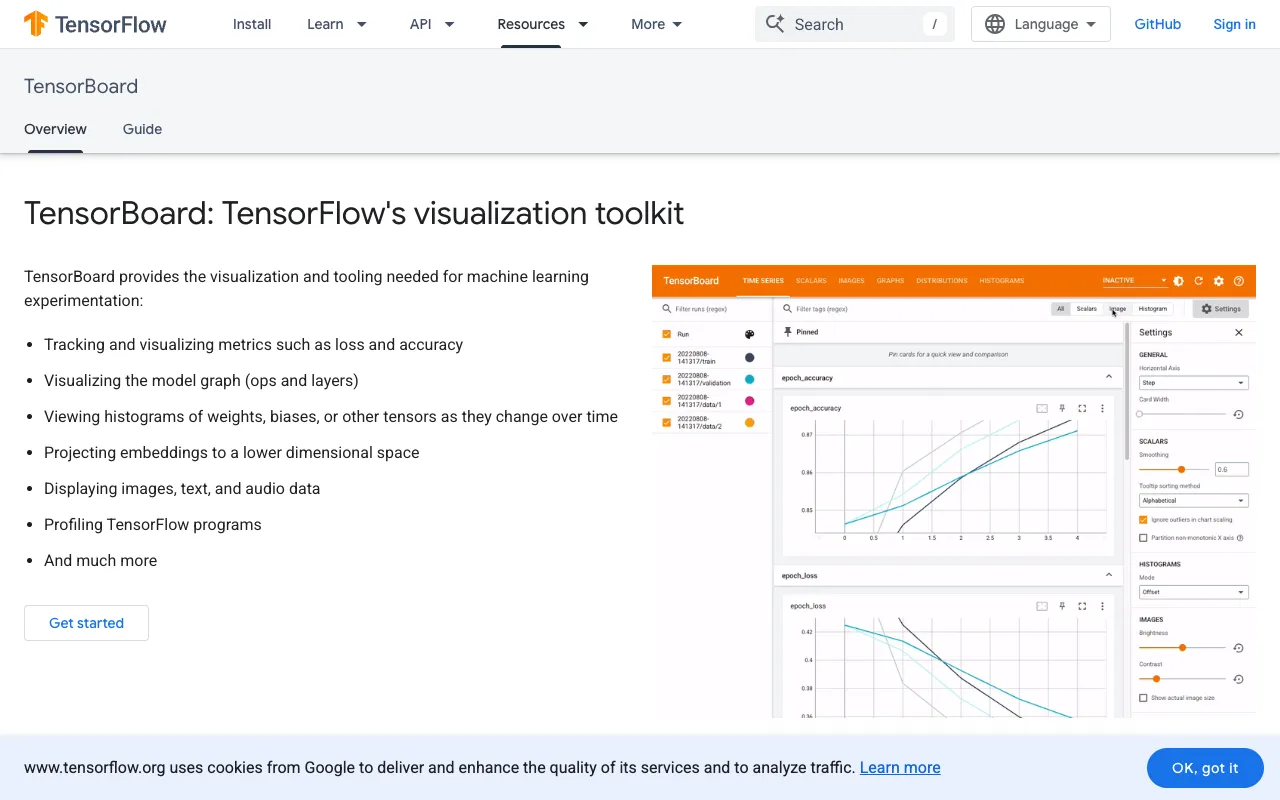
TensorBoard – The Essential Visualization Toolkit for AI Research
TensorBoard is the industry-standard visualization platform that transforms complex machine learning experiments into actionable insights. Developed by the TensorFlow team and widely adopted across the AI research community, it provides researchers with the tools to track metrics in real-time, visualize intricate model architectures, and profile performance bottlenecks. Whether you're training deep neural networks, comparing hyperparameters, or debugging model behavior, TensorBoard offers the clarity needed to accelerate discovery and improve reproducibility in AI research.
What is TensorBoard?
TensorBoard is a comprehensive visualization suite specifically engineered for the machine learning workflow. At its core, it serves as a dashboard for monitoring live training runs, allowing researchers to observe metrics like loss and accuracy as they evolve. Beyond simple tracking, it provides powerful tools to visualize the computational graph of complex models, project high-dimensional embeddings for analysis, and profile hardware utilization to identify training inefficiencies. Originally built for TensorFlow, its functionality has been extended through integrations like TensorBoardX to support PyTorch and other frameworks, making it a universal tool in the modern AI researcher's toolkit.
Key Features of TensorBoard
Scalars Dashboard for Metric Tracking
Monitor and compare critical training metrics like loss, accuracy, and learning rate in real-time. Plot multiple runs simultaneously to analyze the impact of different hyperparameters, enabling data-driven decisions to improve model performance.
Graphs Visualizer for Model Architecture
Interactively visualize your model's computational graph. This feature is invaluable for debugging complex architectures, understanding data flow, and ensuring your model is built as intended, providing a clear map of operations and tensors.
Profiler Tool for Performance Optimization
Identify training bottlenecks and optimize resource usage. The profiler tool analyzes GPU/CPU utilization, memory consumption, and tensor execution times, helping you streamline code for faster iteration and reduced computational costs.
Embeddings Projector for Dimensionality Reduction
Explore high-dimensional data like word or image embeddings. Use PCA, t-SNE, or UMAP to project embeddings into 2D or 3D space, revealing clusters and patterns that inform model understanding and feature engineering.
Who Should Use TensorBoard?
TensorBoard is indispensable for AI researchers, machine learning engineers, and data scientists working on model development and experimentation. It is particularly valuable for: Academic and industrial research teams needing reproducible experiment tracking; Engineers debugging complex neural network architectures in TensorFlow or PyTorch; Practitioners tuning hyperparameters and comparing multiple model runs; Teams requiring clear visualization to communicate results and model behavior to stakeholders. Its ability to bring transparency to the 'black box' of deep learning makes it a critical tool for anyone serious about advancing their ML projects.
TensorBoard Pricing and Free Tier
TensorBoard is completely free and open-source. There is no paid tier, subscription, or usage limit. It is available as a Python package (`tensorboard`) that can be installed via pip and run locally, or it can be hosted as part of managed ML platforms. Its free, accessible nature is a cornerstone of its adoption, ensuring that researchers at any level or institution can leverage professional-grade visualization tools without financial barrier.
Common Use Cases
- Visualizing and comparing loss curves across 50+ hyperparameter tuning experiments
- Debugging a transformer model architecture by inspecting the computational graph in TensorBoard
- Profiling GPU memory usage to eliminate bottlenecks in large-scale distributed model training
Key Benefits
- Achieve faster research iteration cycles by visually identifying underperforming experiments early
- Enhance model reproducibility and collaboration by maintaining a centralized, visual log of all training runs
- Reduce cloud compute costs by using the profiler to optimize inefficient training code and hardware utilization
Pros & Cons
Pros
- Completely free and open-source with no feature restrictions
- Deep integration with TensorFlow and strong community support for PyTorch
- Provides a unified dashboard for the entire ML experiment lifecycle, from debugging to presentation
Cons
- Primarily a local or self-hosted tool, requiring setup compared to some cloud-native SaaS alternatives
- The interface, while powerful, has a learning curve for interpreting advanced visualizations like graphs and histograms
Frequently Asked Questions
Is TensorBoard free to use?
Yes, TensorBoard is completely free and open-source. It is released under the Apache 2.0 license and can be installed, used, and modified without any cost, making it accessible for individual researchers, students, and large enterprises alike.
Can I use TensorBoard with PyTorch?
Absolutely. While native to TensorFlow, you can use TensorBoard seamlessly with PyTorch via the `torch.utils.tensorboard` module or the `tensorboardX` library. This allows PyTorch developers to log scalars, graphs, histograms, and images, leveraging the same powerful visualization dashboard.
What is the best tool for visualizing machine learning experiments?
TensorBoard is widely regarded as the best tool for ML visualization due to its comprehensive feature set, deep framework integration, and status as the industry standard. It excels at providing a single pane of glass for tracking metrics, visualizing models, and profiling performance, which is critical for rigorous AI research and development.
Conclusion
For AI researchers demanding clarity and control over their experiments, TensorBoard remains the definitive visualization toolkit. Its combination of real-time metric tracking, intricate model graph visualization, and powerful performance profiling provides an unmatched window into the training process. As a free, open-source tool with robust community and framework support, it eliminates guesswork, accelerates the research feedback loop, and sets the standard for reproducibility in machine learning. When your work depends on understanding the nuances of model behavior, TensorBoard is not just an option—it's an essential component of a professional AI research workflow.