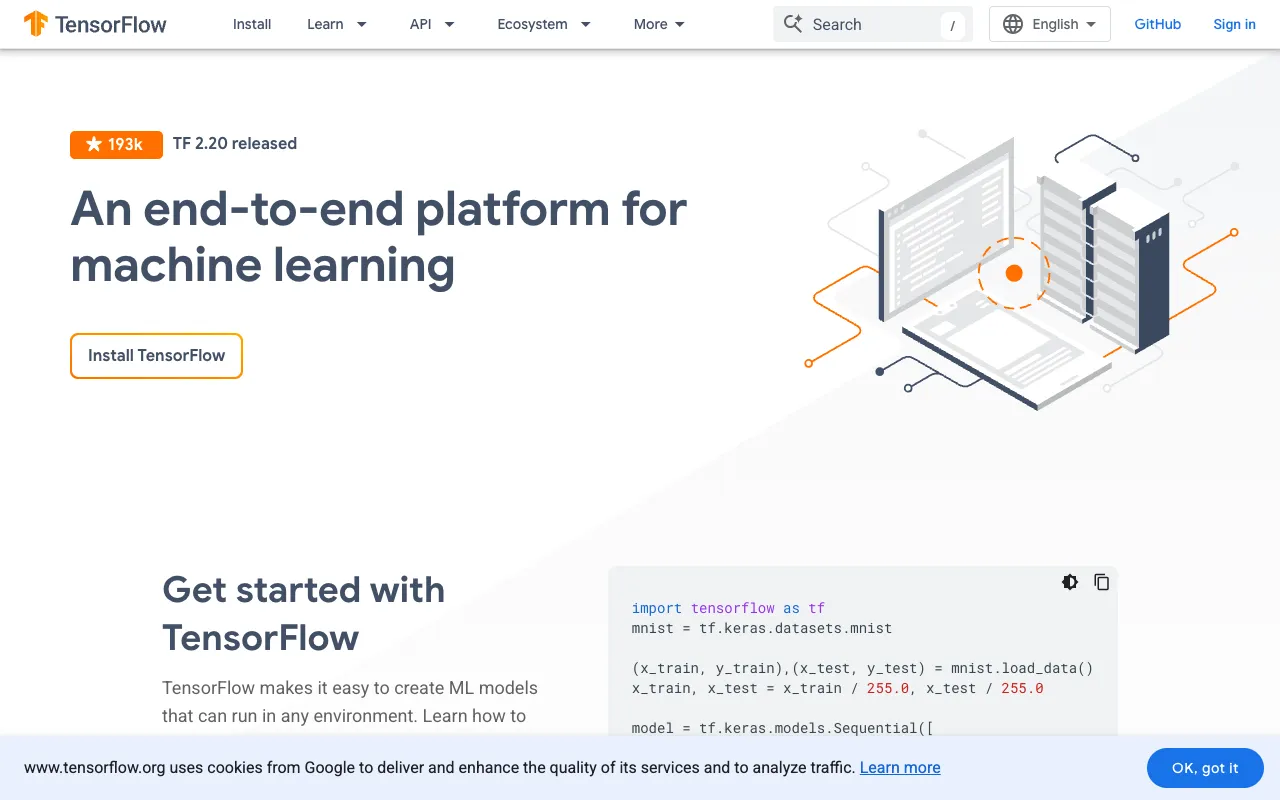
TensorFlow – The Premier Open Source Framework for AI Research
TensorFlow stands as the foundational open-source platform for machine learning and artificial intelligence research. Developed by Google and maintained by a global community, it provides AI researchers, data scientists, and engineers with a comprehensive, flexible ecosystem to conceptualize, build, train, and deploy machine learning models at scale. From experimental neural networks to production-ready AI systems, TensorFlow's robust architecture and extensive tooling make it an indispensable resource for advancing the field of AI.
What is TensorFlow?
TensorFlow is more than just a library; it's a complete end-to-end open-source platform designed specifically for machine learning. At its core, it uses dataflow graphs to represent computation, with tensors (multidimensional data arrays) flowing through these graphs—hence the name. It simplifies the complex process of developing machine learning models by providing high-level APIs like Keras for rapid prototyping, while also offering low-level operations for fine-grained control. This combination makes TensorFlow uniquely suited for both cutting-edge academic research and robust industrial applications, serving as the backbone for countless AI innovations.
Key Features of TensorFlow
Flexible Architecture
TensorFlow's greatest strength is its flexibility. You can execute your computational graphs on a variety of platforms—from CPUs and GPUs to mobile devices (TensorFlow Lite) and edge devices (TensorFlow.js for JavaScript environments). This 'write once, run anywhere' capability ensures that models developed in research environments can be seamlessly transitioned to production across diverse hardware landscapes.
Comprehensive Tooling Ecosystem
The platform extends far beyond its core library. TensorFlow offers a rich suite of tools for every stage of the ML workflow: TensorBoard for visualization and metrics tracking, TFX (TensorFlow Extended) for production pipelines, TensorFlow Datasets for easy data loading, and pre-trained models via TensorFlow Hub. This integrated ecosystem eliminates the need to stitch together disparate tools, accelerating the research-to-deployment lifecycle.
High-Level Keras API
Integrated directly into TensorFlow, the Keras API provides a user-friendly, modular interface for building and training deep learning models. It allows researchers to quickly prototype ideas with concise code, reducing boilerplate and letting them focus on model architecture and experimentation rather than low-level implementation details.
Robust Production Deployment
TensorFlow is built for real-world impact. It provides dedicated tools like TensorFlow Serving for high-performance model serving in production environments, and TF Lite for deploying models on mobile and embedded devices with minimal latency and footprint. This ensures that research breakthroughs can be translated into practical applications efficiently.
Who Should Use TensorFlow?
TensorFlow is the framework of choice for a broad spectrum of professionals in the AI space. It is ideal for: Academic Researchers and PhD students developing novel neural network architectures or exploring new domains in deep learning. Industry ML Engineers and Data Scientists building scalable, production-grade AI systems for companies ranging from startups to tech giants. Developers and Programmers looking to integrate machine learning capabilities into mobile, web, or edge applications. Educators and Students learning the fundamentals of machine learning through a widely-adopted, well-documented platform with immense community support. Its balance of ease-of-use for beginners and depth for experts makes it universally applicable.
TensorFlow Pricing and Free Tier
TensorFlow is completely free and open-source. Released under the Apache 2.0 license, the entire platform—including its core libraries, high-level APIs like Keras, and tools like TensorBoard—can be used for any purpose, including commercial applications, without any licensing fees. This open-access model has been instrumental in its widespread adoption and the rapid pace of innovation in the AI research community. The primary costs associated with using TensorFlow are related to the computational resources (e.g., cloud GPUs/TPUs) required to train large models, not the software itself.
Common Use Cases
- Developing and training complex deep learning models for computer vision research like image classification or object detection
- Building natural language processing (NLP) systems for text generation, sentiment analysis, or language translation models
- Implementing reinforcement learning algorithms for AI agents in simulated environments or game playing
- Creating time-series forecasting models for financial, scientific, or industrial predictive analytics
Key Benefits
- Dramatically accelerates the machine learning development cycle from research prototyping to production deployment
- Provides access to a vast repository of pre-trained models and community contributions, saving months of development time
- Ensures model portability and future-proofing with support for multiple platforms and hardware accelerators
- Fosters collaboration and reproducibility in AI research through standardized tools and a massive global community
Pros & Cons
Pros
- Industry-standard platform with unparalleled community support, documentation, and learning resources
- Exceptional flexibility, supporting everything from quick experiments to large-scale distributed training
- Comprehensive, integrated ecosystem that covers the entire ML workflow, reducing dependency on external tools
- Strong production capabilities with dedicated serving and mobile deployment frameworks
Cons
- The API has evolved significantly, which can lead to confusion between older and newer code examples
- Can have a steeper initial learning curve compared to some newer, more streamlined frameworks for absolute beginners
- Graph-based execution (in eager mode disabled) can make debugging more complex than purely imperative frameworks
Frequently Asked Questions
Is TensorFlow free to use?
Yes, TensorFlow is completely free and open-source. It is released under the Apache 2.0 license, which allows for unrestricted use, modification, and distribution for both personal and commercial projects without any cost.
Is TensorFlow good for AI research and beginners?
Absolutely. For AI research, TensorFlow is one of the most powerful and flexible platforms available, trusted by leading labs worldwide. For beginners, its high-level Keras API offers an intuitive way to start building neural networks, backed by extensive tutorials, courses, and a helpful community, making it an excellent choice for learning foundational ML concepts.
What is the difference between TensorFlow and PyTorch?
TensorFlow and PyTorch are both leading frameworks. TensorFlow traditionally emphasized a define-then-run graph model with superior production deployment tools (TF Serving, Lite). PyTorch uses a dynamic, imperative execution favored for rapid prototyping in research. However, TensorFlow 2.x integrated eager execution by default and Keras, significantly bridging this gap. Today, the choice often comes down to project requirements, team expertise, and specific ecosystem tooling preferences.
Can I run TensorFlow without a powerful GPU?
Yes, you can absolutely run and learn TensorFlow using just your computer's CPU. Many tutorials and initial models are designed to work efficiently on CPUs. For training larger, more complex models, a GPU (or cloud-based GPUs/TPUs) significantly speeds up computation, but it is not a requirement to get started.
Conclusion
For AI researchers and practitioners seeking a powerful, versatile, and production-ready foundation for their work, TensorFlow remains a top-tier choice. Its comprehensive ecosystem, spanning from intuitive high-level APIs to robust deployment tools, supports the entire journey of machine learning innovation. While the landscape of ML frameworks is competitive, TensorFlow's maturity, extensive community, and proven track record in both groundbreaking research and real-world applications solidify its position as an essential tool for anyone serious about advancing the field of artificial intelligence. Whether you're prototyping a novel algorithm or deploying a model to millions of users, TensorFlow provides the infrastructure to turn ambitious AI ideas into reality.