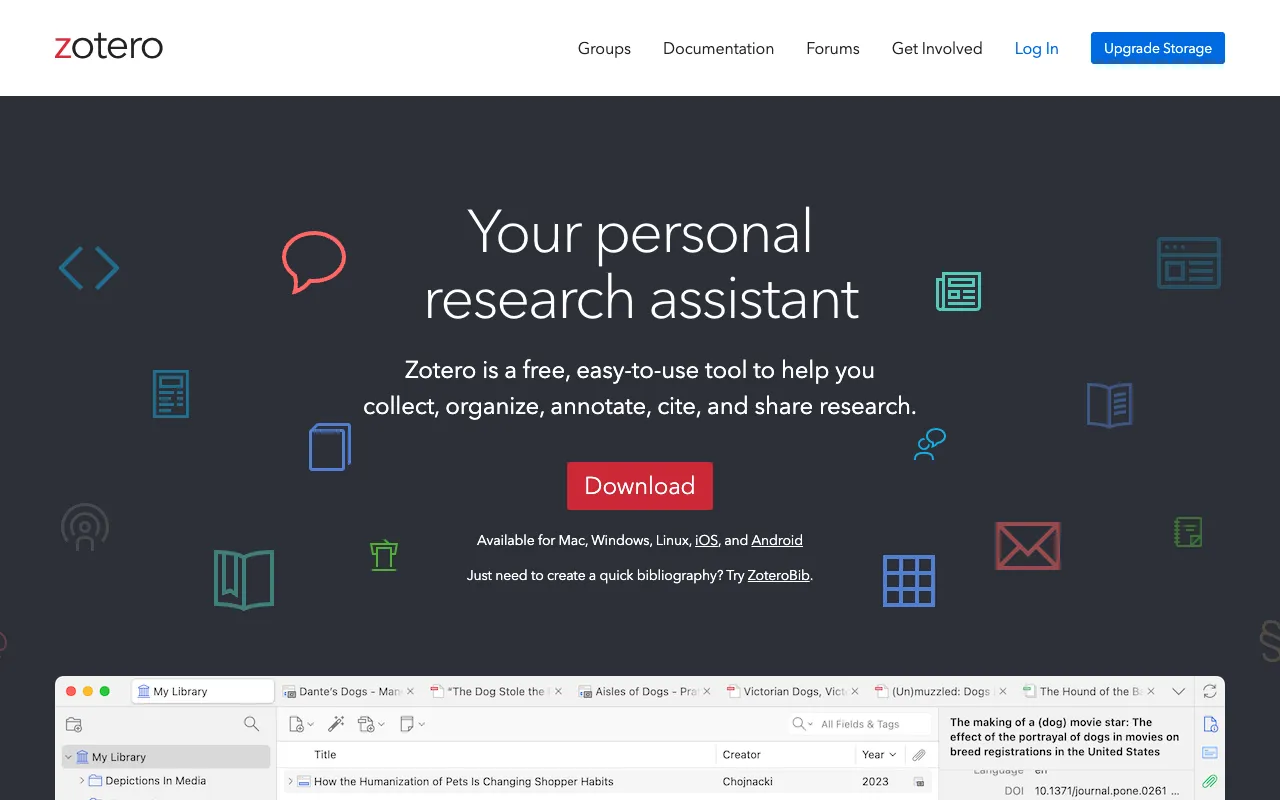
Zotero – The Essential Free Reference Manager for AI Researchers
For AI researchers drowning in a sea of arXiv preprints, conference papers, and journal articles, organizing knowledge is half the battle. Zotero is a powerful, free, and open-source reference management tool designed specifically to conquer this chaos. It goes beyond simple citation generation, acting as a centralized research hub where you can collect papers with one click, annotate PDFs, sync across devices, and collaborate with teams. Trusted by academics worldwide, Zotero is the indispensable productivity booster for anyone conducting literature reviews, writing research papers, or building a personal knowledge base in artificial intelligence and machine learning.
What is Zotero?
Zotero is a comprehensive, free reference management software that functions as both a standalone desktop application and a browser extension. Its primary purpose is to help researchers systematically collect, organize, annotate, and cite their research sources. For AI researchers, this means seamlessly capturing metadata and PDFs from sites like arXiv, Google Scholar, ACM Digital Library, and IEEE Xplore with a single click. Unlike many commercial alternatives, Zotero is open-source, community-driven, and puts user privacy and data ownership first. It serves as the foundational system for managing the explosive growth of literature in fields like deep learning, natural language processing, and computer vision.
Key Features of Zotero for AI Research
One-Click Capture from Any Source
The Zotero Connector browser extension instantly saves complete reference information—authors, title, abstract, PDF—from any academic website or database. This is invaluable for rapidly building a library from arXiv, NeurIPS proceedings, or PMLR workshops without manual data entry.
Smart Organization with Collections & Tags
Organize papers into nested collections (e.g., 'Transformers', 'Reinforcement Learning 2024') and add custom tags ('#must-read', '#reproducible-code'). Advanced search across full-text PDFs and notes helps you rediscover crucial findings buried in your library.
Integrated PDF Reader and Note-Taking
Read and annotate PDFs directly within Zotero. Highlight text, add sticky notes, and attach your own summaries. All annotations are searchable, turning your reference library into an interactive knowledge base tailored to your AI research workflow.
Seamless Citation and Bibliography Generation
Cite papers effortlessly in Microsoft Word, Google Docs, or LaTeX with over 10,000 citation styles (including NeurIPS, ICML, ICLR). Zotero automatically formats in-text citations and generates a perfectly styled bibliography, saving hours of manual formatting.
Cloud Sync and Team Collaboration
Sync your library, notes, and attachments across all your devices. Create shared group libraries to collaborate on literature reviews or paper writing with your AI research lab, ensuring everyone has access to the same curated set of references.
Who Should Use Zotero?
Zotero is ideal for anyone involved in academic or industrial AI research who needs to manage scholarly literature. Primary users include: PhD students and postdocs conducting systematic literature reviews; university professors and lab PIs organizing reading groups and supervising research; industry ML engineers and research scientists staying current with SOTA (State-of-the-Art) publications; and independent researchers or enthusiasts building a personal knowledge base in AI. It's especially powerful for collaborative projects, such as writing survey papers or preparing grant proposals that require meticulous citation management.
Zotero Pricing and Free Tier
Zotero's core software is completely free and open-source forever. This includes the desktop application, browser connector, and all core features like collecting references, organizing libraries, and citing in word processors. For cloud storage to sync PDFs and notes across devices, Zotero provides 300MB of free storage, which is sufficient for hundreds of paper metadata entries. For larger PDF libraries, affordable paid storage plans are available. There are no feature-limited 'free trials'—the powerful tool you get on day one remains fully functional indefinitely.
Common Use Cases
- Managing and annotating hundreds of arXiv preprints for a deep learning literature review
- Collaboratively building a shared reference library for an AI research lab or team
- Writing and formatting citations for a machine learning conference paper or thesis
Key Benefits
- Drastically reduces time spent on manual citation formatting and bibliography management
- Creates a searchable, personal knowledge base from all your read AI research papers
- Ensures research reproducibility and proper credit by maintaining accurate references
Pros & Cons
Pros
- Completely free and open-source with no hidden costs for core functionality
- Lightning-fast one-click capture from academic databases saves immense time
- Powerful organization with tags, collections, and full-text search across PDFs
- Excellent community support, plugins, and integration with word processors and LaTeX
Cons
- The free cloud storage limit (300MB) may be insufficient for very large PDF libraries
- The desktop interface can feel less modern compared to some web-based competitors
- Advanced features and collaboration setups may require a learning curve for new users
Frequently Asked Questions
Is Zotero completely free for AI researchers?
Yes, Zotero is 100% free and open-source. The software itself has no cost, and you get 300MB of free cloud storage for syncing your library. All core features for collecting, organizing, and citing research papers are available without payment, making it an exceptional value for students and researchers.
How does Zotero compare to Mendeley or EndNote for AI research?
Zotero often outperforms Mendeley and EndNote for AI researchers due to its superior one-click capture from arXiv and other preprint servers, robust open-source ecosystem, and strong privacy stance. Unlike Mendeley (owned by Elsevier), Zotero is independent and gives you full control over your data. Its flexibility with tags and collections is better suited for the fast-paced, interdisciplinary nature of AI literature.
Can I use Zotero to manage code repositories or datasets?
While Zotero is primarily designed for managing bibliographic references like papers and books, you can attach any file—including links to GitHub repos, dataset URLs, or conference slides—to a reference entry. Using the 'Extra' field or notes, you can create rich entries for non-traditional research outputs common in AI, making it a central hub for all your project resources.
Conclusion
For AI researchers seeking a powerful, ethical, and cost-effective solution to literature management, Zotero stands out as the top choice. Its unique combination of one-click capture, deep organizational tools, seamless citation generation, and commitment to open-source values makes it more than just a reference manager—it's a foundational tool for building and navigating your personal corpus of AI knowledge. Whether you're a solo enthusiast or part of a large research lab, integrating Zotero into your workflow will save you countless hours, reduce citation errors, and help you build a lasting, searchable library of the research that matters most to your work in artificial intelligence.