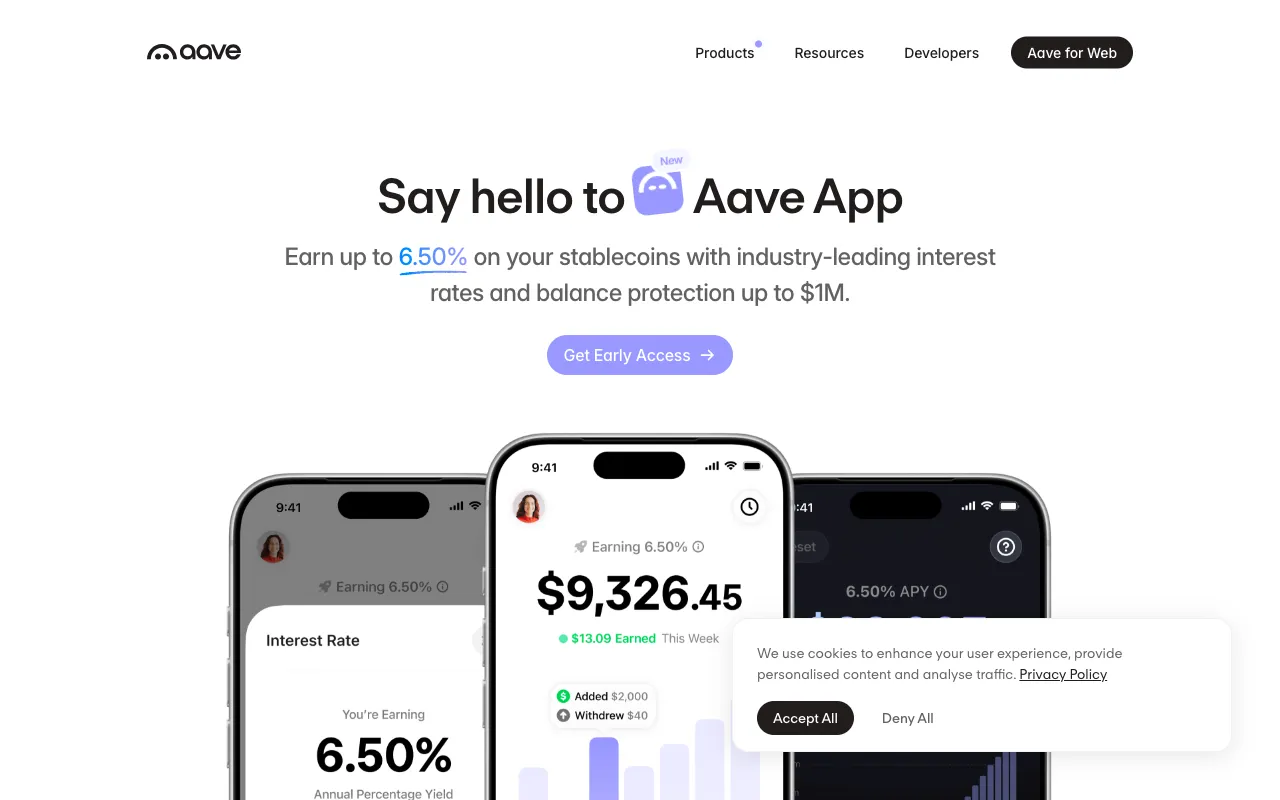
AAVE – The Premier DeFi Lending Protocol for Blockchain Developers
AAVE is the foundational open-source liquidity protocol for blockchain developers building the next generation of decentralized finance (DeFi). It provides a secure, non-custodial infrastructure for earning interest on deposits and borrowing a wide range of crypto assets. With its comprehensive developer tools and Software Development Kit (SDK), AAVE enables seamless integration of sophisticated lending and borrowing functionalities directly into your dApps, making it the go-to protocol for developers prioritizing security, flexibility, and composability.
What is the AAVE Protocol?
AAVE is a decentralized, open-source liquidity protocol that functions as the backbone for permissionless lending and borrowing markets. Operating entirely on-chain without intermediaries, it allows users to deposit digital assets into liquidity pools to earn passive interest, while enabling other users to borrow those assets by providing over-collateralization. For developers, AAVE is not just a protocol but a powerful development platform. Its architecture provides the essential smart contract infrastructure and developer tooling to create, customize, and integrate DeFi lending services, empowering builders to innovate on a proven and secure financial primitive.
Key Features of AAVE for Developers
Open-Source & Non-Custodial Protocol
Gain full transparency and control with AAVE's completely open-source smart contract codebase. The protocol is non-custodial, meaning assets are never held by a central entity, significantly reducing counterparty risk. This allows developers to audit the code, fork it for custom implementations, and build with confidence on a secure, battle-tested foundation trusted by billions in Total Value Locked (TVL).
Comprehensive Developer SDK & Tools
Accelerate your DeFi integration with AAVE's dedicated Software Development Kit (SDK) and robust API. These tools simplify interactions with the protocol's smart contracts, providing easy-to-use functions for querying pool data, interest rates, user positions, and executing transactions like deposits, withdrawals, and borrows. This drastically reduces development time and complexity.
Flash Loans & Innovative Primitives
Leverage AAVE's pioneering flash loan feature—uncollateralized loans that must be borrowed and repaid within a single blockchain transaction. This unique primitive enables advanced DeFi strategies like arbitrage, collateral swapping, and self-liquidation, opening a world of innovative use cases for sophisticated dApp developers and smart contract engineers.
Multi-Asset Liquidity Pools & aTokens
Integrate support for a diverse range of cryptocurrencies. When users deposit assets, they receive interest-bearing aTokens (e.g., aETH for deposited ETH), which automatically accrue yield in real-time. This model simplifies yield accounting for developers and provides a seamless user experience for earning interest within your application.
Who Should Use AAVE?
AAVE is essential for blockchain developers and teams building in the Web3 ecosystem. Ideal users include DeFi dApp developers integrating lending/borrowing features, wallet and portfolio applications adding yield-earning capabilities, fintech platforms exploring decentralized finance, and advanced smart contract developers creating novel financial instruments using flash loans. It's also crucial for protocol researchers and architects who need a reliable, composable money market layer for their broader DeFi stack.
AAVE Pricing and Free Tier
The AAVE protocol itself is free for developers to integrate and use. There are no licensing fees or upfront costs to access its open-source code, SDK, or APIs. Network gas fees (on Ethereum, Polygon, Avalanche, etc.) apply for transaction execution. For end-users, the protocol charges variable borrowing interest rates (paid to liquidity providers) and may take a small reserve factor from this interest for ecosystem development. Developers can start building and testing on testnets completely free of charge.
Common Use Cases
- Building a DeFi savings app with automated yield on user deposits
- Creating a crypto borrowing platform for leveraged trading or liquidity
- Integrating flash loans for advanced arbitrage bots and DeFi strategies
- Developing a multi-chain wallet that displays and manages interest-bearing aTokens
Key Benefits
- Reduce development time by months using battle-tested, secure smart contracts.
- Attract users by offering trusted, industry-standard yield and borrowing services.
- Build composable applications that interoperate with the broader DeFi ecosystem.
- Future-proof your dApp with a protocol that continuously innovates (e.g., AAVE v3 features).
Pros & Cons
Pros
- Industry-leading security and extensive protocol audits.
- Massive liquidity and deep integration across the DeFi landscape.
- Powerful, well-documented SDK and developer tools.
- Pioneering features like flash loans enable unique applications.
- Truly decentralized and governed by the AAVE token community.
Cons
- Smart contract complexity requires solid Solidity/Web3 knowledge to integrate deeply.
- Gas fees on Ethereum mainnet can be prohibitive for small transactions (mitigated by L2 deployments).
- Interest rates and pool parameters are volatile and market-driven.
Frequently Asked Questions
Is AAVE free to use for developers?
Yes, the AAVE protocol is completely free for developers to integrate. There are no licensing fees. You only pay standard blockchain network gas fees for deploying contracts and executing transactions. The open-source code, SDK, and documentation are freely accessible.
Is AAVE the best tool for blockchain developers building DeFi apps?
For integrating lending and borrowing functionality, AAVE is widely considered the top choice. Its combination of security, massive liquidity, comprehensive developer tools, and innovative features like flash loans makes it the most robust and widely adopted protocol in the space, offering the strongest foundation for serious DeFi applications.
What blockchains does AAVE support?
AAVE is deployed on multiple networks, offering developers flexibility. It's native to Ethereum mainnet and also available on Layer 2 scaling solutions like Polygon and Arbitrum, as well as other chains like Avalanche and Optimism. This multi-chain presence allows developers to choose a network based on gas costs and user base.
Do I need the AAVE token to build on the protocol?
No, you do not need the AAVE governance token to integrate or use the core lending/borrowing protocol. The token is used for community governance (voting on proposals). Your dApp's users only need the asset they wish to deposit or borrow, and collateral for borrowing.
Conclusion
For blockchain developers aiming to build secure, feature-rich, and competitive DeFi applications, AAVE is an indispensable protocol. It provides more than just liquidity pools; it offers a complete, developer-friendly ecosystem for integrating sophisticated financial primitives. By leveraging AAVE's open-source contracts, powerful SDK, and industry-leading security, you can accelerate your development timeline and deliver a product built on the same infrastructure that powers billions in decentralized finance. Whether you're creating a simple savings dApp or a complex platform utilizing flash loans, AAVE provides the reliable, composable foundation necessary for success in the Web3 economy.