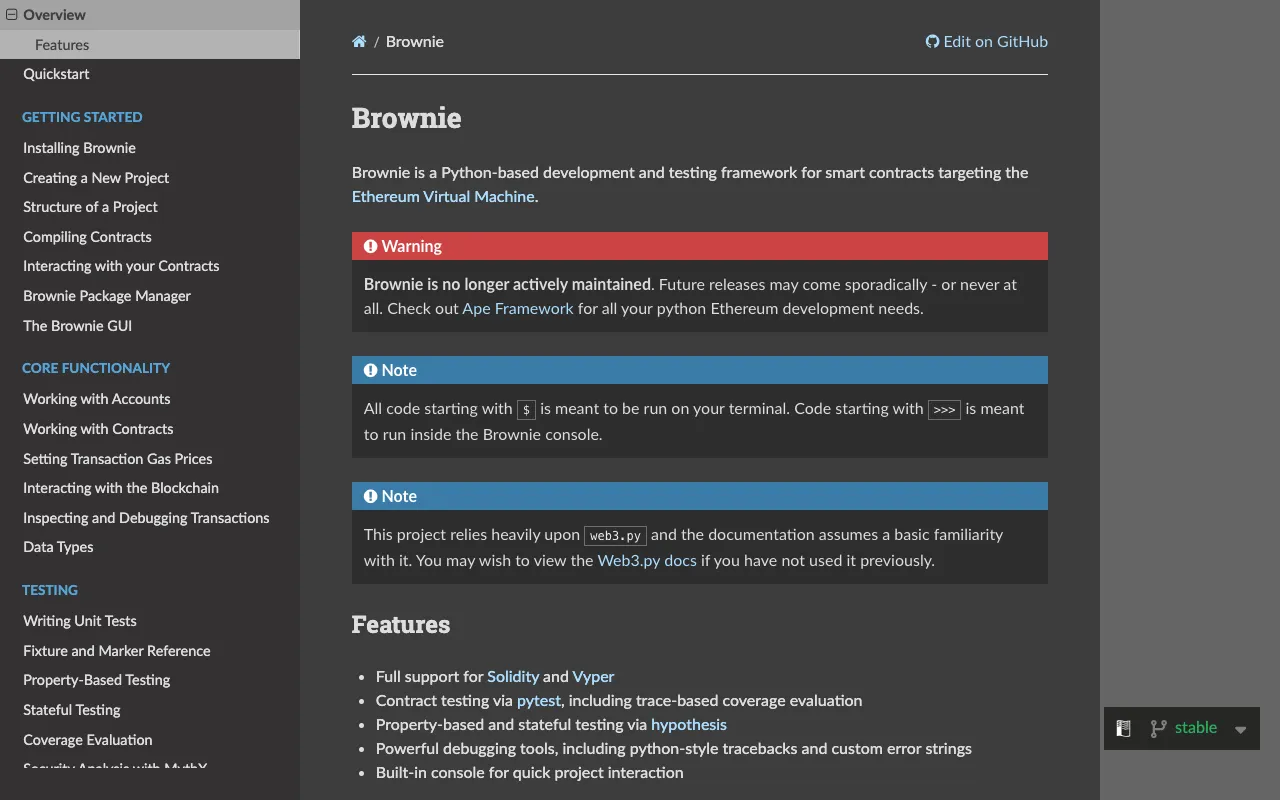
Brownie – The Python Framework for Ethereum Smart Contract Development
Brownie is a robust, Python-based development environment designed specifically for building, testing, and deploying smart contracts on the Ethereum Virtual Machine (EVM). It streamlines the entire workflow for blockchain developers by leveraging Python's simplicity and vast ecosystem, making it one of the best tools for blockchain developers transitioning from Web2 or those who prefer Python over Solidity-centric frameworks. Brownie integrates seamlessly with popular tools like Ganache and Web3.py, offering a full-featured, intuitive alternative for Ethereum development.
What is Brownie?
Brownie is an open-source development and testing framework written in Python, specifically tailored for smart contracts targeting the Ethereum Virtual Machine (EVM). Its core purpose is to bridge the gap between Python developers and the Ethereum blockchain, providing a familiar and powerful environment for writing tests, scripting deployments, and debugging contracts. Unlike frameworks that require learning a new testing language, Brownie allows developers to use Python—a language known for its readability and extensive libraries—for all aspects of the development lifecycle. It's the ideal tool for developers, DevOps engineers, and QA specialists who want to apply Pythonic principles to blockchain development.
Key Features of Brownie
Python-Based Testing
Write comprehensive unit and integration tests for your smart contracts using pytest, the industry-standard Python testing framework. This allows for complex fixture management, parameterized tests, and clear, readable assertions, leading to more reliable and maintainable contract code.
Built-in Console and Debugger
Brownie includes an interactive console for quick experimentation and a powerful traceback debugger for transaction reverts. You can inspect state changes, step through contract calls, and diagnose failures directly in your terminal, dramatically speeding up the development and debugging process.
Automated Contract Interaction
Interact with deployed contracts effortlessly. Brownie automatically generates and manages Python classes for your Solidity contracts, allowing you to call functions, read state variables, and listen for events using simple, object-oriented syntax directly from your scripts or tests.
Ganache Integration & Network Management
Brownie has first-class support for Ganache, enabling rapid local development and testing. It features built-in network management for connecting to local chains, testnets (like Sepolia or Goerli), and mainnet, simplifying environment configuration and deployment scripting.
Who Should Use Brownie?
Brownie is the optimal choice for Python developers entering the Web3 space, blockchain engineers seeking a more productive testing environment, and teams building complex DeFi protocols or NFT projects on EVM chains. It's particularly valuable for developers who are already proficient in Python and want to leverage those skills for smart contract automation, testing, and deployment scripting without switching context to JavaScript-based tools. Data scientists and analysts working with on-chain data will also find Brownie's scripting capabilities invaluable for building custom data pipelines.
Brownie Pricing and Free Tier
Brownie is completely free and open-source software released under the MIT license. There is no paid tier, enterprise plan, or usage limits. You can install it via pip, use all its features for local development, testing, and deployment to public networks, and contribute to its development on GitHub at no cost. This makes it an accessible and powerful entry point for developers and teams of all sizes.
Common Use Cases
- Automated testing and deployment pipelines for Ethereum smart contracts using Python
- Building custom scripts to interact with DeFi protocols and analyze on-chain data
Key Benefits
- Accelerate development cycles by writing tests and scripts in Python, reducing the learning curve for new blockchain developers.
- Increase code reliability with a mature Python testing ecosystem (pytest) applied to smart contract validation.
Pros & Cons
Pros
- Leverages Python's simplicity and extensive library ecosystem for blockchain tasks.
- Excellent, built-in debugging tools for transaction analysis and failure diagnosis.
- Completely free and open-source with an active community.
- Seamless integration with Ganache for local development.
Cons
- Primarily focused on the EVM, so not suitable for non-EVM chains like Solana or Cosmos.
- The ecosystem, while strong, is smaller than the dominant JavaScript/TypeScript (Hardhat) tooling.
Frequently Asked Questions
Is Brownie free to use?
Yes, Brownie is 100% free and open-source. It is released under the MIT license, meaning you can use it for personal and commercial projects without any cost or restriction.
Is Brownie good for Ethereum smart contract development?
Absolutely. Brownie is considered one of the top frameworks for Ethereum development, especially for developers who prefer Python. It provides a comprehensive suite of tools for writing, testing, debugging, and deploying EVM smart contracts, making it an excellent choice for serious blockchain development projects.
Can I use Brownie with other EVM-compatible blockchains?
Yes. While designed for Ethereum, Brownie works with any EVM-compatible blockchain such as Polygon, Avalanche C-Chain, Binance Smart Chain, Arbitrum, and Optimism. You simply need to configure the correct RPC endpoint in your network settings.
Conclusion
For blockchain developers who value the power and readability of Python, Brownie stands out as a premier framework for Ethereum and EVM-compatible development. It transforms the smart contract workflow by integrating sophisticated testing, intuitive debugging, and robust deployment scripting into a single, cohesive environment. Whether you're building a new DeFi protocol, launching an NFT collection, or creating automation scripts, Brownie provides the professional-grade tooling to do it efficiently and reliably. As a completely free and open-source project, it offers tremendous value and is a top recommendation for any developer's Web3 toolkit.