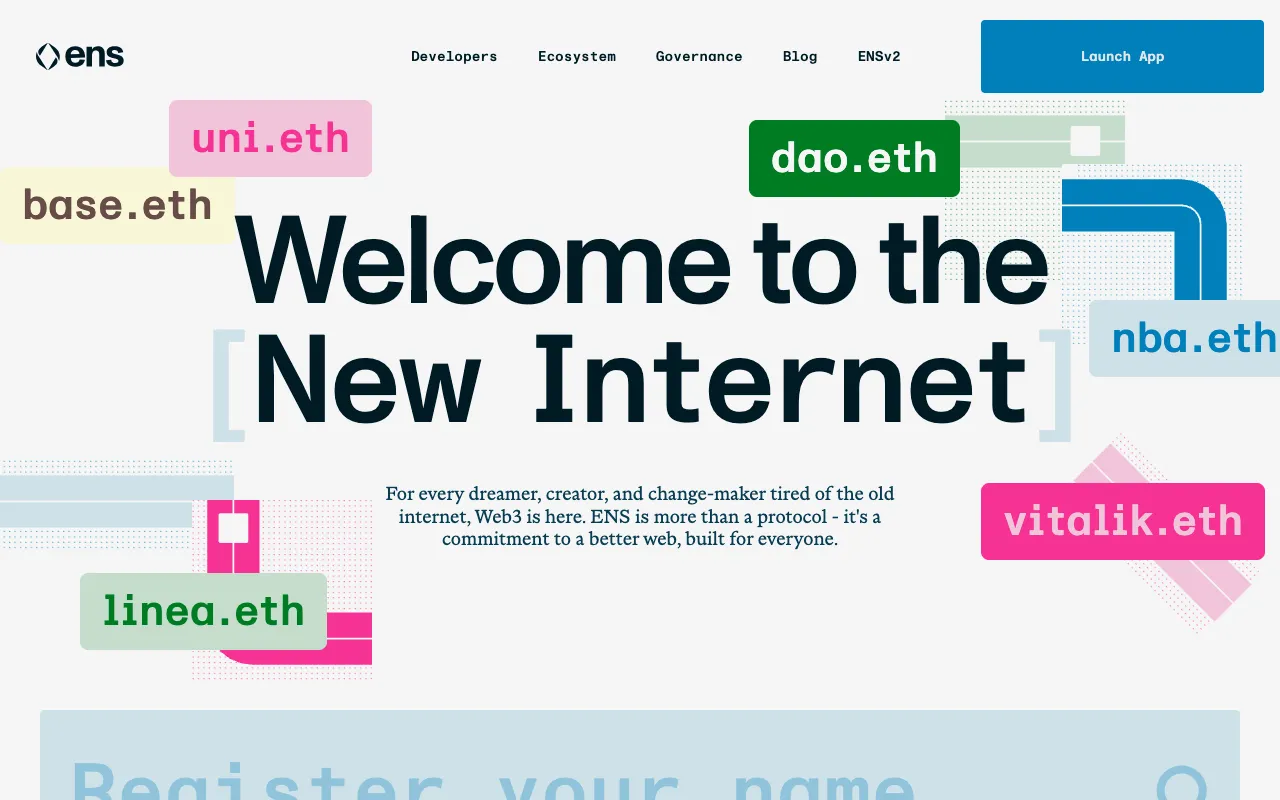
ENS (Ethereum Name Service) – The Essential Naming Protocol for Blockchain Developers
ENS (Ethereum Name Service) is the foundational naming layer for the decentralized web, transforming cumbersome blockchain addresses into simple, human-readable names like 'alice.eth'. As a critical infrastructure protocol, it enables developers to build dApps with vastly improved user experience by abstracting away the complexity of 42-character hexadecimal addresses. For any developer working in Web3, ENS is a non-negotiable tool for creating accessible, user-friendly applications.
What is the Ethereum Name Service (ENS)?
ENS is a distributed, open-source naming system built on the Ethereum blockchain. Its core function is to map human-readable, memorable names (e.g., 'yourname.eth') to machine-readable identifiers. While most commonly used to simplify sending crypto to an Ethereum wallet address, its utility extends far beyond. ENS can resolve names to content hashes (IPFS, Swarm), Tor .onion addresses, and other blockchain data, acting as a universal nametag for your digital identity and assets across Web3.
Key Features of ENS for Developers
Decentralized & Trustless Resolution
ENS operates entirely on-chain via smart contracts, eliminating centralized points of failure or control. Name resolution is permissionless and verifiable, aligning with core Web3 principles and ensuring censorship resistance for your dApp's addressing layer.
Multi-Chain & Multi-Coin Support
An ENS name isn't limited to a single Ethereum address. It can be configured with records for multiple cryptocurrencies (BTC, DOGE, LTC) and across different chains via CCIP-read, making it a cross-chain identity standard. This allows users to receive any asset with one simple name.
Extensible Record Types
Beyond cryptocurrency addresses, developers can leverage custom record types. Store avatar images, website URLs (IPFS/Swarm hashes), email addresses, Discord handles, and more. This turns an ENS name into a rich, portable profile for users.
Subdomain Management & Permissions
Name owners can create and manage unlimited subdomains (e.g., 'pay.invoice.eth') programmatically. This is powerful for dApps needing to issue branded addresses or manage user identities, with fine-grained control over subdomain registrars.
Who Should Use ENS?
ENS is indispensable for Ethereum and Web3 developers building consumer-facing applications. Wallet developers integrate it for seamless sending/receiving. DeFi and NFT platform developers use it to enhance transaction clarity and reduce user error. DAO tooling creators leverage it for member identification. Any project aiming to reduce friction and abstract blockchain complexity for end-users will benefit profoundly from ENS integration.
ENS Pricing and Registration Model
ENS operates on a registration model, not a subscription. Users pay a one-time gas fee to register a name for a minimum of one year, followed by an annual renewal fee paid directly to the protocol treasury. Fees are dynamic based on name length and demand (e.g., 3+ character names are cheaper, 3-letter names are premium). There is no traditional 'free tier,' but developers can experiment on testnets. The protocol's decentralized governance (ENS DAO) controls fee parameters and treasury funds.
Common Use Cases
- Simplify crypto payments in your dApp by allowing users to send to 'username.eth' instead of a long address
- Build a decentralized website by linking your ENS name to an IPFS hash for uncensorable hosting
- Create user profiles for your NFT community where members can verify identity with their ENS name
Key Benefits
- Drastically reduces transaction errors by replacing prone-to-mistype addresses with simple names
- Enhances brand identity and user experience in dApps, leading to higher adoption and retention
- Future-proofs applications by using a naming standard that works across multiple blockchains and asset types
Pros & Cons
Pros
- Industry-standard protocol with wide ecosystem support (wallets, dApps, browsers)
- Truly decentralized and censorship-resistant infrastructure
- Extremely versatile with support for multiple record types and chains
- Strong community and DAO governance ensuring protocol evolution
Cons
- Requires users to pay Ethereum gas fees for registration and updates, which can be volatile
- Annual renewal model can lead to name loss if forgotten, unlike one-time-purchase DNS
- Mainstream user understanding of Web3 domains and wallets is still developing
Frequently Asked Questions
Is ENS free to use?
No, ENS is not free. Registering an ENS name requires paying an Ethereum network gas fee and an annual registration fee to the protocol, priced in ETH. The cost varies based on name length and network congestion. However, resolving (looking up) a name is free.
Is ENS good for blockchain developers?
Absolutely. For blockchain developers, ENS is a critical tool for improving dApp usability. It provides a standardized, decentralized way to handle user identities and addresses, reducing support issues from wrong transactions and creating a more polished, professional user experience that can drive adoption.
What's the difference between ENS and traditional DNS?
Traditional DNS (like .com) is a centralized system managed by ICANN and registrars. ENS is decentralized, running on Ethereum smart contracts. You own your ENS name outright via your crypto wallet, without reliance on a central authority. ENS also integrates with DNS, allowing you to import your traditional domain (e.g., yoursite.com) to use with ENS features.
Can I use ENS with other blockchains besides Ethereum?
Yes. Through technologies like CCIP-read and multi-coin address records, an ENS name can resolve to addresses on Bitcoin, Litecoin, Dogecoin, and many other Layer 1 and Layer 2 networks. This makes it a powerful cross-chain naming solution.
Conclusion
For developers serious about building the next generation of user-centric Web3 applications, integrating the Ethereum Name Service is not an optional enhancement—it's a fundamental requirement. By abstracting away the raw, unfriendly nature of blockchain addresses, ENS provides the crucial usability layer that bridges the gap between complex technology and mainstream adoption. Its status as a decentralized, extensible, and widely adopted standard makes it the premier tool for any blockchain developer's toolkit when aiming for production-ready, polished dApps.