Go back
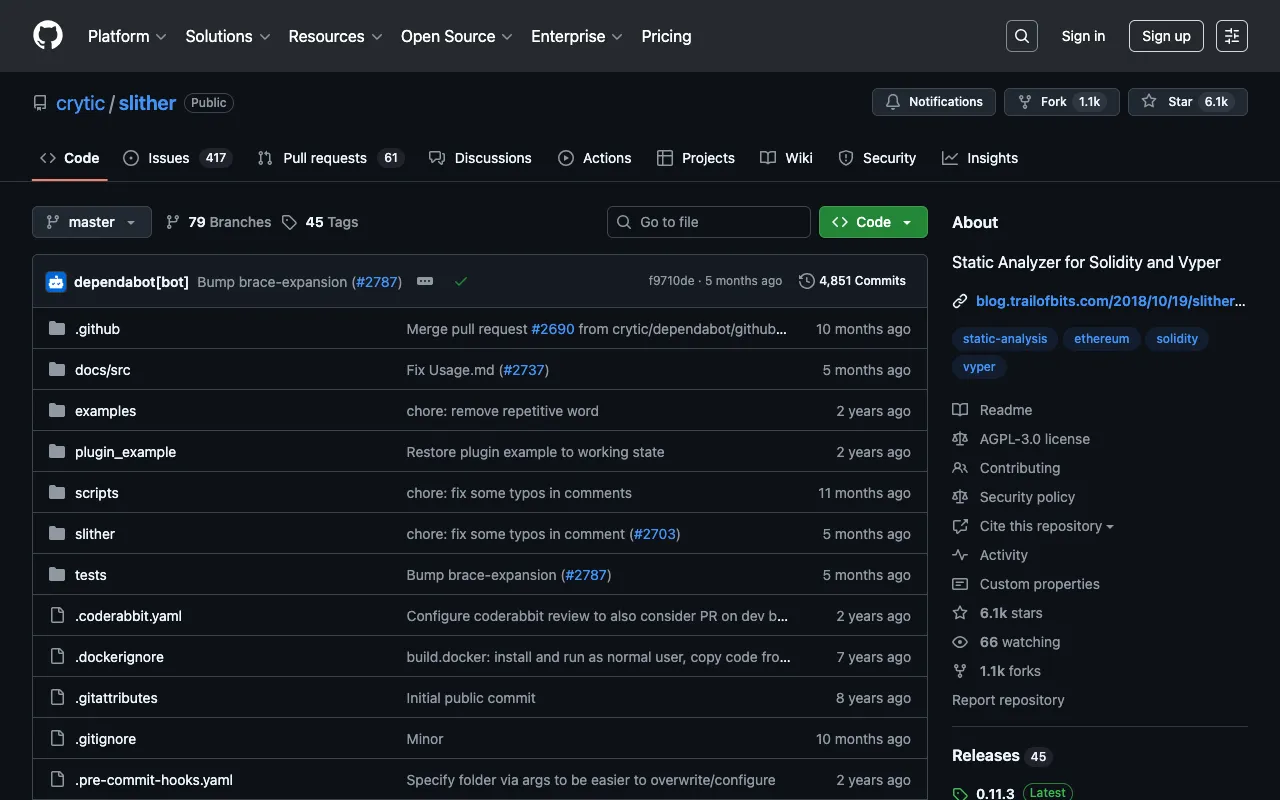
Image of Slither – Best Static Analysis Tool for Solidity Smart Contracts

Slither – Best Static Analysis Tool for Solidity Smart Contracts

Slither is an essential, open-source static analysis framework built specifically for Solidity, the primary programming language for Ethereum smart contracts. Designed for security researchers and blockchain developers, Slither automatically detects a wide range of common and complex vulnerabilities, provides deep insights into contract structure and inheritance, and offers a flexible API for writing custom security analyses. It stands out as a critical tool for anyone building, auditing, or maintaining secure decentralized applications.

What is Slither?

Slither is a comprehensive static analysis tool written in Python, created to analyze Solidity smart contracts for security flaws, code quality issues, and optimization opportunities. Unlike simple linters, Slither performs deep semantic analysis on the contract's Abstract Syntax Tree (AST) and control flow graph. Its primary purpose is to empower developers and auditors to proactively identify risks before deployment, making it a cornerstone of the secure blockchain development lifecycle. It is trusted by leading security firms and protocol teams for its accuracy and extensibility.

Key Features of Slither

Suite of Vulnerability Detectors

Slither comes pre-loaded with dozens of built-in detectors that identify critical security issues like reentrancy, integer overflows/underflows, incorrect access control, and unsafe delegate calls. These detectors are continuously updated to catch emerging threats in the Solidity ecosystem.

Contract Visualization and Reporting

Gain immediate clarity on your smart contract's architecture. Slither can generate human-readable inheritance graphs, function call graphs, and data dependency charts, helping you understand complex codebases and spot design flaws at a glance.

Extensible API for Custom Analysis

Go beyond the standard checks. Slither provides a powerful Python API that allows security engineers to write custom detectors, printers, and utilities tailored to their specific project requirements, internal standards, or novel attack vectors.

Integration into CI/CD Pipelines

Automate security as part of your development workflow. Slither's command-line interface and clear exit codes make it ideal for integration into continuous integration systems like GitHub Actions, GitLab CI, or Jenkins, ensuring every commit is automatically scanned.

Who Should Use Slither?

Slither is indispensable for Solidity smart contract developers, blockchain security auditors, DevOps engineers, and protocol teams. It is perfect for developers writing new contracts who need real-time feedback, security firms conducting thorough audits, and DevOps professionals tasked with implementing automated security gates. Any team serious about deploying robust, secure, and high-quality smart contracts on Ethereum and other EVM-compatible chains will benefit from integrating Slither into their toolkit.

Slither Pricing and Free Tier

Slither is completely free and open-source software (FOSS) released under the MIT license. There is no paid tier, subscription, or enterprise version—all features, including the full suite of detectors, visualization tools, and the extensible API, are available to everyone at no cost. It is developed and maintained as a public good by the security research team at Trail of Bits.

Common Use Cases

Key Benefits

Pros & Cons

Pros

  • Extensive library of pre-built, highly accurate security vulnerability detectors.
  • Powerful visualization tools that demystify complex contract relationships and data flows.
  • Fully open-source with a permissive license and a strong, active community behind it.
  • Flexible API enables creation of project-specific analyses and compliance checks.

Cons

  • Primarily a command-line tool, which may have a steeper learning curve for developers less familiar with terminals.
  • Focused exclusively on Solidity and EVM-compatible chains, not suitable for other blockchain languages like Rust (Solana) or Move (Aptos/Sui).

Frequently Asked Questions

Is Slither free to use?

Yes, Slither is completely free and open-source. There are no charges, licenses, or hidden fees. All its features are available for personal, commercial, and enterprise use under the MIT license.

Is Slither good for auditing DeFi smart contracts?

Absolutely. Slither is one of the top tools for auditing DeFi (Decentralized Finance) contracts. Its detectors are specifically tuned to find financial logic flaws, price oracle manipulations, and access control issues common in complex DeFi protocols, making it a standard in the industry.

How does Slither compare to other Solidity linters?

Slither performs deep static analysis, going far beyond basic linting. While linters like Solhint check for style and simple patterns, Slither analyzes control flow, data dependencies, and semantic meaning to find sophisticated security vulnerabilities that simpler tools would miss.

Can I use Slither in my automated build process?

Yes, Slither is designed for CI/CD integration. Its CLI output can be configured for machine readability (JSON), and it provides meaningful exit codes, allowing you to fail builds automatically when new vulnerabilities are introduced.

Conclusion

For any developer or team building on Ethereum and EVM-compatible blockchains, Slither is not just a tool—it's a critical component of a professional security posture. Its combination of automated vulnerability detection, insightful visualizations, and unparalleled extensibility makes it the definitive static analysis framework for Solidity. By integrating Slither into your development and auditing workflow, you invest in the security, quality, and long-term reliability of your smart contracts, safeguarding your users and your protocol's reputation.