Go back
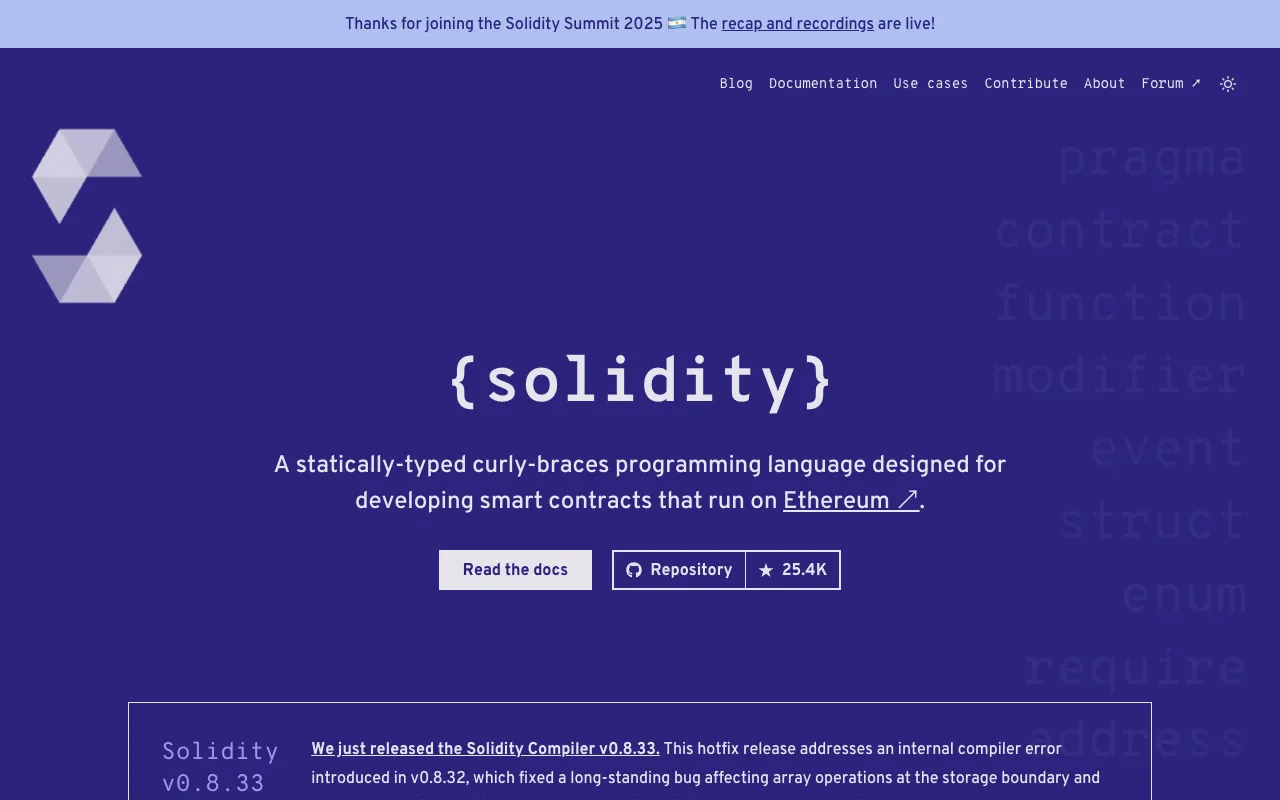
Image of Solidity – The Essential Programming Language for Blockchain Developers

Solidity – The Essential Programming Language for Blockchain Developers

Solidity is the cornerstone of Web3 development. As the primary, purpose-built programming language for creating smart contracts on the Ethereum Virtual Machine (EVM), it powers the decentralized applications, DeFi ecosystems, and digital assets that define the blockchain space. If you're serious about building on Ethereum, Avalanche, Polygon, Binance Smart Chain, or any EVM-compatible chain, mastering Solidity is your first and most critical step. This guide explains why Solidity dominates smart contract development and how you can leverage its full potential.

What is the Solidity Programming Language?

Solidity is a statically-typed, curly-braced, contract-oriented programming language specifically designed for writing smart contracts that run on the Ethereum Virtual Machine (EVM). Think of it as the JavaScript or Python of the blockchain world, but with built-in features for handling cryptocurrency, executing immutable code, and managing on-chain state. Unlike general-purpose languages, Solidity is intrinsically aware of blockchain concepts like gas, transactions, and cryptographic addresses, making it the most efficient and secure choice for developing decentralized logic. Its syntax is intentionally familiar to developers who know JavaScript, C++, or Python, reducing the learning curve for entering the Web3 space.

Key Features of Solidity for Smart Contract Development

Contract-Oriented Architecture

Everything in Solidity revolves around 'contracts,' which are the fundamental building blocks of Ethereum applications. A contract is akin to a class in object-oriented programming, encapsulating state (variables) and behavior (functions). This model perfectly maps to the concept of a smart contract as an autonomous, on-chain agent with its own balance and rules.

Explicit Gas & Transaction Management

Solidity provides developers with fine-grained control over gas consumption and transaction execution. Features like `payable` functions, `view`/`pure` modifiers, and low-level calls (`address.call`) allow developers to write gas-efficient and cost-effective contracts, a critical skill for optimizing dApp performance and user costs.

Rich Standard Library & Inheritance

Solidity supports multiple inheritance and a rich set of built-in global units and functions. Libraries like OpenZeppelin Contracts provide secure, audited, reusable components for common patterns (ERC-20 tokens, ERC-721 NFTs, access control), enabling rapid, secure development and promoting best practices across the ecosystem.

EVM Bytecode Compilation

The Solidity compiler (`solc`) translates human-readable Solidity code into EVM bytecode, which is then deployed to the blockchain. It also produces the Application Binary Interface (ABI), a JSON file that describes the contract's interface, enabling seamless interaction from frontends and other contracts.

Who Should Use Solidity?

Solidity is indispensable for any developer or organization building on EVM-based blockchains. This includes: **Smart Contract Developers** crafting DeFi lending protocols, DEXs, or NFT marketplaces; **Web3 Full-Stack Developers** integrating blockchain backends with traditional frontends; **Protocol Engineers** designing new layer-1 or layer-2 blockchain systems; **Security Auditors** analyzing contract code for vulnerabilities; and **Entrepreneurs & Product Managers** who need to understand the technical possibilities and constraints of their Web3 projects. Simply put, if your goal involves creating trustless, automated, on-chain applications, you need Solidity.

Solidity Pricing and Free Tier

Solidity is a 100% free and open-source programming language. The language specification, core compiler (`solc`), official documentation, and all community tooling are freely available. There are no licensing fees, subscriptions, or paid tiers to use Solidity itself. The only costs associated with development are standard blockchain network fees (gas) for deploying and interacting with your contracts on public testnets or mainnets. You can write, compile, and test Solidity code locally at zero cost using frameworks like Hardhat or Foundry.

Common Use Cases

Key Benefits

Pros & Cons

Pros

  • Industry Standard: The undisputed, most widely adopted language for EVM smart contracts with massive community and tooling support.
  • Purpose-Built: Designed specifically for blockchain, with native features for security, gas optimization, and crypto-economic design.
  • Strong Typing & Security: Reduces runtime errors and facilitates the creation of secure, predictable contract behavior.
  • Vast Ecosystem: Access to thousands of audited, open-source libraries (e.g., OpenZeppelin) and development frameworks (Hardhat, Foundry).

Cons

  • EVM-Locked: Code is primarily designed for the Ethereum Virtual Machine, limiting direct portability to non-EVM chains (e.g., Solana, Cosmos).
  • Steep Learning Curve: Requires understanding novel concepts like gas, immutability, and decentralization patterns alongside the language syntax.
  • Rapid Evolution: The language and best practices evolve quickly to address security concerns, requiring developers to stay continuously updated.

Frequently Asked Questions

Is Solidity free to use?

Yes, Solidity is completely free and open-source. There are no costs associated with downloading the compiler, using the language, or accessing its documentation. The only potential expenses are the gas fees required to deploy and interact with your contracts on a live blockchain network.

Is Solidity good for blockchain development?

Solidity is not just 'good'—it is essential for Ethereum and EVM-compatible blockchain development. It is the most mature, widely supported, and feature-complete language specifically designed for writing secure and efficient smart contracts. For building on networks like Ethereum, Polygon, or Avalanche, proficiency in Solidity is a non-negotiable core skill for any serious blockchain developer.

What is the best way to learn Solidity?

The best way to learn Solidity is through hands-on practice. Start with the official documentation (docs.soliditylang.org), then use a local development environment like Remix IDE (browser-based) or Hardhat. Follow tutorials to build simple contracts (e.g., a token, a vault), experiment on testnets, and study code from reputable open-source projects. Understanding foundational Web3 concepts like wallets, transactions, and gas is equally important.

Can I get a job knowing only Solidity?

While knowing Solidity is a highly valuable and sought-after skill, most blockchain developer roles require a broader skill set. This typically includes knowledge of a frontend framework (React, JavaScript), Web3 libraries (ethers.js, web3.js), development tools (Hardhat, Foundry), and concepts like cryptography and decentralized system design. Solidity is the critical core, but it's most powerful when combined with full-stack Web3 development skills.

Conclusion

Solidity remains the undisputed gateway to blockchain development. Its position as the standard language for the expansive EVM ecosystem makes it the most strategic and future-proof skill for developers aiming to build in Web3. While it presents a unique learning curve, the payoff is access to the forefront of technological innovation in finance, digital ownership, and decentralized systems. For any developer committed to building the next generation of the internet, investing time in mastering Solidity is not just an option—it's a necessity. Start writing your first smart contract today and become a builder of the decentralized future.