Go back
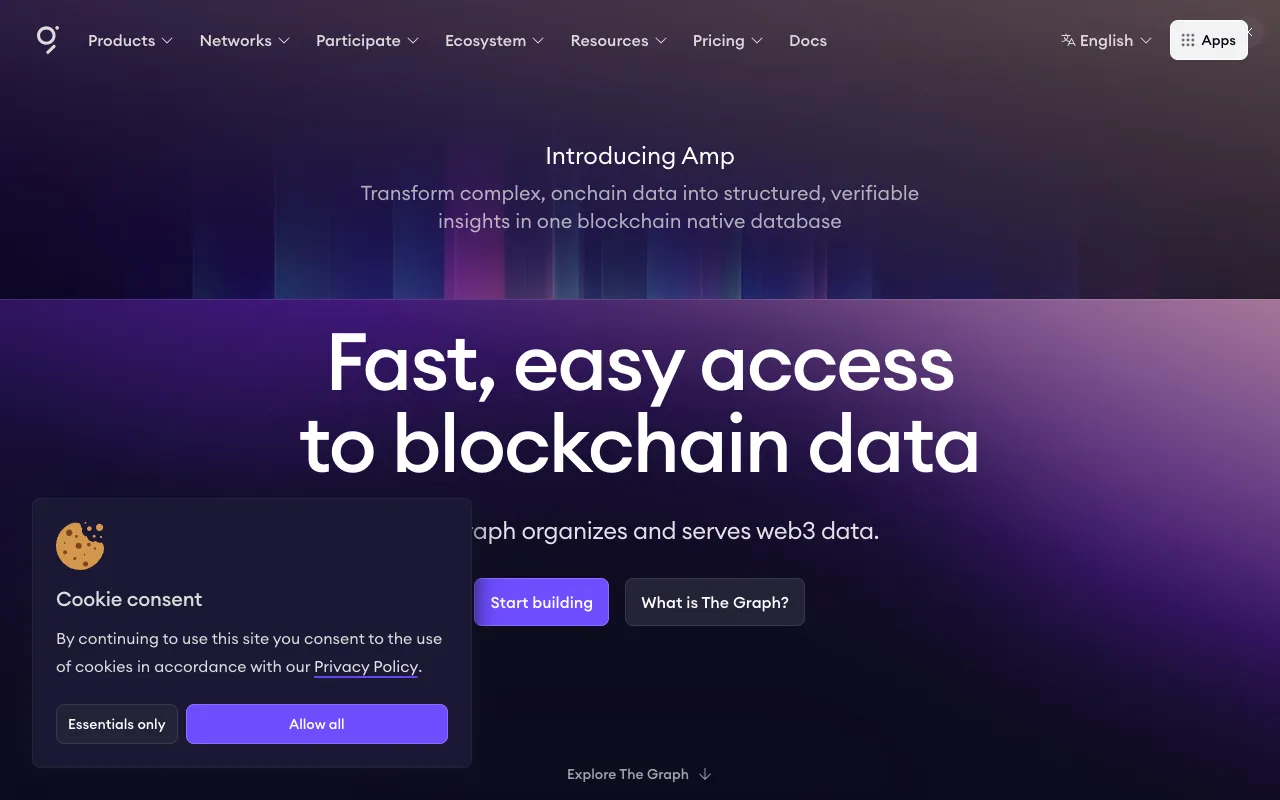
Image of The Graph – The Essential Decentralized Indexing Protocol for Blockchain Developers

The Graph – The Essential Decentralized Indexing Protocol for Blockchain Developers

The Graph is the foundational decentralized protocol for indexing and querying data from blockchains, transforming how developers build and scale decentralized applications (dApps). By providing open APIs called subgraphs, it allows anyone to query blockchain data without running a centralized server. This makes The Graph an indispensable tool for developers creating the next generation of Web3 applications, from DeFi platforms and NFT marketplaces to DAOs and beyond, all running on robust public infrastructure.

What is The Graph Protocol?

The Graph is an open-source, decentralized protocol for indexing and querying data from blockchains, starting with Ethereum. It solves a critical problem in Web3 development: efficiently accessing and utilizing on-chain data. Instead of building custom, centralized indexing servers, developers publish and query open APIs called 'subgraphs.' These subgraphs define how to ingest, process, and store blockchain data, making it easily queryable using GraphQL. This serverless architecture empowers developers to build dApps that are more reliable, scalable, and truly decentralized from the data layer up.

Key Features of The Graph Protocol

Decentralized Data Indexing

The Graph network consists of Indexers, Curators, and Delegators who work together to index blockchain data in a trustless manner. This eliminates reliance on single points of failure and ensures data availability and integrity, providing a robust foundation for mission-critical dApps.

Subgraphs (Open APIs)

Subgraphs are the core building blocks. Developers define a subgraph manifest that specifies the smart contracts to index, the events to listen for, and how to map event data into entities. Once deployed, this data becomes instantly queryable via a GraphQL endpoint, dramatically speeding up development.

Powerful GraphQL API

Query indexed blockchain data using the intuitive and efficient GraphQL query language. This allows front-end applications to request exactly the data they need in a single request, simplifying client-side logic and improving application performance.

Hosted Service & Decentralized Network

Start building instantly with the free Hosted Service for a managed experience. For production-grade, censorship-resistant applications, seamlessly migrate subgraphs to The Graph's decentralized mainnet, supported by a global network of node operators.

Who Should Use The Graph?

The Graph is essential for any developer or team building on EVM-compatible blockchains and beyond. It's particularly valuable for: DeFi developers needing real-time price feeds, liquidity pool data, and transaction histories; NFT project teams building marketplaces, galleries, or analytics dashboards; DAO tooling creators requiring governance proposal and voting data; and any application that needs fast, reliable, and composable access to on-chain events and states without managing complex backend infrastructure.

The Graph Pricing and Free Tier

The Graph offers a generous and developer-friendly model. The Hosted Service provides a completely free tier for development, testing, and smaller-scale production dApps, including free querying. For applications requiring the security and decentralization of the mainnet, query fees are paid in GRT tokens. The cost is based on query volume and complexity, with pricing determined by a decentralized market of Indexers. This 'pay-as-you-query' model ensures you only pay for the data you use at scale.

Common Use Cases

Key Benefits

Pros & Cons

Pros

  • Fundamentally simplifies and accelerates blockchain data access for developers.
  • Robust free tier (Hosted Service) perfect for prototyping and launching new projects.
  • Decentralized network ensures data availability, integrity, and resistance to censorship.
  • Vibrant ecosystem with thousands of published subgraphs for popular protocols.

Cons

  • Learning curve involved in defining subgraph mappings and working with GraphQL schemas.
  • For the decentralized network, query costs in GRT must be managed as application usage scales.
  • Indexing latency for new blocks can be a consideration for ultra low-latency applications.

Frequently Asked Questions

Is The Graph free to use?

Yes, The Graph offers a completely free Hosted Service for development and production use. You can build, deploy, and query subgraphs without cost. For applications requiring the decentralized mainnet's guarantees, queries incur a small fee paid in GRT tokens based on usage.

Is The Graph good for Ethereum development?

Absolutely. The Graph is the industry-standard tool for Ethereum and EVM-compatible chain (like Polygon, Arbitrum, Avalanche) development. It is used by nearly every major DeFi protocol, NFT platform, and DAO to power their data layers, making it essential for professional blockchain development.

What is the difference between a subgraph and an API?

A subgraph is a specialized, open API for blockchain data. You define the logic for what data to index from which smart contracts. Once deployed, it provides a GraphQL endpoint. Unlike a traditional API, it runs on decentralized infrastructure, and its indexing logic is transparent and verifiable on-chain.

Conclusion

For blockchain developers, The Graph is not just another tool—it's a critical infrastructure layer that defines modern dApp development. By abstracting away the immense complexity of blockchain data indexing, it allows developers to focus on building innovative user experiences and core application logic. Whether you're prototyping a new idea on the free hosted service or scaling a leading DeFi protocol on the decentralized network, The Graph provides the reliable, efficient, and open data access layer that Web3 demands. For any serious project interacting with smart contract data, integrating The Graph is a foundational best practice.