Go back
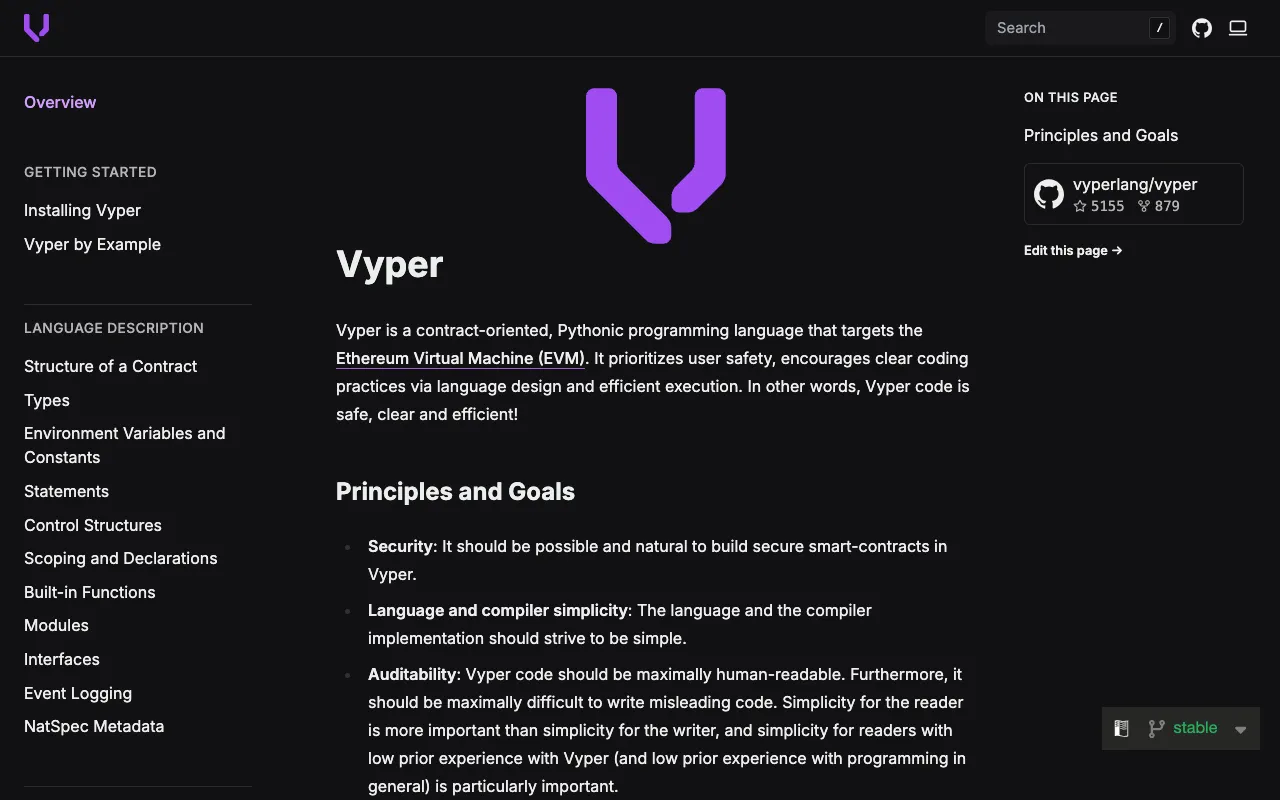
Image of Vyper – The Best Pythonic Smart Contract Language for Ethereum

Vyper – The Best Pythonic Smart Contract Language for Ethereum

Vyper is a purpose-built, contract-oriented programming language for the Ethereum Virtual Machine (EVM) that brings Python's simplicity and readability to blockchain development. Designed with security as its core principle, Vyper offers developers a cleaner, more auditable alternative to Solidity for writing secure smart contracts. As a top tool for blockchain developers, it eliminates complexity, reduces attack surfaces, and enforces best practices by design, making it an excellent choice for DeFi protocols, NFTs, DAOs, and any application where security is non-negotiable.

What is the Vyper Programming Language?

Vyper is a statically-typed, high-level programming language specifically created for writing smart contracts on the Ethereum blockchain and other EVM-compatible networks. Its primary design philosophy centers on security and simplicity, drawing heavy inspiration from Python's syntax to lower the barrier to entry for developers. Unlike more feature-rich languages, Vyper intentionally limits complexity—it has no inheritance, no function overloading, and no recursive calling—to create contracts that are easier to read, audit, and reason about. This makes it a powerful tool for developers who prioritize security, transparency, and reducing the risk of costly vulnerabilities in their decentralized applications.

Key Features of Vyper for Ethereum Development

Pythonic Syntax and Readability

Vyper's syntax is familiar and clean, closely resembling Python. This drastically improves code readability and maintainability, allowing developers and auditors to understand contract logic quickly. The reduced cognitive load minimizes errors and makes the language accessible to a broader range of programmers.

Security-First Design Philosophy

Security isn't an afterthought in Vyper; it's the foundation. The language removes dangerous features like unlimited loops, recursion, and modifier overuse that are common sources of bugs in Solidity. This built-in protection helps prevent entire classes of vulnerabilities like reentrancy attacks and gas limit issues by design.

Strong Typing and Bounds Checking

Vyper enforces strong typing and includes automatic bounds checking for arrays and integer arithmetic. This prevents common errors such as integer overflows and underflows, which have led to significant financial losses in other smart contract languages, providing a safer development environment out of the box.

Superior Auditability and Transparency

With its emphasis on simplicity and explicit code, Vyper produces smart contracts that are inherently more transparent. The lack of hidden behaviors and complex inheritance chains means the contract's actions are clear, making security audits more straightforward, thorough, and reliable.

Who Should Use Vyper for Smart Contract Development?

Vyper is ideal for blockchain developers, security engineers, and projects where contract safety is the top priority. It's perfectly suited for teams building high-value DeFi protocols, governance systems, secure token contracts, and transparent DAOs. Python developers looking to transition into Web3 will find Vyper exceptionally approachable. Furthermore, enterprises and institutions requiring the highest standards of auditability for their blockchain solutions will benefit from Vyper's enforced clarity and reduced attack surface.

Vyper Pricing and Free Tier

Vyper is completely free and open-source software. There are no licensing fees, subscription costs, or paid tiers. As a public good for the Ethereum ecosystem, it is developed openly and can be used by anyone to build, deploy, and interact with smart contracts without any cost barrier. The official compiler and extensive documentation are available for free, making professional-grade smart contract development accessible to all developers.

Common Use Cases

Key Benefits

Pros & Cons

Pros

  • Unmatched focus on security and prevention of common smart contract bugs
  • High code readability and maintainability familiar to Python developers
  • Completely free and open-source with strong community and documentation
  • Produces smaller, more gas-efficient bytecode in many cases compared to Solidity

Cons

  • Smaller ecosystem and fewer learning resources compared to Solidity
  • Limited language features by design (no inheritance, few built-in functions) can restrict complex designs
  • Younger tooling and less third-party framework support

Frequently Asked Questions

Is Vyper free to use?

Yes, Vyper is completely free and open-source. There are no costs associated with using the Vyper language, its compiler, or its tooling to write, compile, or deploy smart contracts on Ethereum or other EVM-compatible blockchains.

Is Vyper better than Solidity for Ethereum development?

Vyper is not universally 'better,' but it is superior for specific use cases. If your top priority is security, auditability, and simplicity, Vyper is an excellent choice. It enforces safer coding patterns by design. Solidity has a larger ecosystem and more features, which is beneficial for complex applications. The best choice depends on your project's security requirements and team expertise.

Can I use Vyper for NFTs?

Absolutely. Vyper is well-suited for creating secure NFT (ERC-721) and fungible token (ERC-20) contracts. Its security features help protect valuable digital assets from exploits. Several high-profile NFT projects use Vyper to ensure the integrity and safety of their collections.

What blockchains support Vyper smart contracts?

Vyper compiles to EVM bytecode, meaning it is compatible with any blockchain that supports the Ethereum Virtual Machine. This includes Ethereum Mainnet, Layer 2 solutions like Arbitrum and Optimism, and other EVM chains like Polygon, Avalanche C-Chain, BNB Smart Chain, and Fantom.

Conclusion

For blockchain developers who refuse to compromise on security, Vyper stands out as a premier smart contract language. Its Pythonic elegance, combined with a ruthless focus on eliminating dangerous coding patterns, makes it a powerful tool for building the next generation of secure, transparent, and reliable decentralized applications. While it may sacrifice some flexibility for safety, this trade-off is precisely what makes it the optimal choice for high-stakes DeFi, governance, and asset contracts. If your goal is to write smart contracts that are as secure and understandable as possible, Vyper from NutterTools.dev is an essential addition to your Web3 development toolkit.