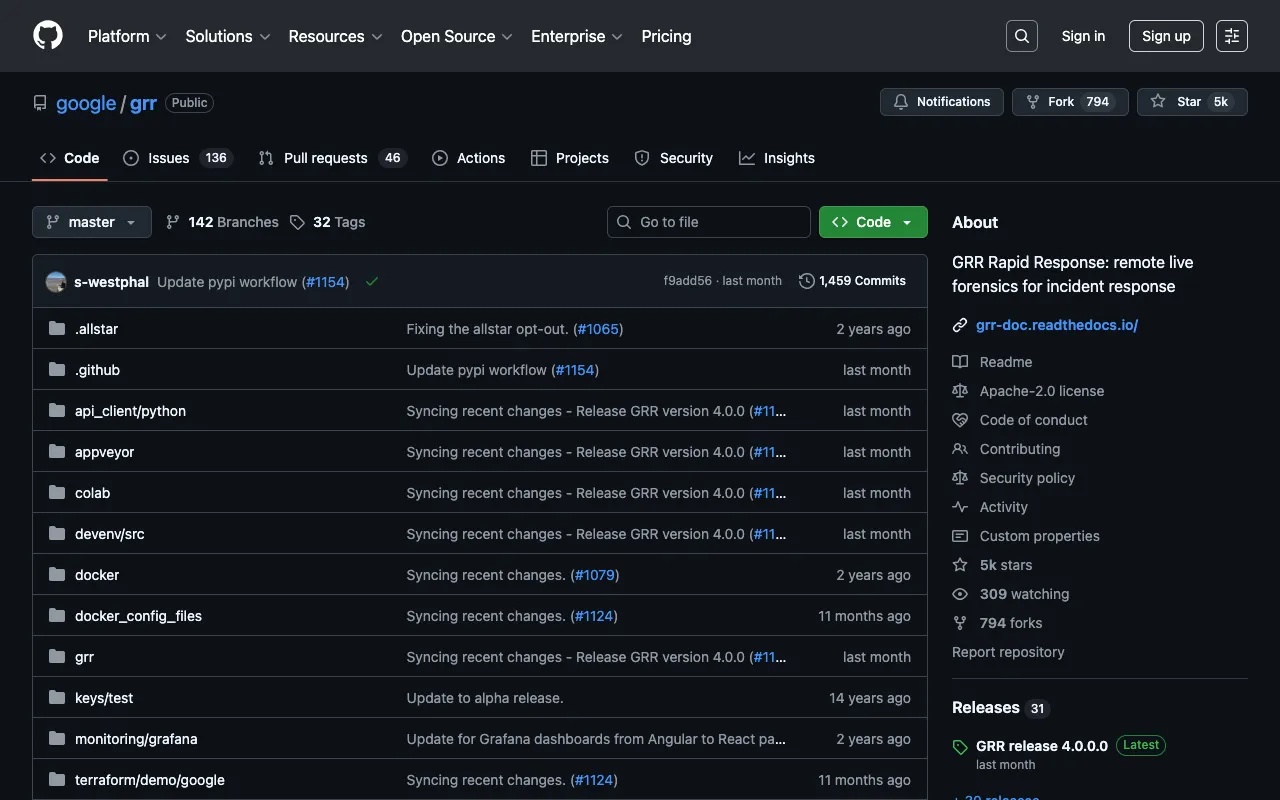
GRR Rapid Response – Best Remote Forensics Tool for Cybersecurity Experts
GRR Rapid Response is an enterprise-grade, open-source incident response framework developed initially by Google. Designed for cybersecurity professionals facing modern threats, it enables rapid remote live forensics at scale. Instead of manually accessing individual compromised machines, GRR allows you to interrogate thousands of endpoints simultaneously from a centralized management console, dramatically accelerating threat investigation, evidence collection, and incident containment. It is the definitive tool for teams that need to answer critical security questions across a vast digital estate.
What is GRR Rapid Response?
GRR Rapid Response is a powerful, client-server framework built specifically for remote forensic live response. At its core, GRR deploys lightweight agents (clients) on target systems—whether workstations, servers, or cloud instances. These agents communicate with a central GRR server, which security analysts use to schedule and manage forensic collection jobs. This architecture allows experts to perform detailed investigations—like examining memory, analyzing running processes, hunting for specific files or registry keys, and collecting system artifacts—without requiring physical access to the machines or disrupting normal business operations. It transforms incident response from a slow, sequential process into a parallel, scalable operation.
Key Features of GRR Rapid Response
Scalable Remote Interrogation
GRR's primary strength is its ability to interact with a massive number of systems concurrently. You can target an entire fleet or a specific subset with a single command, collecting forensic data in parallel. This is essential for understanding the scope of a breach or hunting for indicators of compromise (IOCs) across your organization efficiently.
Live Forensics Capabilities
Go beyond static disk analysis. GRR performs live forensics, allowing you to collect volatile data from memory, enumerate network connections, list running processes and loaded DLLs, and examine system state in real-time. This is critical for detecting fileless malware, advanced persistent threats (APTs), and understanding attacker activity that leaves no trace on disk.
Flexible Artifact Collection
GRR uses a powerful artifact system to define what data to collect. You can gather standard forensic artifacts (like browser history, prefetch files, event logs) or create custom collections tailored to your investigation. Data is streamed back to the server for centralized analysis, maintaining chain of custody.
Centralized Management & Analysis
All communication flows through the GRR server, which provides a web-based user interface (UI) and API. Analysts can manage clients, launch flows (investigative actions), and analyze collected files and data all in one place, facilitating collaboration and streamlining the investigation workflow.
Who Should Use GRR Rapid Response?
GRR is designed for professional cybersecurity teams in medium to large enterprises, Managed Security Service Providers (MSSPs), and government agencies. It is ideal for Security Operations Center (SOC) analysts, Incident Response (IR) team members, digital forensics investigators, and threat hunters. If your role involves investigating security alerts, responding to breaches, performing compromise assessments, or hunting for malicious activity across hundreds or thousands of endpoints, GRR provides the scalable toolkit you need. It is less suited for individual home users or very small businesses with only a handful of machines.
GRR Rapid Response Pricing and Free Tier
GRR Rapid Response is completely open-source and free to use, released under the Apache License 2.0. There is no cost for the software itself, making it an incredibly powerful and accessible option for organizations of any size. The 'cost' involves the infrastructure to host the GRR server and the time & expertise required for deployment, configuration, and maintenance. For organizations needing enterprise support, managed services, or additional features, commercial offerings and professional services are available from various cybersecurity firms that specialize in GRR deployments.
Common Use Cases
- Rapid triage and investigation of a widespread ransomware infection across corporate network
- Hunting for lateral movement evidence and persistence mechanisms after initial access detection
- Conducting a proactive compromise assessment across all cloud servers and endpoints
Key Benefits
- Drastically reduces Mean Time to Respond (MTTR) by enabling parallel forensic data collection
- Provides centralized visibility and evidence management for complex incident investigations
- Eliminates the need for disruptive on-site imaging or manual access to every affected system
Pros & Cons
Pros
- Powerful, scalable architecture proven by Google and large enterprises
- Completely free and open-source with no licensing fees
- Specializes in remote live forensics, a critical capability for modern IR
- Highly flexible and extensible artifact collection system
Cons
- Requires significant expertise and effort to deploy and configure properly
- Infrastructure overhead for managing the server and client communications
- Steeper learning curve compared to simpler, point-and-click forensic tools
Frequently Asked Questions
Is GRR Rapid Response free to use?
Yes, GRR Rapid Response is 100% free and open-source software released under the Apache 2.0 license. You can download, use, and modify it without any cost. Organizations only need to cover their own infrastructure and operational costs.
Is GRR Rapid Response good for enterprise cybersecurity?
Absolutely. GRR is specifically engineered for enterprise-scale incident response. Its ability to perform remote live forensics on thousands of systems simultaneously makes it an indispensable tool for large-scale breach investigations, proactive threat hunting, and compliance-driven forensic audits in complex IT environments.
How does GRR compare to commercial EDR tools?
GRR is a focused incident response and forensic collection framework, while many commercial Endpoint Detection and Response (EDR) tools include broader features like real-time behavioral blocking and managed threat intelligence. GRR excels at deep, targeted forensic interrogation and can be used alongside EDR for enhanced investigation capabilities. It offers unparalleled control and depth for forensic specialists.
Conclusion
For cybersecurity experts tasked with defending large, distributed networks, GRR Rapid Response is not just a tool—it's a force multiplier. It addresses the fundamental challenge of scale in digital forensics, turning days of manual investigation into hours of automated, parallel analysis. While it demands technical investment, no other open-source solution delivers the same level of powerful, scalable remote live forensics. If your mission requires answering 'what happened' across thousands of endpoints during a critical security incident, GRR Rapid Response is an essential component of your professional toolkit.