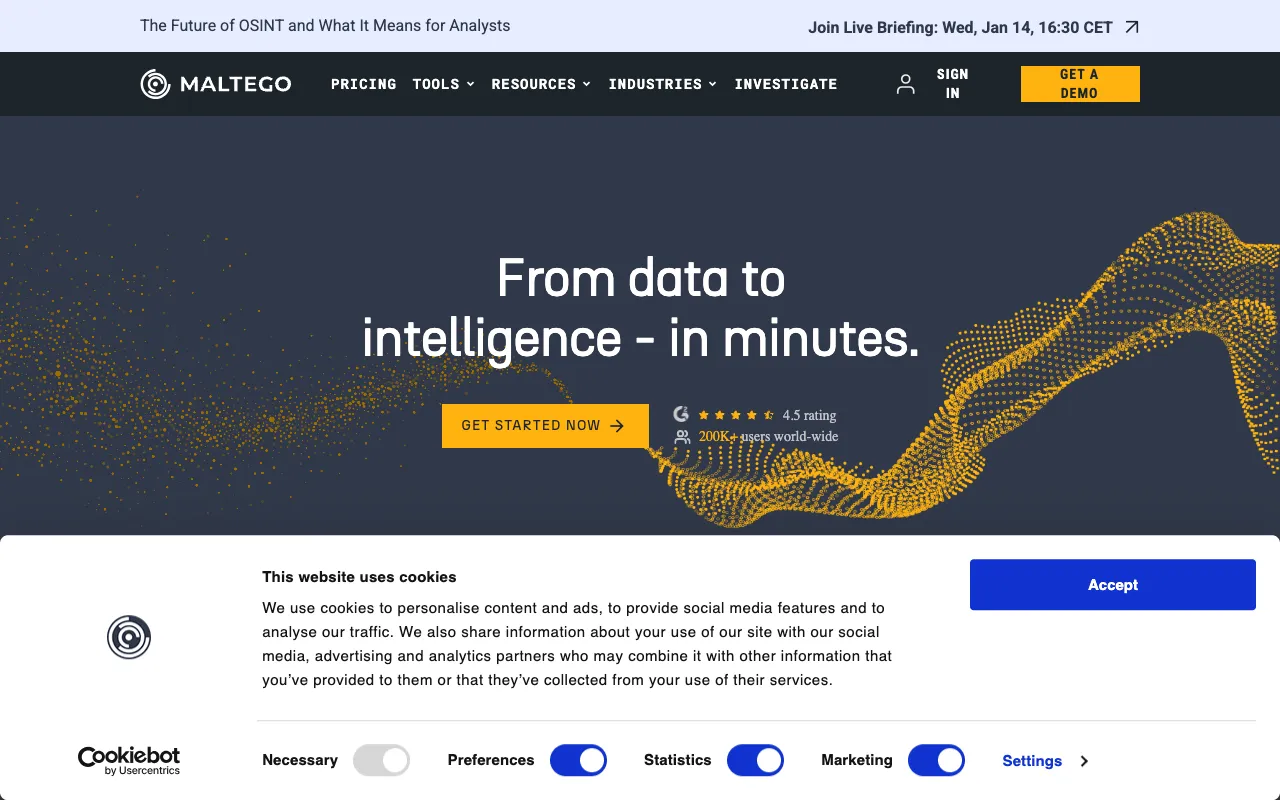
Maltego – The Leading Interactive Data Mining Tool for Cybersecurity Investigations
Maltego is the definitive interactive data mining and link analysis platform built for cybersecurity experts, threat intelligence analysts, and digital investigators. It transforms fragmented data points—from domains and IP addresses to social media profiles and corporate infrastructure—into clear, actionable visual graphs. By mapping relationships and connections across the open, deep, and dark web, Maltego provides unparalleled insight into attack surfaces, threat actor networks, and complex digital footprints, making it an indispensable tool for proactive defense and forensic analysis.
What is Maltego?
Maltego is a powerful desktop application for interactive data mining and link analysis, specifically engineered for cybersecurity and online investigations. Unlike traditional SIEMs or log analyzers, Maltego specializes in relationship mapping, visually rendering entities (like people, companies, websites, and digital assets) as nodes and their connections as lines in a directed graph. This graphical approach allows analysts to see the 'big picture,' uncovering hidden relationships, pivoting between data sources, and building intelligence from disparate pieces of information. It's used globally by security teams, law enforcement, and corporate investigators to perform OSINT (Open-Source Intelligence), threat hunting, and infrastructure mapping.
Key Features of Maltego
Interactive Link Analysis & Visualization
The core of Maltego is its powerful graph-based visualization engine. You can drag, drop, and connect entities to build intelligence maps dynamically. This visual pivotting allows you to follow leads intuitively, revealing patterns and connections that would be impossible to spot in spreadsheets or text logs.
Extensive Transform Hub & Data Integration
Maltego connects to a vast library of data sources through 'Transforms.' These are automated queries that pull information from public databases, social networks, threat intelligence feeds, domain registries, and more into your graph, enriching your investigation with real-time, contextual data.
Entity-Based Investigation Framework
Work with predefined entity types like Persons, Organizations, Domains, IP Addresses, and vulnerabilities. This structured approach ensures data consistency, enables automated analysis, and allows for the creation of repeatable investigation workflows and playbooks.
Collaborative Case Management
Manage complex investigations with built-in case management features. Share graphs and findings securely with team members, annotate discoveries, and maintain a clear audit trail of your investigative process, which is crucial for reporting and collaboration in security operations centers (SOCs).
Who Should Use Maltego?
Maltego is essential for security professionals who need to move beyond alert monitoring into proactive intelligence gathering. Its primary users include: Threat Intelligence Analysts building profiles on threat actors and campaigns; Security Researchers mapping attack infrastructure and exploit chains; Digital Forensics and Incident Response (DFIR) teams tracing attack origins and impact; Corporate Security personnel assessing executive digital footprints and third-party risks; and Law Enforcement agencies conducting cybercrime investigations. If your work involves connecting dots across the digital landscape, Maltego is your specialized tool.
Maltego Pricing and Free Tier
Maltego operates on a subscription-based licensing model tailored for individual professionals, teams, and large enterprises. While it does not have a permanent, feature-complete free tier, Maltego offers a fully-functional 14-day free trial for new users to evaluate the platform with access to core transforms and visualization features. Following the trial, users can choose from various plans (Maltego CE, Maltego Pro, Maltego Enterprise) that scale in data access, collaboration features, and premium transform availability. For students and educators, academic licensing options are available. Contact Maltego sales for detailed enterprise pricing and custom data integration packages.
Common Use Cases
- Mapping threat actor infrastructure and command & control (C2) servers for proactive blocking
- Conducting due diligence and digital footprint analysis on potential business partners or acquisition targets
- Investigating phishing campaigns by linking fraudulent domains, hosting IPs, and associated email addresses
- Performing attack surface discovery to identify exposed assets, subdomains, and outdated technology belonging to your organization
Key Benefits
- Accelerates threat intelligence and investigation timelines by visually automating data correlation
- Enhances investigative accuracy by revealing non-obvious connections between disparate data points
- Improves reporting and communication of complex cyber threats to both technical and non-technical stakeholders through clear visual graphs
- Centralizes intelligence gathering from dozens of sources into a single, actionable investigation platform
Pros & Cons
Pros
- Industry-standard tool with unparalleled capability for link analysis and relationship mapping in cybersecurity
- Massive and growing library of Transforms for automated data enrichment from critical sources
- Intuitive visual interface that makes complex data relationships understandable at a glance
- Strong community and professional support, with extensive documentation and use case sharing
Cons
- Steep learning curve for new users unfamiliar with graph-based analysis or specific investigation methodologies
- Advanced data sources and high-volume transforms require paid subscriptions, limiting functionality in lower-tier plans
- Primarily a desktop application, which may not suit cloud-first workflows without complementary server components
Frequently Asked Questions
Is Maltego free to use?
Maltego offers a 14-day free trial of its professional features. After the trial, a paid subscription is required for continued use. There is a community edition with limited functionality, but for professional cybersecurity work, a paid plan is necessary to access critical data transforms and collaboration tools.
Is Maltego good for OSINT (Open-Source Intelligence)?
Absolutely. Maltego is considered one of the premier OSINT tools for cybersecurity professionals. Its ability to automate queries across public data sources (social media, domain records, business registries) and visualize the results makes it exceptionally powerful for building intelligence profiles and conducting online investigations ethically and efficiently.
What is the difference between Maltego and traditional threat intelligence platforms?
Traditional threat intelligence platforms often focus on aggregating and correlating threat feeds and alerts. Maltego complements these by focusing on the investigative process. It is an interactive tool for hypothesis testing, relationship discovery, and building custom intelligence maps from the ground up, rather than just consuming pre-processed intelligence.
Can Maltego be used for penetration testing?
Yes, penetration testers and red teams frequently use Maltego in the reconnaissance phase. It is excellent for mapping a target organization's external digital footprint, discovering connected assets, identifying key personnel (for social engineering assessments), and finding potential points of entry, making it a valuable asset for comprehensive security assessments.
Conclusion
For cybersecurity experts who need to see the hidden connections within vast amounts of data, Maltego is not just a tool—it's a force multiplier. Its unique strength in interactive data mining and graphical link analysis fills a critical gap in the security toolkit, enabling proactive threat hunting, deep-dive investigations, and clear communication of complex risks. While it requires an investment in learning and licensing, the depth of insight and investigative speed it provides makes Maltego an essential platform for any serious threat intelligence, DFIR, or security research operation aiming to stay ahead of modern adversaries.