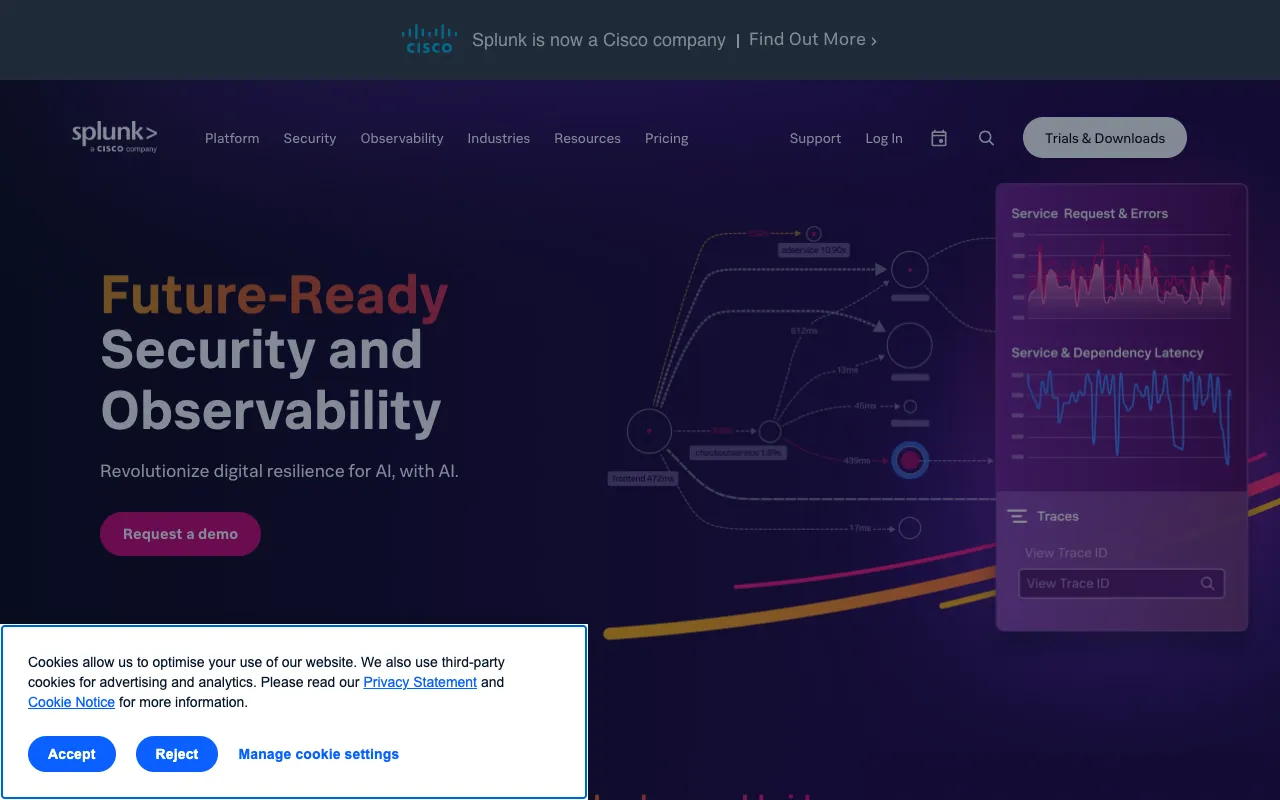
Splunk – The Leading SIEM Platform for Cybersecurity Experts
Splunk is the industry-standard Security Information and Event Management (SIEM) platform trusted by security teams worldwide to turn massive volumes of machine data into actionable security intelligence. By ingesting and correlating data from endpoints, networks, cloud environments, and applications, Splunk provides real-time visibility, advanced threat detection, and powerful forensic capabilities, empowering cybersecurity professionals to hunt for threats, investigate incidents, and automate responses at scale.
What is Splunk?
Splunk is a powerful, scalable platform designed for searching, monitoring, and analyzing machine-generated big data through a web-style interface. At its core, Splunk indexes and makes searchable any form of machine data—logs, metrics, traces, and more—from any source in your IT and security infrastructure. For cybersecurity experts, it functions as a central nervous system for Security Operations Centers (SOCs), providing the telemetry needed for security monitoring, threat hunting, compliance reporting, and operational intelligence. It transforms raw, unstructured data into coherent insights, dashboards, and alerts that drive faster, more informed security decisions.
Key Features of Splunk for Cybersecurity
Universal Data Ingestion
Splunk's core strength is its ability to ingest and index data from virtually any source—firewalls, IDS/IPS, endpoints, cloud services (AWS, Azure, GCP), applications, and custom sources. This provides a single pane of glass for all security-relevant telemetry, eliminating data silos and ensuring comprehensive visibility for threat detection and investigation.
Powerful Search Processing Language (SPL)
SPL is Splunk's proprietary search and analysis language, offering unparalleled flexibility for security analysts. It allows for complex data correlation, statistical analysis, and pattern recognition across petabytes of data. Analysts can craft precise queries to hunt for IOCs, investigate breaches, or build custom dashboards without needing deep programming skills.
Real-Time Security Monitoring & Alerting
Splunk continuously monitors ingested data against predefined correlation rules and behavioral baselines to identify potential security incidents in real-time. Customizable alerts and dashboards ensure SOC teams are immediately notified of anomalies, failed logins, malware activity, or policy violations, enabling rapid response.
Advanced Threat Detection & User Behavior Analytics (UBA)
Beyond rule-based detection, Splunk leverages machine learning and behavioral analytics through its Splunk Enterprise Security (ES) app. UBA models establish baselines for user and entity behavior, detecting insider threats, compromised accounts, and lateral movement that traditional tools might miss.
Incident Investigation & Forensic Capabilities
When an alert fires, analysts can pivot directly from the alert into a full-fledged investigation. Splunk's forensic workflows allow for timeline analysis, drill-down into raw events, and linking related incidents. This drastically reduces Mean Time to Detect (MTTD) and Mean Time to Respond (MTTR).
Automated Response (SOAR) Integration
Splunk integrates seamlessly with Security Orchestration, Automation, and Response (SOAR) platforms, including its own Splunk Phantom. This enables security teams to automate repetitive tasks, such as blocking an IP address, isolating an endpoint, or creating a service desk ticket, directly from within the Splunk interface.
Who Should Use Splunk?
Splunk is an enterprise-grade platform ideal for Security Operations Center (SOC) teams, threat hunters, incident responders, IT security managers, and compliance officers in mid-to-large organizations. It's particularly valuable for businesses in finance, healthcare, technology, and government that handle sensitive data and face stringent regulatory requirements (like GDPR, HIPAA, PCI-DSS). While powerful for solo researchers, its full potential is unlocked by dedicated security teams managing complex, hybrid infrastructures.
Splunk Pricing and Free Tier
Splunk offers a flexible, consumption-based pricing model primarily based on daily data ingestion volume. For smaller teams or proof-of-concept projects, Splunk provides a robust **Free Tier**. This free plan includes full platform functionality but limits daily indexing to 500MB and offers basic support. It's an excellent way for cybersecurity professionals to explore SPL, build prototypes, or monitor a small environment. For production use, paid plans (Splunk Enterprise, Splunk Cloud, and the security-specific Splunk Enterprise Security) scale to meet the needs of the largest global enterprises.
Common Use Cases
- Real-time security event monitoring and log management for SOC teams
- Threat hunting and investigation of advanced persistent threats (APTs)
- Compliance auditing and reporting for regulations like PCI-DSS and SOX
- User and Entity Behavior Analytics (UEBA) to detect insider threats
- Cloud security monitoring across AWS, Azure, and Google Cloud Platform
Key Benefits
- Achieve complete visibility across on-premises, hybrid, and multi-cloud environments from a single platform.
- Reduce incident investigation time from hours to minutes with powerful search and correlation capabilities.
- Improve security posture and meet compliance mandates with automated, auditable reporting.
- Scale security operations efficiently to handle exponential data growth without performance loss.
- Empower security analysts with a flexible, powerful tool that adapts to evolving threat landscapes.
Pros & Cons
Pros
- Unmatched flexibility and power for searching and correlating diverse machine data.
- Vast ecosystem of pre-built security apps and integrations (Splunkbase).
- Highly scalable architecture capable of handling petabyte-scale data ingestion.
- Industry-standard platform with a massive community and extensive professional services.
- Strong capabilities for both real-time monitoring and deep forensic analysis.
Cons
- Can have a steep learning curve, particularly for mastering the Search Processing Language (SPL).
- Total cost of ownership can be high for organizations with massive daily data volumes.
- Initial setup and configuration for optimal performance require careful planning and expertise.
Frequently Asked Questions
Is Splunk free to use?
Yes, Splunk offers a fully functional Free Tier that is ideal for learning, development, and small-scale monitoring. It includes all core features but limits daily data ingestion to 500MB. For production use with higher data volumes and enterprise support, paid licenses are required.
Is Splunk a SIEM tool?
Yes, Splunk is widely recognized as a leading SIEM (Security Information and Event Management) platform, especially when used with its Splunk Enterprise Security (ES) application. It provides log management, real-time monitoring, correlation, alerting, and incident investigation—all core SIEM functionalities.
What is the difference between Splunk and Splunk Enterprise Security?
Splunk (often referring to Splunk Enterprise or Splunk Cloud) is the core data platform that ingests and indexes data. Splunk Enterprise Security (ES) is a premium security-specific application that runs on top of the core platform. ES adds advanced security features like correlated event analysis, threat intelligence management, adaptive response actions, and glass tables designed specifically for SOC workflows.
How does Splunk help with threat hunting?
Splunk empowers threat hunters by providing a centralized repository of all machine data and a powerful search language (SPL). Hunters can proactively search for Indicators of Compromise (IOCs), craft queries based on TTPs (Tactics, Techniques, and Procedures), analyze behavioral anomalies, and pivot across data sources to uncover hidden threats that evade automated detection rules.
Conclusion
For cybersecurity professionals tasked with defending complex digital environments, Splunk remains the gold standard for security analytics and operational intelligence. Its unparalleled data ingestion capabilities, powerful search language, and mature ecosystem make it an indispensable tool for any serious Security Operations Center. While the platform demands investment in both learning and licensing, the return in terms of improved visibility, faster detection, and more efficient incident response is substantial. If your organization's security strategy requires a scalable, flexible, and powerful central nervous system for all machine data, Splunk is the definitive choice.