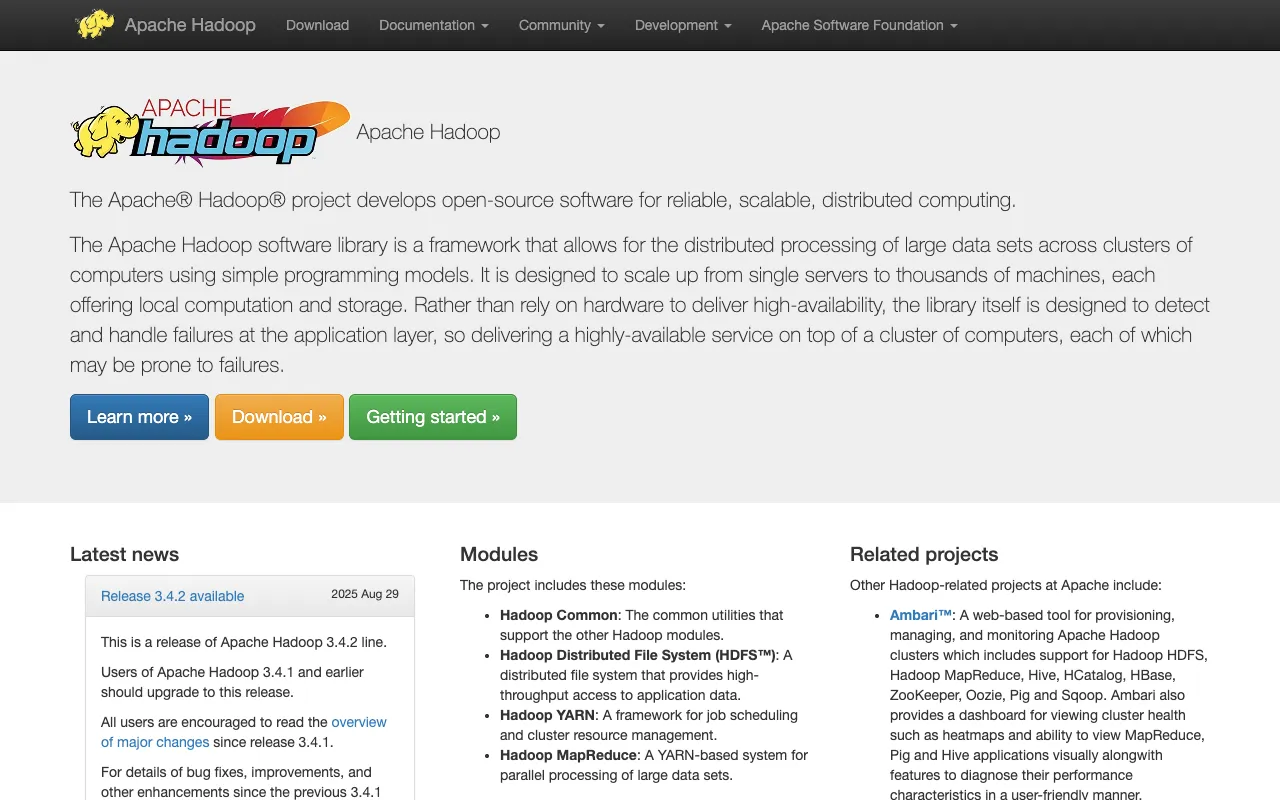
Apache Hadoop – Best Distributed Data Processing Framework for Data Scientists
Apache Hadoop is the foundational open-source framework that revolutionized big data processing. Designed to handle petabytes of data across clusters of computers, it provides data scientists, engineers, and analysts with a reliable, scalable system for distributed storage and computation. By breaking down massive data processing tasks into smaller, parallel jobs, Hadoop makes it feasible and cost-effective to derive insights from data that was previously too large or complex to manage with traditional databases.
What is Apache Hadoop?
Apache Hadoop is an open-source software framework built for distributed processing of extremely large datasets across clusters of commodity servers. Its core design principle is to scale out horizontally, meaning you can add more standard machines to a cluster to increase processing power and storage capacity linearly. Hadoop abstracts the complexity of distributed computing, allowing developers and data scientists to write programs using simple models like MapReduce, while the framework handles task scheduling, fault tolerance, and data distribution across the network. It is the cornerstone of the modern big data ecosystem, enabling the storage, processing, and analysis of data at an unprecedented scale.
Key Features of Apache Hadoop
Hadoop Distributed File System (HDFS)
HDFS is Hadoop's primary storage system. It splits large files into blocks and distributes them across the nodes in a cluster, providing high-throughput access to application data. Its fault-tolerant design automatically replicates data blocks on multiple machines, ensuring data is not lost if a node fails. This makes HDFS ideal for storing very large files and streaming data access patterns common in big data workloads.
Yet Another Resource Negotiator (YARN)
YARN is Hadoop's cluster resource management layer. It acts as an operating system for the cluster, managing compute resources and scheduling tasks across all nodes. YARN allows multiple data processing engines like MapReduce, Apache Spark, and Apache Tez to run on the same Hadoop cluster, enabling a versatile and efficient multi-workload environment.
MapReduce Programming Model
MapReduce is Hadoop's original processing engine, a simple yet powerful programming model for parallel data processing. It works in two phases: the 'Map' phase filters and sorts data, and the 'Reduce' phase performs a summary operation. This model allows developers to write code that can process vast amounts of data in parallel across thousands of nodes, abstracting away the challenges of distributed systems like fault tolerance and network communication.
Fault Tolerance and High Availability
Hadoop is designed with hardware failure as a norm, not an exception. Its architecture automatically detects and handles failures at the application layer. Data replication in HDFS and the re-execution of failed tasks in MapReduce ensure that jobs complete successfully even if individual servers or network components fail, providing exceptional reliability for long-running analytics jobs.
Who Should Use Apache Hadoop?
Apache Hadoop is essential for organizations and professionals who work with data volumes beyond the capacity of traditional relational databases. Primary users include: Data Scientists and Analysts needing to run complex algorithms on massive datasets for machine learning and predictive analytics. Data Engineers building and maintaining large-scale data pipelines, data lakes, and ETL processes. Enterprises in sectors like finance, telecommunications, retail, and healthcare that generate terabytes of log files, transaction data, or sensor data daily. Developers and Architects designing scalable backend systems for applications that require batch processing of large historical datasets.
Apache Hadoop Pricing and Free Tier
Apache Hadoop is a 100% free and open-source framework released under the Apache License 2.0. There is no cost for the software itself, and its free tier is effectively unlimited—you can download, use, and modify it for any purpose, including commercial deployment. The primary costs associated with Hadoop are operational: the commodity hardware for your cluster, cloud infrastructure costs if running on services like AWS EMR or Google Dataproc, and the personnel required for cluster administration and development. This open-source model has made it the most accessible platform for embarking on big data projects.
Common Use Cases
- Building a scalable data lake for centralized enterprise data storage
- Performing batch ETL processing on multi-terabyte log files
- Running large-scale data mining and machine learning algorithms on historical data
Key Benefits
- Enables cost-effective analysis of data at a petabyte scale using inexpensive hardware.
- Provides a highly resilient system where processing jobs continue despite individual machine failures.
- Offers a flexible ecosystem that supports a wide range of data processing tools and frameworks beyond MapReduce.
Pros & Cons
Pros
- Unmatched scalability for batch processing of enormous datasets.
- Proven fault tolerance ensures high reliability for critical data jobs.
- Vibrant open-source ecosystem with extensive tooling and community support.
- Runs on low-cost commodity hardware, reducing infrastructure expenditure.
Cons
- Primarily optimized for batch processing, making it less suitable for real-time, low-latency analytics.
- Can have a steep learning curve for setup, tuning, and cluster administration.
- The original MapReduce model can be slower for iterative processing compared to in-memory frameworks like Spark.
Frequently Asked Questions
Is Apache Hadoop free to use?
Yes, Apache Hadoop is completely free and open-source software. You can download, use, modify, and distribute it at no cost under the Apache License. The only expenses are for the hardware or cloud infrastructure to run your clusters and the personnel to manage them.
Is Apache Hadoop good for data science?
Absolutely. Apache Hadoop is a foundational tool for data science at scale. It allows data scientists to store and process the massive datasets required for training complex machine learning models. While newer tools like Apache Spark are often used for the iterative algorithms common in data science, they frequently run on top of Hadoop's YARN and HDFS, making Hadoop a critical part of the underlying data infrastructure.
What is the difference between Hadoop and Spark?
Hadoop is primarily a distributed storage (HDFS) and batch processing (MapReduce) framework. Apache Spark is a fast, in-memory data processing engine often used for machine learning and streaming. A common architecture is to use Hadoop's HDFS for storage and YARN for resource management, while running Spark on top for faster, more complex analytics, combining the strengths of both ecosystems.
Can I run Hadoop on a single machine for learning?
Yes, Hadoop can be configured in a 'pseudo-distributed' mode on a single machine, which is ideal for learning and development. This setup runs all Hadoop daemons (NameNode, DataNode, ResourceManager) on one local machine, allowing you to experiment with HDFS and run MapReduce jobs without a multi-node cluster.
Conclusion
Apache Hadoop remains a cornerstone technology for anyone dealing with big data. Its ability to reliably store and process petabytes of information across clusters of standard hardware has democratized large-scale data analytics. For data scientists and engineers, proficiency with Hadoop's ecosystem is a valuable skill, providing the foundation upon which faster processing engines and advanced analytics are built. Whether you're building a corporate data lake or processing vast datasets for research, Hadoop offers the proven, scalable, and cost-effective platform to turn massive data into meaningful insights.