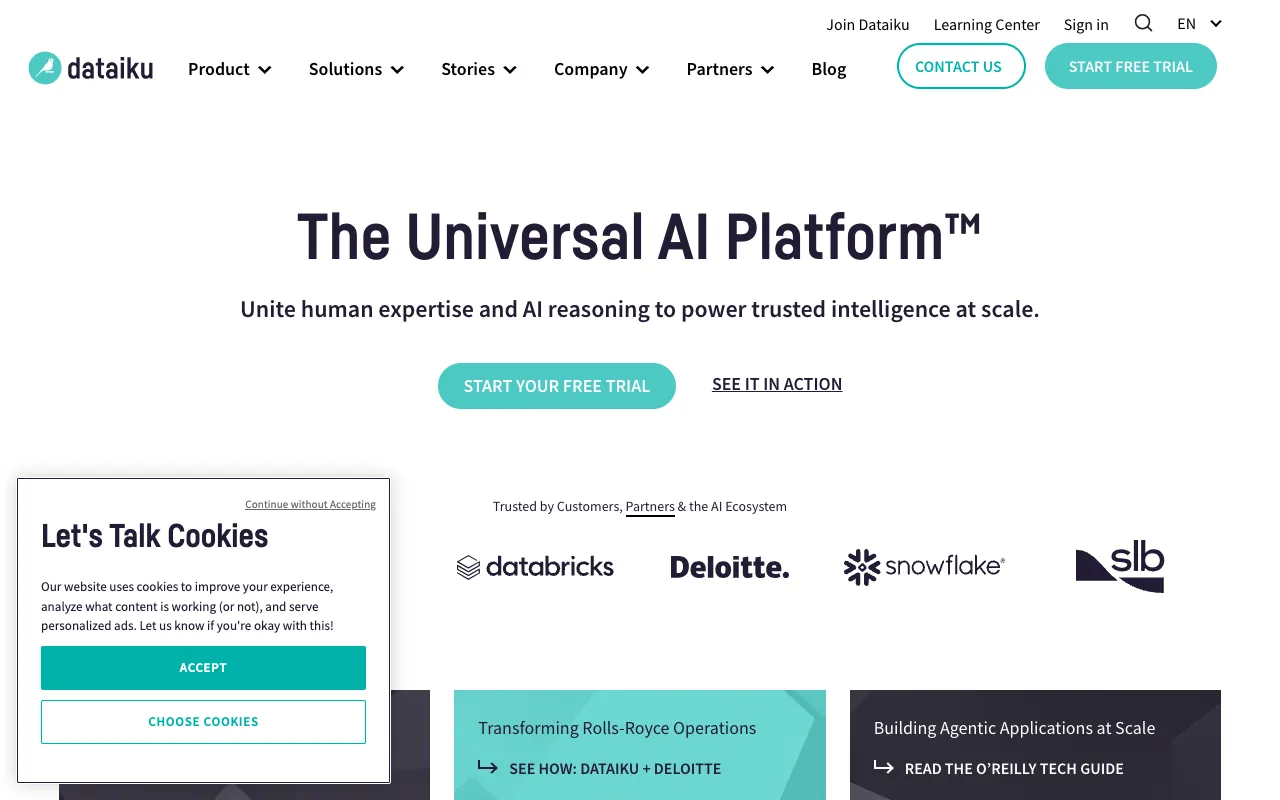
Dataiku – The Unified Platform for End-to-End Data Science
Dataiku stands out as a premier, collaborative platform designed to bridge the gap between data exploration and production machine learning. By unifying the entire data science lifecycle—from data preparation and visualization to advanced analytics, model training, and deployment—Dataiku empowers data scientists, analysts, and engineers to work together seamlessly. It's the definitive solution for organizations and individuals seeking to accelerate data projects, foster collaboration, and operationalize AI with governance and scalability.
What is Dataiku?
Dataiku is a comprehensive, end-to-end data science and AI platform that provides a single, unified environment for the complete analytics workflow. Unlike point solutions that focus on just modeling or visualization, Dataiku connects every stage: connecting to diverse data sources, performing exploratory data analysis (EDA), building and cleaning datasets, developing machine learning and statistical models, and finally deploying those models into production applications or APIs. Its core philosophy centers on collaboration, enabling mixed-skills teams (data scientists, ML engineers, analysts, business users) to contribute to projects through a shared, visual interface or code, breaking down silos and accelerating time-to-value.
Key Features of Dataiku
Visual & Code-Friendly Interface
Dataiku offers a unique dual interface. Users can build entire data pipelines using intuitive drag-and-drop visual tools, perfect for prototyping and analysts. For advanced work, data scientists can seamlessly switch to code (Python, R, SQL) within notebooks or code recipes, providing full flexibility without leaving the platform. This lowers the barrier to entry while maintaining depth for experts.
End-to-End Project Lifecycle Management
The platform manages the entire project journey in one place. From the initial data connection and preparation (with over 80+ built-in data processors) to feature engineering, model training (with AutoML capabilities and integration with major ML libraries like Scikit-learn, TensorFlow, and XGBoost), validation, and finally deployment as real-time APIs, batch scoring jobs, or embedded applications. This eliminates the need to juggle multiple disparate tools.
Built-in Collaboration & Governance
Dataiku is built for team-based data science. Features like project wikis, shared code environments, visual comments, version control for datasets and models, and granular user permissions ensure transparent, reproducible, and governed workflows. Teams can track lineage, monitor model performance in production, and audit all activities, which is critical for enterprise adoption and responsible AI.
Scalable MLOps & Deployment
Moving models from experimentation to production is streamlined. Dataiku provides robust MLOps features for one-click deployment, A/B testing, monitoring model drift, performance tracking, and automated retraining pipelines. It integrates with Kubernetes, Docker, and cloud services (AWS, GCP, Azure) to deploy scalable, reliable data and AI applications.
Who Should Use Dataiku?
Dataiku is ideal for data scientists, ML engineers, data analysts, and IT teams working in collaborative environments, especially within mid-to-large enterprises. It's perfect for organizations looking to standardize their data science process, improve collaboration between business and technical teams, and efficiently operationalize a large number of machine learning models. Individual data scientists and small teams also benefit from the free tier to structure personal projects and learn end-to-end workflow management.
Dataiku Pricing and Free Tier
Dataiku operates on a subscription-based pricing model tailored to the size of the team and deployment needs (SaaS or on-premises/private cloud). Crucially, Dataiku offers a robust and fully-featured **Free Edition** for individual users and small teams. This free tier includes core platform functionality for data preparation, visualization, machine learning, and project collaboration, making it an excellent way to evaluate the platform, build prototypes, and manage personal data science projects without any initial investment.
Common Use Cases
- Building and deploying a customer churn prediction model with collaborative input from business analysts
- Creating a scalable data pipeline for real-time fraud detection in financial transactions
- Developing a unified analytics platform for supply chain optimization across multiple departments
Key Benefits
- Accelerates the end-to-end data science lifecycle by up to 10x, reducing time from idea to production.
- Enhances team productivity and model quality through built-in collaboration, versioning, and reproducibility tools.
- Reduces operational complexity and cost by consolidating multiple data science tools into a single, governed platform.
Pros & Cons
Pros
- Unifies the entire data-to-insights workflow in a single, cohesive environment.
- Excellent balance of visual tools for speed and code flexibility for depth.
- Strong enterprise features for collaboration, governance, security, and MLOps.
- Powerful free tier for individual learning and small project development.
Cons
- Can have a steeper initial learning curve compared to simpler, single-purpose tools due to its breadth.
- Pricing for full enterprise features and larger teams represents a significant investment.
Frequently Asked Questions
Is Dataiku free to use?
Yes, Dataiku offers a fully-featured Free Edition designed for individual data scientists, students, and small teams. It provides access to core data preparation, visualization, machine learning, and collaboration features, making it ideal for learning, prototyping, and managing personal projects.
Is Dataiku good for collaborative data science teams?
Absolutely. Dataiku is specifically engineered for collaboration. Its shared project environment, visual commenting, integrated wikis, and role-based permissions allow data scientists, analysts, and engineers to work together seamlessly on the same project, significantly improving communication, reproducibility, and project velocity compared to using isolated notebooks and scripts.
How does Dataiku compare to using Jupyter Notebooks and separate tools?
While Jupyter Notebooks are excellent for exploration, Dataiku provides structure, governance, and production readiness. It integrates notebook-like coding but within a managed project that includes data lineage, version control, visual pipeline orchestration, and built-in deployment tools. This prevents the 'notebook spaghetti' problem and ensures experimental work can be robustly turned into production applications.
Can Dataiku handle big data and complex machine learning?
Yes. Dataiku can connect to and process data from big data backends like Spark, Snowflake, and Databricks. For machine learning, it supports both its visual ML tools and deep integration with code-based libraries like Scikit-learn, TensorFlow, PyTorch, and H2O.ai, allowing you to build anything from simple regression models to complex deep learning architectures.
Conclusion
For data scientists and teams serious about moving beyond isolated experiments to delivering impactful, production-grade data products, Dataiku represents a top-tier choice. Its unique strength lies in unifying the fragmented data science toolkit into a single, collaborative, and governed platform. By streamlining the entire journey from raw data to deployed AI, it not only accelerates individual workflows but also transforms how organizations build and scale their data capabilities. Whether you're an individual leveraging the powerful free tier or an enterprise deploying mission-critical models, Dataiku provides the end-to-end foundation for modern, collaborative data science.