Go back
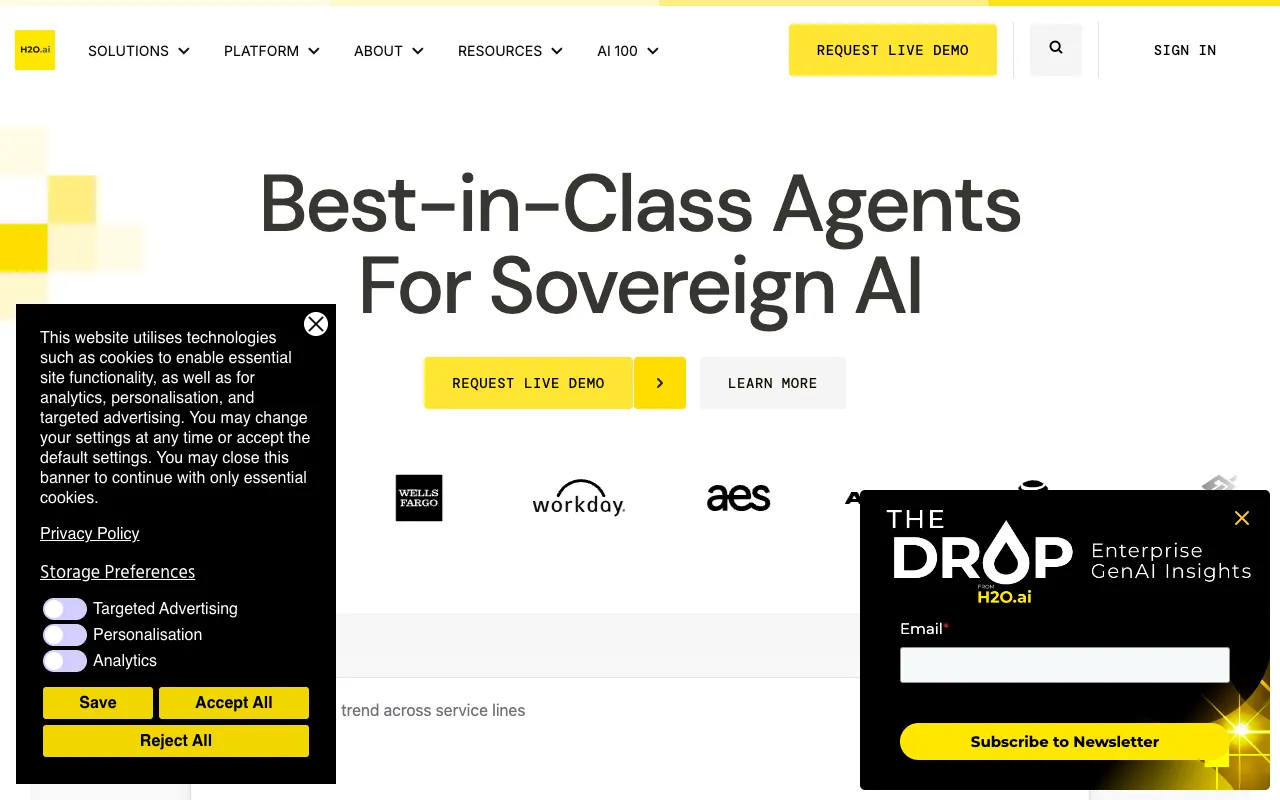
Image of H2O.ai – Best Open Source Machine Learning Platform for Data Scientists

H2O.ai – Best Open Source Machine Learning Platform for Data Scientists

H2O.ai is a powerful, open-source machine learning platform designed for data scientists and ML engineers who need to build, scale, and deploy models efficiently. Its distributed in-memory architecture provides linear scalability, handling massive datasets that overwhelm traditional tools. With native support for the most widely used statistical and machine learning algorithms, H2O.ai accelerates the journey from data exploration to production, making it a top-tier solution for modern data science teams.

What is H2O.ai?

H2O.ai is a comprehensive, open-source platform for machine learning and predictive analytics. At its core is H2O, a fast, in-memory, distributed machine learning engine that scales linearly, allowing data scientists to train models on datasets of virtually any size. It provides interfaces in Python, R, Scala, and a web-based GUI (Flow), making it accessible for diverse technical teams. Beyond the core engine, the H2O.ai ecosystem includes specialized products like Driverless AI for automated machine learning (AutoML) and Sparkling Water for integration with Apache Spark, positioning it as a full-stack solution for enterprise ML workflows.

Key Features of H2O.ai

Distributed In-Memory Processing

H2O's architecture distributes data and computation across a cluster, performing all model training in memory. This eliminates disk I/O bottlenecks and enables incredibly fast processing of terabytes of data, providing linear scalability as you add more nodes to your cluster.

Comprehensive Algorithm Library

The platform supports a vast array of supervised and unsupervised learning algorithms out-of-the-box, including Generalized Linear Models (GLM), Gradient Boosting Machines (GBM), Distributed Random Forest (DRF), Deep Learning, and more. It also includes stacked ensembles and AutoML for automated model selection and tuning.

Seamless Integration & APIs

H2O.ai integrates smoothly into existing data science workflows. Use it directly from Python via `h2o` package, R, Scala, or through Apache Spark via Sparkling Water. The H2O Flow web UI provides a notebook-like interface for interactive modeling, visualization, and collaboration without writing code.

Enterprise-Grade MLOps & Deployment

Move models from experimentation to production seamlessly. H2O supports model export in standard formats like MOJO (Model Optimized, Java Optimized) and POJO (Plain Old Java Object), enabling low-latency, scalable scoring in any Java environment, from real-time APIs to batch processes.

Who Should Use H2O.ai?

H2O.ai is ideal for data scientists, ML engineers, and analytics teams working with large-scale data who have outgrown single-machine tools like scikit-learn or R. It's perfect for enterprises in finance, insurance, healthcare, and retail that require scalable, interpretable models for risk assessment, fraud detection, customer churn prediction, and recommendation systems. Teams leveraging big data frameworks like Hadoop and Spark will find its integration capabilities particularly valuable for building end-to-end ML pipelines.

H2O.ai Pricing and Free Tier

The core H2O open-source platform is completely free to use, modify, and distribute under the Apache 2.0 license. This includes the H2O engine, Flow UI, and all core algorithms. For organizations needing advanced features like automated feature engineering, model interpretation, and managed MLOps, H2O.ai offers commercial products like Driverless AI and H2O AI Cloud with enterprise licensing and support. The robust free tier makes H2O.ai an accessible entry point for startups, academic institutions, and any team beginning their scalable machine learning journey.

Common Use Cases

Key Benefits

Pros & Cons

Pros

  • True linear scalability for handling massive datasets beyond the memory of a single machine
  • Extensive support for popular ML algorithms and cutting-edge techniques like stacked ensembles
  • Strong community and enterprise backing, ensuring active development and reliability for production use

Cons

  • Steeper learning curve compared to simpler single-machine libraries, requiring knowledge of distributed systems
  • The open-source core lacks some automated feature engineering and MLOps features found in the paid Driverless AI product
  • Cluster setup and management adds operational overhead compared to cloud-managed ML services

Frequently Asked Questions

Is H2O.ai free to use?

Yes, the core H2O open-source machine learning platform is completely free under the Apache 2.0 license. This includes the distributed engine, Flow web interface, and all core algorithms. H2O.ai also offers commercial products with advanced capabilities for enterprises.

Is H2O.ai good for big data machine learning?

Absolutely. H2O.ai is specifically designed for big data machine learning. Its distributed in-memory architecture allows it to scale linearly across clusters, making it an excellent choice for data scientists working with datasets that are too large for traditional tools like pandas or scikit-learn.

How does H2O.ai compare to cloud ML services?

H2O.ai offers more control and can be run on-premises or in any cloud (avoiding vendor lock-in), often at a lower cost for high-volume workloads. While cloud services provide managed simplicity, H2O.ai delivers superior scalability and algorithmic flexibility for teams with the expertise to manage their own infrastructure.

What programming languages does H2O.ai support?

H2O.ai provides native APIs for Python, R, and Scala. It also offers Sparkling Water for integration with Apache Spark (Scala/Python) and a point-and-click web interface called H2O Flow, making it highly accessible for diverse data science teams.

Conclusion

For data scientists and engineering teams facing the challenges of scale, H2O.ai presents a compelling, production-ready solution. Its powerful combination of open-source accessibility, linear scalability, and extensive algorithm support bridges the gap between experimental machine learning and enterprise deployment. While it demands more infrastructure knowledge than simple libraries, the payoff is the ability to train robust models on datasets of virtually any size. If your machine learning projects are constrained by data volume or computational limits, H2O.ai is a top-tier platform to unlock the next level of predictive performance.