Go back
Image of Kaggle – The Ultimate Platform for Data Scientists & ML Practitioners

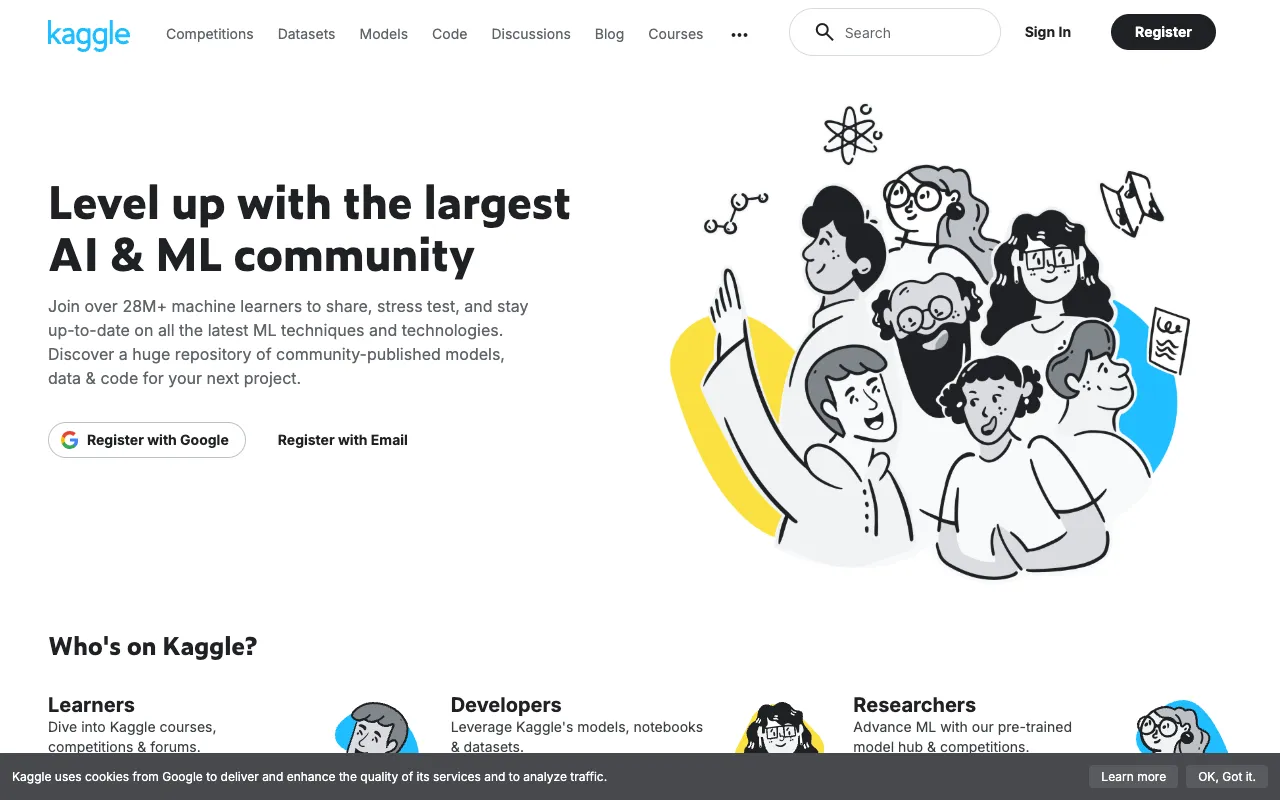
Kaggle – The Ultimate Platform for Data Scientists & ML Practitioners

Kaggle is the definitive online ecosystem for data scientists, machine learning engineers, and AI enthusiasts. It combines a massive repository of datasets, real-world machine learning competitions, collaborative cloud-based notebooks (Kaggle Notebooks), and an active community of over 8 million members. Whether you're learning data science, building a portfolio, or solving complex business problems, Kaggle provides the tools, data, and community support to succeed. It's more than a tool—it's the central hub for the global data science community.

What is Kaggle?

Kaggle is an all-in-one web platform owned by Google that serves as the premier destination for data science and machine learning. Its core mission is to democratize data science by providing free access to high-quality datasets, hosting competitive machine learning challenges with real-world impact, and offering a collaborative environment for coding and learning. It functions as a social network for coders, a portfolio builder for aspiring data scientists, and a talent pipeline for tech companies, making it indispensable for anyone serious about data-driven problem-solving.

Key Features of Kaggle

Datasets & Data Catalog

Kaggle hosts one of the largest collections of public datasets on the internet, covering topics from finance and healthcare to social media and astronomy. Each dataset is version-controlled, includes community discussions, and can be loaded directly into Kaggle Notebooks, eliminating data wrangling hassles. This feature is perfect for finding training data for ML models or exploring new domains.

Machine Learning Competitions

Kaggle competitions are world-famous for tackling complex, real-world problems posed by companies and research institutions. Participants compete for cash prizes and prestige by building the most accurate predictive models. These competitions provide unparalleled hands-on experience, from feature engineering to model stacking, and are a proven way to gain recognition in the field.

Kaggle Notebooks (Cloud-Based IDE)

Kaggle Notebooks is a free, zero-setup Jupyter notebook environment that runs in your browser. It comes pre-installed with major data science libraries (like pandas, scikit-learn, TensorFlow, PyTorch) and includes free GPU and TPU acceleration. This allows for seamless experimentation, collaboration, and sharing of complete analysis and model code.

Courses & Learning Paths (Kaggle Learn)

Kaggle Learn offers concise, hands-on micro-courses on essential data science topics like Python, Pandas, Data Visualization, Machine Learning, and Deep Learning. These free courses are designed for practical application, with coding exercises run directly in the browser, making it ideal for beginners and professionals looking to upskill efficiently.

Community & Collaboration

At its heart, Kaggle is a collaborative community. Users can fork and upvote notebooks, participate in dataset and competition discussions, form teams, and learn from publicly shared code. This open-source ethos accelerates learning and fosters innovation, allowing you to see how top performers approach problems.

Who Should Use Kaggle?

Kaggle is essential for a wide range of users within the data science spectrum. **Aspiring Data Scientists and Students** use it to learn skills, build a project portfolio, and participate in competitions to gain practical experience. **Professional Data Scientists & ML Engineers** leverage it to benchmark models, find novel datasets, and stay sharp by competing with peers. **Researchers & Academics** utilize it to share reproducible research and access public data. **Companies and Organizations** host competitions on Kaggle to crowdsource innovative solutions to challenging problems and recruit top talent from the community.

Kaggle Pricing and Free Tier

Kaggle's core platform is **completely free to use**. There is no charge for accessing datasets, entering competitions, using Kaggle Notebooks with free GPU/TPU quotas, taking Kaggle Learn courses, or participating in the community. This freemium model, backed by Google, makes professional-grade data science tools accessible to everyone. Some enterprise-level features or very high compute usage may have associated costs, but for the vast majority of individual users and learners, Kaggle remains a 100% free resource.

Common Use Cases

Key Benefits

Pros & Cons

Pros

  • Entirely free core platform with generous compute resources.
  • Unparalleled access to real-world datasets and business problems.
  • Strong community support and collaborative learning environment.
  • Excellent tool for building a demonstrable data science portfolio.
  • Seamless integration of datasets, notebooks, and competitions in one place.

Cons

  • The competitive environment can be intense for absolute beginners.
  • Notebook compute resources, while free, have usage limits for GPU/TPU.
  • Primarily focused on the Python ecosystem, with less support for other languages like R.
  • As a web platform, it requires an internet connection for full functionality.

Frequently Asked Questions

Is Kaggle completely free to use?

Yes, Kaggle is completely free for its core features. You can access all datasets, enter all competitions, use Kaggle Notebooks with free GPU/TPU hours, complete all Kaggle Learn courses, and participate in the community at no cost. It is one of the most generous free tiers in data science.

Is Kaggle good for beginners in data science?

Absolutely. Kaggle is excellent for beginners. Start with the structured, interactive courses on Kaggle Learn to build foundational skills. Then, explore datasets and public notebooks to see code in action. Participating in beginner-friendly competitions or working on personal projects using Kaggle datasets is a powerful way to learn by doing in a supportive environment.

How do Kaggle competitions help data scientists?

Kaggle competitions provide practical, high-stakes experience with real-world data and problems. They force you to master the full ML pipeline: data cleaning, feature engineering, model selection, and hyperparameter tuning. Success in competitions demonstrates proven skill to employers, and the collaborative discussions are a masterclass in advanced techniques.

Can I use Kaggle to get a job in data science?

Yes, a strong Kaggle profile is highly valued in the data science job market. High competition rankings (like Kaggle Master or Grandmaster) are prestigious. More importantly, a profile filled with well-documented notebooks on diverse projects serves as a dynamic, hands-on portfolio that showcases your coding, analysis, and communication skills better than any resume.

Conclusion

For any data scientist—from student to seasoned professional—Kaggle is a non-negotiable resource. It successfully consolidates the essential pillars of the discipline: data, tools, education, and community, all at the accessible price of free. While other platforms may offer isolated components, Kaggle's integrated ecosystem is unmatched for practical learning, portfolio development, and engaging with cutting-edge machine learning challenges. If your goal is to learn, practice, compete, or collaborate in data science, your journey should begin on Kaggle.