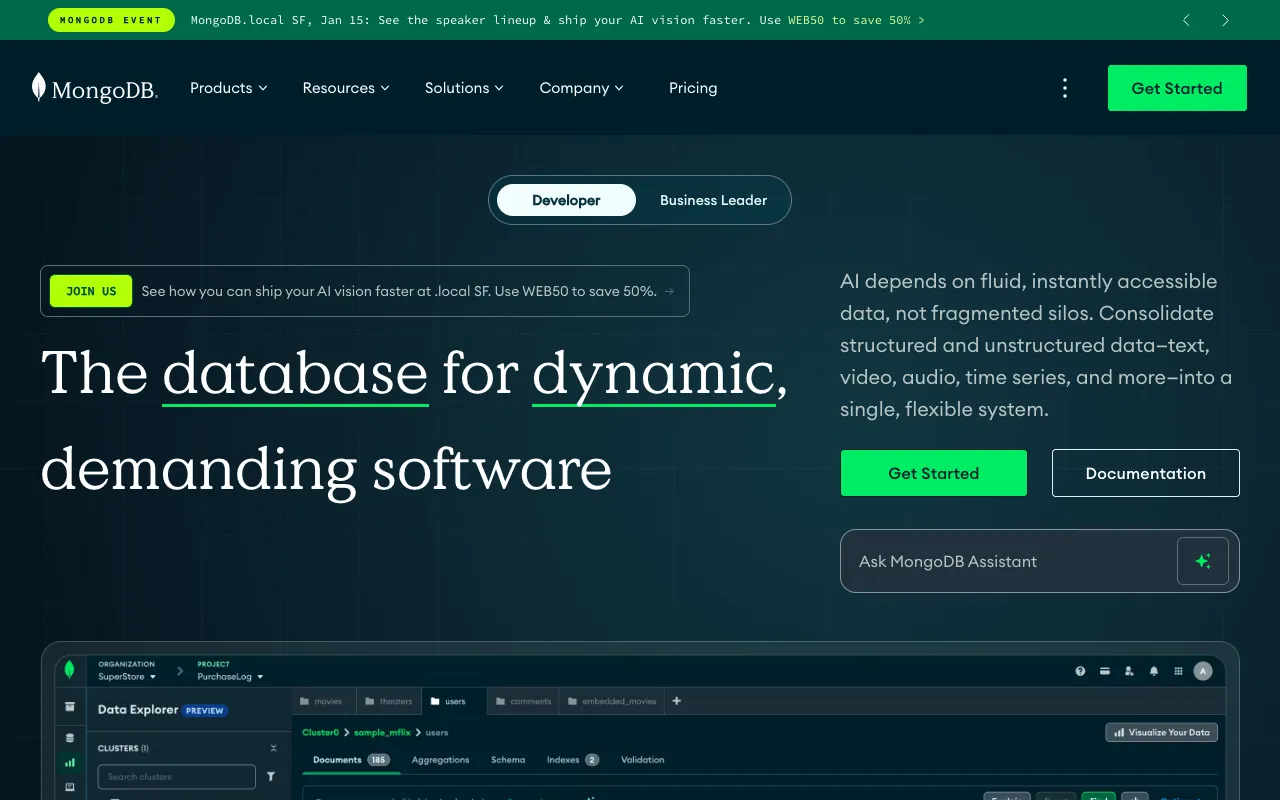
MongoDB – The Essential NoSQL Database for Data Scientists
In the world of data science, where information comes in varied, complex, and often unstructured formats, traditional relational databases can be a bottleneck. MongoDB emerges as the definitive solution—a powerful, document-oriented NoSQL database built for scale, flexibility, and developer productivity. It empowers data scientists to store, query, and analyze diverse data types—from JSON-like documents and time-series data to geospatial information—without the constraints of a fixed schema. With its robust aggregation framework, native drivers for Python and R, and a forever-free tier, MongoDB is engineered to accelerate data exploration, feature engineering, and model deployment, making it a cornerstone of the modern data stack.
What is MongoDB?
MongoDB is a leading source-available, cross-platform NoSQL database that uses a flexible document data model. Instead of storing data in tables and rows like traditional SQL databases, MongoDB stores data in JSON-like documents with dynamic schemas (BSON format). This fundamental design makes it exceptionally well-suited for handling the semi-structured and unstructured data prevalent in data science, such as log files, sensor data, social media feeds, and rapidly evolving datasets. As a document database, it provides the scalability and performance needed for large-scale analytics while offering querying and indexing capabilities that feel familiar to developers and data professionals.
Key Features of MongoDB for Data Science
Flexible Document Model
Store complex, hierarchical data within a single document, closely mirroring objects in your application code. This eliminates the need for complex, multi-table joins and allows your database schema to evolve alongside your data science experiments and model requirements.
Powerful Aggregation Framework
Perform sophisticated data processing and transformation pipelines entirely within the database. The aggregation framework allows for filtering, grouping, sorting, reshaping, and computing statistics on your data, reducing the need to move large datasets into external processing engines for initial analysis.
Rich Query Language & Indexing
Query data using a powerful and expressive language that supports everything from simple lookups to complex geospatial and text searches. Support for secondary, compound, and specialized indexes (like text, geospatial, and wildcard) ensures fast query performance on large datasets, crucial for interactive data exploration.
Native Drivers for Python & R
Integrate MongoDB seamlessly into your data science workflow using the official PyMongo and mongolite drivers. These provide idiomatic interfaces for data scientists to connect, query, and manipulate data directly from Jupyter notebooks, scripts, and production ML pipelines.
Horizontal Scalability with Sharding
Scale your database cluster horizontally by distributing data across multiple machines (sharding). This provides a clear path to handle massive volumes of data and high-throughput workloads common in data ingestion and real-time analytics applications.
Who Should Use MongoDB?
MongoDB is ideal for data scientists, ML engineers, and analysts working with modern, diverse data stacks. It's particularly valuable for professionals dealing with real-time data streams, IoT sensor data, content management systems, product catalogs, user profile data, and any project where the data structure is not perfectly known upfront or changes frequently. Teams building recommendation engines, fraud detection systems, or personalization platforms will find MongoDB's flexible model and powerful querying capabilities indispensable for managing the complex feature stores and user data these systems require.
MongoDB Pricing and Free Tier
MongoDB offers a generous and fully-featured free tier called MongoDB Atlas, its managed cloud database service. The Atlas Free Tier provides a shared cluster with 512 MB to 5 GB of storage, perfect for learning, developing, and deploying small applications. For production workloads, paid tiers start with dedicated clusters offering higher performance, more storage, advanced security features, and support. Pricing is based on a combination of cluster tier, storage, and data transfer, providing scalable options for projects of any size, from proof-of-concept to enterprise-grade deployments.
Common Use Cases
- Building a feature store for machine learning models with nested attributes
- Storing and analyzing JSON log data for system monitoring and anomaly detection
- Managing user profiles and session data for real-time recommendation systems
Key Benefits
- Accelerate development cycles by eliminating rigid schema migrations, allowing data models to adapt to your analysis.
- Improve performance for complex queries on nested data structures compared to relational databases requiring multiple joins.
- Simplify your data architecture by handling diverse data types (structured, semi-structured, unstructured) in a single, scalable platform.
Pros & Cons
Pros
- Unmatched flexibility for evolving data schemas, perfect for experimental and research-driven data science.
- Excellent performance for read and write operations on document-oriented data, especially at scale.
- Comprehensive managed service (Atlas) with a robust free tier, reducing operational overhead.
- Strong ecosystem and community support with extensive documentation and integrations.
Cons
- Lack of native joins can require application-level logic for certain relational data patterns, potentially increasing code complexity.
- Eventual consistency in default configurations may not be suitable for use cases requiring immediate, strong transactional guarantees across multiple documents.
Frequently Asked Questions
Is MongoDB free to use for data science projects?
Yes, MongoDB offers a completely free tier through its MongoDB Atlas cloud service. This tier provides a shared cluster with up to 5GB of storage, which is sufficient for learning, prototyping, and running small to medium-sized data science projects, making it an excellent cost-effective choice for students, researchers, and startups.
Is MongoDB a good database for data scientists?
Absolutely. MongoDB is an excellent database for data scientists because it directly addresses the challenge of unstructured data. Its flexible schema allows for storing raw, unprocessed data (like JSON from APIs or logs) and evolving feature sets without costly redesigns. The aggregation framework enables powerful in-database transformations, and native Python/R drivers integrate seamlessly into the data science workflow, from exploration to production.
How does MongoDB compare to SQL databases like PostgreSQL for analytics?
MongoDB and SQL databases serve different strengths. SQL databases (PostgreSQL) excel at complex queries involving multiple joins across highly structured, relational data with strong ACID guarantees. MongoDB shines with semi-structured/unstructured data, rapid iteration, and hierarchical data models. For many modern data science pipelines that ingest varied data sources, MongoDB's flexibility often leads to faster development and simpler data models, while SQL remains optimal for traditional business intelligence on cleaned, relational datasets.
Can you run machine learning models directly on MongoDB data?
While MongoDB itself is not a machine learning runtime, it is an optimal data layer for ML workflows. You can use its native drivers to efficiently pull feature data from MongoDB into Python/R environments (like Pandas DataFrames or NumPy arrays) where models are trained (e.g., using scikit-learn, TensorFlow). Furthermore, you can store model outputs, user embeddings, or inference results back into MongoDB for low-latency serving in applications.
Conclusion
For data scientists navigating the complexities of modern data, MongoDB is not just another database—it's a strategic platform that aligns with the iterative, exploratory nature of the field. Its ability to seamlessly absorb diverse data formats, empower rapid prototyping with a flexible schema, and scale to meet production demands makes it an indispensable tool. Whether you're building the data backbone for a new machine learning service, analyzing real-time streams, or simply need a robust place to store evolving experimental data, MongoDB provides the performance, flexibility, and developer experience required to move from insight to impact faster. Its commitment to accessibility through a powerful free tier further cements its position as a top-tier choice for data professionals at every level.