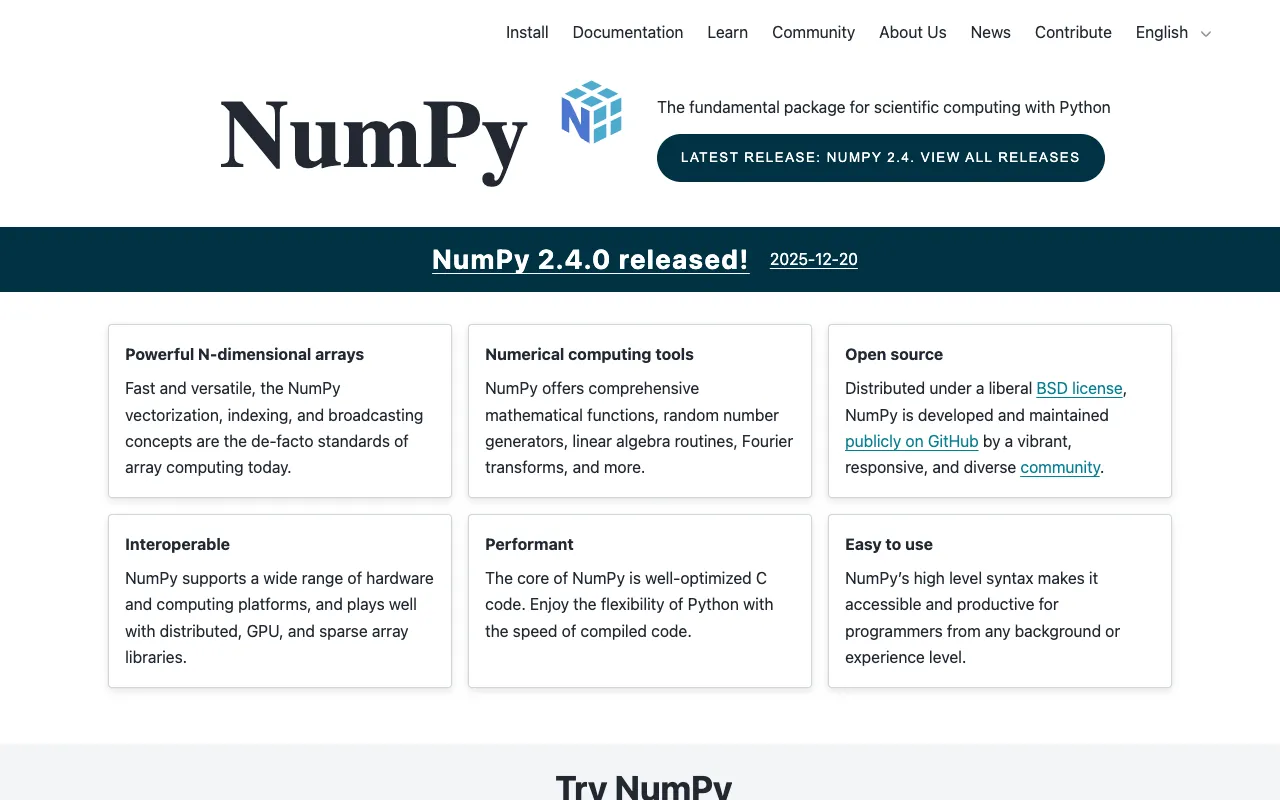
NumPy – The Foundational Python Library for Data Scientists
NumPy is the indispensable, open-source Python library that forms the bedrock of the entire scientific Python ecosystem. It provides the core data structure—the powerful, N-dimensional array object—and high-performance mathematical functions that enable fast, efficient numerical computations. For data scientists, machine learning engineers, researchers, and anyone working with numerical data in Python, mastering NumPy is non-negotiable. It's the engine behind libraries like Pandas, SciPy, scikit-learn, and TensorFlow, making it the most critical tool for anyone serious about data science and scientific computing.
What is NumPy?
NumPy (Numerical Python) is a foundational, open-source Python library designed for high-performance scientific computing and data analysis. At its heart is the `ndarray` (N-dimensional array), a fast, flexible container for large datasets. Unlike native Python lists, NumPy arrays are stored in contiguous blocks of memory, enabling vectorized operations that are executed in compiled C code. This architecture eliminates the overhead of Python loops, resulting in speed improvements of up to 100x. NumPy provides the essential building blocks for numerical work, including tools for linear algebra, Fourier transforms, random number generation, and seamless integration with C/C++ and Fortran code. It is the universal standard for array computing in Python.
Key Features of NumPy
The N-Dimensional Array (ndarray)
The `ndarray` is NumPy's core object—a homogeneous, multi-dimensional array of fixed-size items. It supports vectorized operations, broadcasting for arithmetic on arrays of different shapes, and sophisticated indexing (slicing, integer, and boolean). This structure is memory-efficient and provides the speed necessary for manipulating large datasets, making it the ideal container for numerical data, images, sound waves, or any other binary data.
Broad Mathematical Function Library
NumPy comes with a comprehensive suite of mathematical functions that operate on entire arrays without the need for explicit loops. This includes basic arithmetic, statistical operations (mean, std, var), trigonometric functions, and more complex operations like linear algebra (matrix multiplication, determinants, eigenvalues) via the `numpy.linalg` module and Fourier transforms via `numpy.fft`. These functions are optimized in C and Fortran, delivering computational speed critical for scientific research and data analysis.
Broadcasting and Vectorization
NumPy's broadcasting rules allow arithmetic operations between arrays of different shapes, intelligently expanding smaller arrays to match larger ones. Combined with vectorization—applying operations to entire arrays instead of individual elements—this feature enables you to write concise, readable, and incredibly fast code. This paradigm is fundamental to writing efficient, 'Pythonic' numerical code and is a key reason for NumPy's widespread adoption.
Seamless Interoperability
NumPy arrays serve as the universal data exchange format for the scientific Python ecosystem. Libraries like Pandas (DataFrames are built on NumPy), SciPy (advanced scientific computing), scikit-learn (machine learning), Matplotlib (visualization), and TensorFlow/PyTorch (deep learning) all use NumPy arrays as a common interface. This interoperability creates a cohesive and powerful toolchain for the entire data science workflow.
Who Should Use NumPy?
NumPy is essential for any professional or student who uses Python for numerical work. Its primary audience includes: **Data Scientists & Analysts** for data manipulation, cleaning, and statistical analysis; **Machine Learning Engineers & Researchers** for implementing algorithms and preparing training data; **Academic Researchers** in physics, biology, engineering, and finance for simulations and modeling; **Software Developers** building scientific applications or needing high-performance numerical computations; and **Students** learning the fundamentals of scientific computing, linear algebra, or data science. If your work involves numbers, arrays, or matrices in Python, you need NumPy.
NumPy Pricing and Free Tier
NumPy is a **100% free and open-source software (FOSS)** library released under a liberal BSD license. There is no paid tier, premium version, or subscription fee. It is developed and maintained by a vibrant community of volunteers and supported by institutions like NumFOCUS. You can install it for free via `pip install numpy` or as part of scientific Python distributions like Anaconda. Its free, permissive license allows unrestricted use in both academic and commercial projects, which is a key factor in its dominance as the standard for numerical computing in Python.
Common Use Cases
- Cleaning and transforming large datasets for machine learning model training
- Performing linear algebra operations for computer graphics or physics simulations
- Conducting statistical analysis and hypothesis testing on experimental data
- Implementing core numerical algorithms from scratch for educational purposes
- Processing and analyzing image or signal data using array manipulations
Key Benefits
- Massively accelerates numerical computations compared to native Python, reducing processing time from hours to minutes.
- Provides a standardized, efficient data structure (the array) that is the lingua franca for the entire Python data science stack.
- Enables writing concise, readable, and mathematically expressive code through vectorization and broadcasting.
- Offers a vast, battle-tested library of mathematical functions, eliminating the need to reinvent the wheel for common tasks.
- Facilitates seamless integration with low-level languages (C/C++/Fortran) for performance-critical code sections.
Pros & Cons
Pros
- Unmatched performance for array operations due to its C/Fortran core.
- The universal standard and prerequisite for virtually all advanced Python data science libraries.
- Extensive, well-documented API with a massive community and decades of development.
- Completely free and open-source with a permissive license for any use case.
- Excellent educational resource for understanding the fundamentals of array computing.
Cons
- The API can have a steep learning curve for beginners, especially around advanced indexing and broadcasting rules.
- Primarily focused on homogeneous numerical data; for heterogeneous tabular data, Pandas is a more convenient layer on top.
- While fast, for certain ultra-large-scale or parallel computing tasks, specialized libraries like Dask or CuPy might be necessary.
Frequently Asked Questions
Is NumPy free to use?
Yes, absolutely. NumPy is 100% free and open-source software. It is released under a BSD-style license, which allows for unrestricted use, modification, and distribution in both open-source and proprietary commercial projects. There are no costs, licensing fees, or paid tiers.
Is NumPy good for data science?
NumPy is not just good for data science—it is fundamental and essential. It is the core numerical engine of the Python data science ecosystem. Libraries like Pandas for data manipulation, scikit-learn for machine learning, and SciPy for advanced mathematics all build directly upon NumPy arrays. Proficiency in NumPy is a prerequisite for efficient and effective data science work in Python.
What is the difference between a NumPy array and a Python list?
Python lists are heterogeneous, can contain any data type, and are slow for numerical loops. NumPy arrays are homogeneous (all elements are the same type, usually a number), stored in contiguous memory, and support vectorized operations executed in compiled code. This makes NumPy arrays dramatically faster (often 10-100x) for mathematical operations on large datasets.
Do I need to know linear algebra to use NumPy?
A basic understanding of linear algebra (vectors, matrices, dot products) is extremely helpful for unlocking NumPy's full potential, especially for machine learning. However, you can start using NumPy for basic array creation, slicing, and arithmetic without deep linear algebra knowledge. As you progress, learning the concepts alongside NumPy's implementation is a powerful way to master both.
Conclusion
For anyone working with numerical data in Python, NumPy is not merely a library—it is the essential infrastructure. Its combination of raw speed, a powerful and expressive array object, and its role as the foundational layer for the entire scientific Python stack makes it irreplaceable. While the initial learning curve focuses on its array-oriented paradigm, the payoff in code performance, clarity, and interoperability is immense. Whether you're a student, researcher, or industry professional building the next generation of data-driven applications, investing time to master NumPy is one of the highest-return decisions you can make in your data science toolkit.