Redash – Best Open Source BI Tool for Data Scientists & Teams
Redash is a powerful, open-source business intelligence (BI) and data visualization platform designed to democratize data access. It empowers data scientists, analysts, and entire teams to connect to any data source, write SQL and NoSQL queries, build interactive dashboards, and share insights in real-time. By breaking down data silos, Redash makes data-driven decision-making accessible to everyone in your company, not just the technical experts.
What is Redash?
Redash is a comprehensive data collaboration platform that simplifies the workflow from data query to insight sharing. At its core, it's a web-based SQL editor with built-in visualization capabilities. Unlike monolithic, expensive BI suites, Redash focuses on agility and collaboration. It connects to a vast array of data sources—from traditional SQL databases like PostgreSQL and MySQL to modern data warehouses like BigQuery and Redshift, and even APIs and NoSQL stores. Once connected, users can create queries, transform them into charts and graphs, and compile them into shareable dashboards. Its open-source nature means you can self-host it for full control, or use their managed cloud service for convenience.
Key Features of Redash
Multi-Source Data Connectivity
Redash supports over 40+ data sources out-of-the-box, including PostgreSQL, MySQL, Amazon Redshift, Google BigQuery, Snowflake, MongoDB, and CSV uploads. This universal connectivity eliminates the need to switch between multiple tools, centralizing your data exploration in one interface.
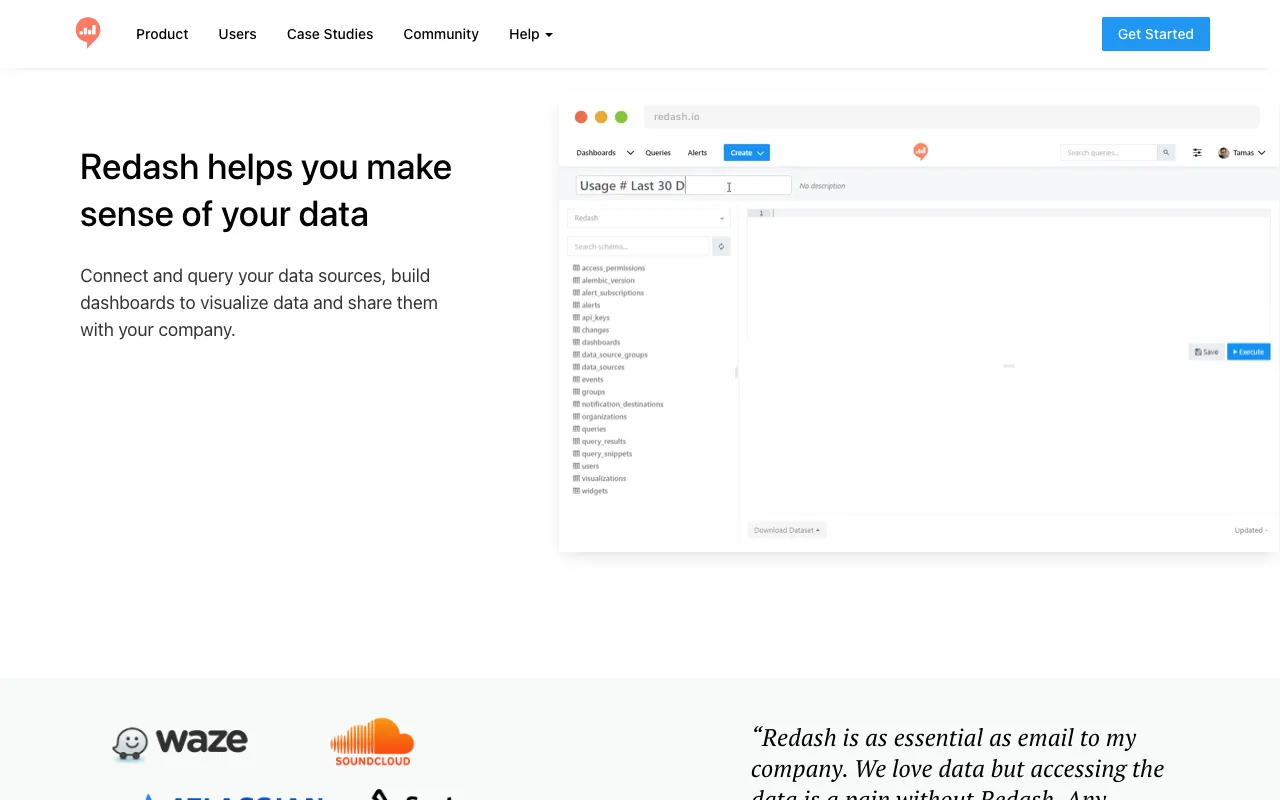
Collaborative SQL Query Editor
The heart of Redash is its browser-based query editor with syntax highlighting, auto-completion, and version history. Teams can fork, comment on, and collaboratively edit queries, fostering knowledge sharing and reducing dependency on single experts.
Interactive Dashboards & Visualizations
Transform query results into a wide variety of visualizations—line charts, bar graphs, pie charts, pivot tables, cohorts, and more. Drag-and-drop these visualizations onto dynamic dashboards that automatically refresh, providing a single source of truth for business metrics.
Scheduled Refreshes & Alerts
Automate your data workflows by scheduling queries to run and refresh dashboards at regular intervals. Set up alerts to be notified via email, Slack, or webhook when your data meets specific conditions, enabling proactive monitoring.
Granular User Permissions & Sharing
Control data access with fine-grained permissions for data sources, queries, and dashboards. Easily share insights via public links, embed dashboards in other applications (like Confluence or internal tools), or integrate with Slack for daily digests.
Who Should Use Redash?
Redash is ideal for data scientists, data analysts, product managers, and engineering teams in startups and mid-sized companies seeking a flexible, cost-effective BI solution. It's perfect for organizations that need to move faster than traditional BI tools allow, value transparency and collaboration in their data culture, and may have a mix of technical and non-technical stakeholders who need access to insights. It's particularly valuable for teams already using SQL as their primary data exploration language.
Redash Pricing and Free Tier
Redash offers a compelling 'freemium' model. The core software is 100% open-source and free to use forever. You can self-host it on your own infrastructure at no cost. For teams wanting a fully managed, hassle-free experience, Redash.io provides a cloud-hosted service starting with a generous free plan that includes up to 3 users and 5 data sources. Paid plans scale based on the number of users and offer additional features like advanced permissions, white-labeling, and priority support, making it accessible for teams of all sizes and budgets.
Common Use Cases
- Building a real-time KPI dashboard for executive reporting
- Enabling product teams to self-serve analytics without engineering help
- Creating automated data alerts for anomaly detection in marketing campaigns
- Consolidating data from multiple SaaS platforms into a single operational dashboard
Key Benefits
- Accelerates time-to-insight by centralizing querying and visualization in one tool
- Reduces costs significantly compared to proprietary enterprise BI platforms
- Fosters a data-driven culture by making insights shareable and accessible company-wide
- Provides full data sovereignty and control with the self-hosted open-source option
Pros & Cons
Pros
- Powerful open-source core with no vendor lock-in
- Extensive support for modern and legacy data sources
- Excellent for collaborative, SQL-centric teams
- Strong free tier and transparent, scalable pricing
- Easy to deploy and get started with
Cons
- Self-hosting requires technical DevOps resources for maintenance and scaling
- Advanced data modeling and ETL capabilities are limited compared to full-stack platforms
- The user interface, while functional, may feel less polished than some commercial competitors
Frequently Asked Questions
Is Redash free to use?
Yes, absolutely. The Redash software is open-source and can be self-hosted for free indefinitely. Additionally, their managed cloud service (Redash.io) offers a free plan that supports up to 3 users and 5 data sources, which is perfect for small teams or getting started.
Is Redash good for data science teams?
Redash is an excellent tool for data science teams, particularly for sharing and operationalizing insights. While data scientists may use Python/R for deep analysis, Redash excels at making the results of that analysis accessible. They can use it to publish interactive dashboards for stakeholders, set up monitoring alerts on key models, and enable other teams to explore curated datasets safely using SQL.
Can I connect Redash to Google BigQuery or Snowflake?
Yes, Redash has first-class, native support for major cloud data warehouses including Google BigQuery, Amazon Redshift, Snowflake, and Microsoft Azure SQL Data Warehouse. Setting up these connections is straightforward, allowing you to visualize and dashboard your warehouse data instantly.
How does Redash compare to tools like Metabase or Tableau?
Redash shares similarities with Metabase in being open-source and SQL-friendly, but Redash often appeals more to technical users who prefer writing SQL directly. Compared to Tableau, Redash is generally more lightweight, cost-effective, and focused on the query-to-dashboard workflow rather than complex visual data discovery. It's often chosen for its simplicity, collaboration features, and strong data source support.
Conclusion
For data scientists and teams looking to build a scalable, collaborative data culture without the high cost and complexity of enterprise BI tools, Redash presents a compelling solution. Its open-source foundation offers unparalleled flexibility and control, while its managed service provides an easy on-ramp. By effectively bridging the gap between raw data and actionable business insights, Redash empowers organizations to make faster, more informed decisions. Whether you choose to self-host or use their cloud, it's a top-tier tool for any data stack focused on accessibility and agility.