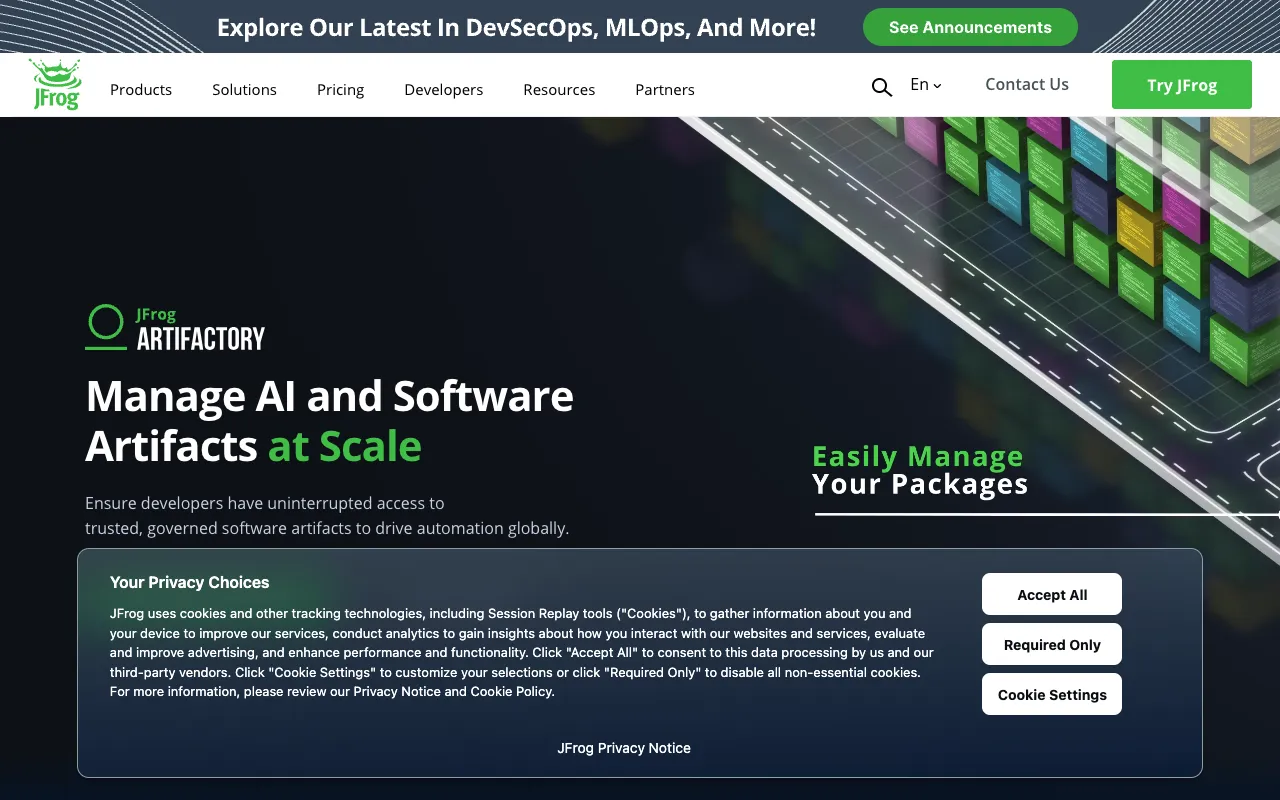
JFrog Artifactory – The Universal Binary Repository for DevOps
JFrog Artifactory stands as the industry-standard binary repository manager, purpose-built for modern DevOps and CI/CD pipelines. It acts as the single source of truth for all your build artifacts, dependencies, Docker containers, Helm charts, and Maven packages. By providing secure, centralized storage and lightning-fast distribution, Artifactory eliminates build inconsistencies, accelerates deployment cycles, and enforces security and compliance across your entire software supply chain. It's the foundational tool that empowers engineering teams to ship software faster and more reliably.
What is JFrog Artifactory?
JFrog Artifactory is a universal artifact repository manager that supports every major packaging format, build tool, and CI server. It's more than just storage; it's an intelligent hub for your DevOps pipeline. Artifactory proxies remote repositories, caches dependencies locally, and stores your internally produced binaries. This creates a reliable, performant, and secure environment where builds are reproducible and deployments are predictable. It integrates seamlessly with tools like Jenkins, GitLab CI, GitHub Actions, and Kubernetes, making it an indispensable component for any team practicing continuous integration and delivery.
Key Features of JFrog Artifactory
Universal Repository Support
Artifactory is format-agnostic, natively supporting Maven, Gradle, npm, PyPI, Docker, Helm, NuGet, Go, and more. This eliminates the need for multiple, siloed repository solutions and provides a consistent management experience across all your technologies.
Advanced Metadata & Search
Powerful search capabilities allow you to find any artifact using properties, dependencies, build info, or security vulnerabilities. This deep visibility is critical for auditing, troubleshooting, and impact analysis.
CI/CD Integration & Build Tools
Tight integration with all major CI/CD platforms ensures artifacts are automatically promoted through development, staging, and production environments. Build integration captures extensive context, linking every artifact to the exact code, dependencies, and environment that produced it.
Robust Security & Compliance
Artifactory provides fine-grained access control, integrates with LDAP/SSO, and offers certified compliance for standards like SOC2, ISO, and FedRAMP. It scans artifacts for security vulnerabilities and licenses as part of the DevOps workflow.
High Availability & Disaster Recovery
Enterprise-grade architecture ensures mission-critical availability with multi-site replication, smart remote repositories, and cross-datacenter synchronization, guaranteeing your DevOps pipeline never slows down.
Who Should Use JFrog Artifactory?
Artifactory is essential for any organization with a serious DevOps practice. It is ideally suited for: Development and DevOps Engineers managing complex dependencies and build pipelines; Platform and SRE Teams building internal developer platforms and ensuring deployment reliability; Security and Compliance Officers who need to govern the software supply chain; and Enterprise Architects standardizing tooling across large, polyglot engineering organizations. From fast-moving startups to global enterprises, any team that values speed, security, and stability in their release process will benefit from Artifactory.
Artifactory Pricing and Free Tier
JFrog offers a flexible pricing model for Artifactory. The **JFrog Artifactory Free (Community) Tier** is available for small teams, open-source projects, and individual developers, offering core repository functionality for a limited number of users. For professional and enterprise teams, paid tiers (Pro, Enterprise) unlock advanced features like high availability, multi-site replication, advanced security scanning, and enterprise-scale support. Pricing is typically based on a subscription model, with details available directly from JFrog. The free tier makes it easy to start and scale as your needs grow.
Common Use Cases
- Managing Maven and npm dependencies for large-scale Java and JavaScript projects
- Creating a secure, private Docker registry for Kubernetes deployments
- Implementing a reproducible build pipeline for compliance-sensitive industries like finance or healthcare
Key Benefits
- Eliminates "works on my machine" problems by ensuring consistent artifact access for all developers and builds
- Dramatically reduces build times by caching dependencies locally and eliminating network latency
- Strengthens software security by scanning for vulnerabilities and enforcing policies before deployment
Pros & Cons
Pros
- Unmatched universal support for virtually every packaging format and technology stack
- Deep, native integration with the entire JFrog Platform for end-to-end DevOps
- Enterprise-grade reliability, security, and scalability for mission-critical workloads
Cons
- The learning curve can be steep for complete beginners due to its extensive feature set
- Advanced enterprise features are only available in higher-tier paid subscriptions
Frequently Asked Questions
Is JFrog Artifactory free to use?
Yes, JFrog offers a free Community Edition of Artifactory. It provides core binary repository management features, perfect for individual developers, small teams, and open-source projects to get started. For advanced capabilities like high availability, advanced security, and enterprise support, paid Pro and Enterprise plans are available.
Is JFrog Artifactory good for DevOps engineers?
Absolutely. JFrog Artifactory is considered a cornerstone tool for modern DevOps. It solves critical pain points around dependency management, build reproducibility, and artifact security. By integrating directly into CI/CD pipelines, it provides the reliability and speed DevOps engineers need to achieve continuous delivery. Its universal nature makes it a future-proof investment for any technology stack.
What is the difference between Artifactory and a simple file server?
While a file server can store binaries, Artifactory is intelligent repository management. It maintains rich metadata, understands package formats, proxies and caches remote resources, provides powerful search, enforces security policies, and integrates with build tools. This turns a simple storage location into an active, optimized component of your software supply chain.
Can Artifactory manage Docker images and Helm charts?
Yes, Artifactory is a universal repository. It functions as a fully-featured private Docker registry, managing your container images with fine-grained permissions and vulnerability scanning. It also natively supports Helm charts as a repository, making it a central hub for all your Kubernetes deployment artifacts.
Conclusion
For DevOps teams aiming to master their software supply chain, JFrog Artifactory is not just a tool—it's a strategic platform. It brings order, speed, and security to the complex world of binaries and dependencies. Whether you're struggling with slow builds, inconsistent environments, or security vulnerabilities, Artifactory provides a proven, enterprise-grade solution. Starting with its capable free tier, it scales seamlessly to support the largest global deployments, making it the definitive choice for any engineering organization committed to excellence in continuous delivery.