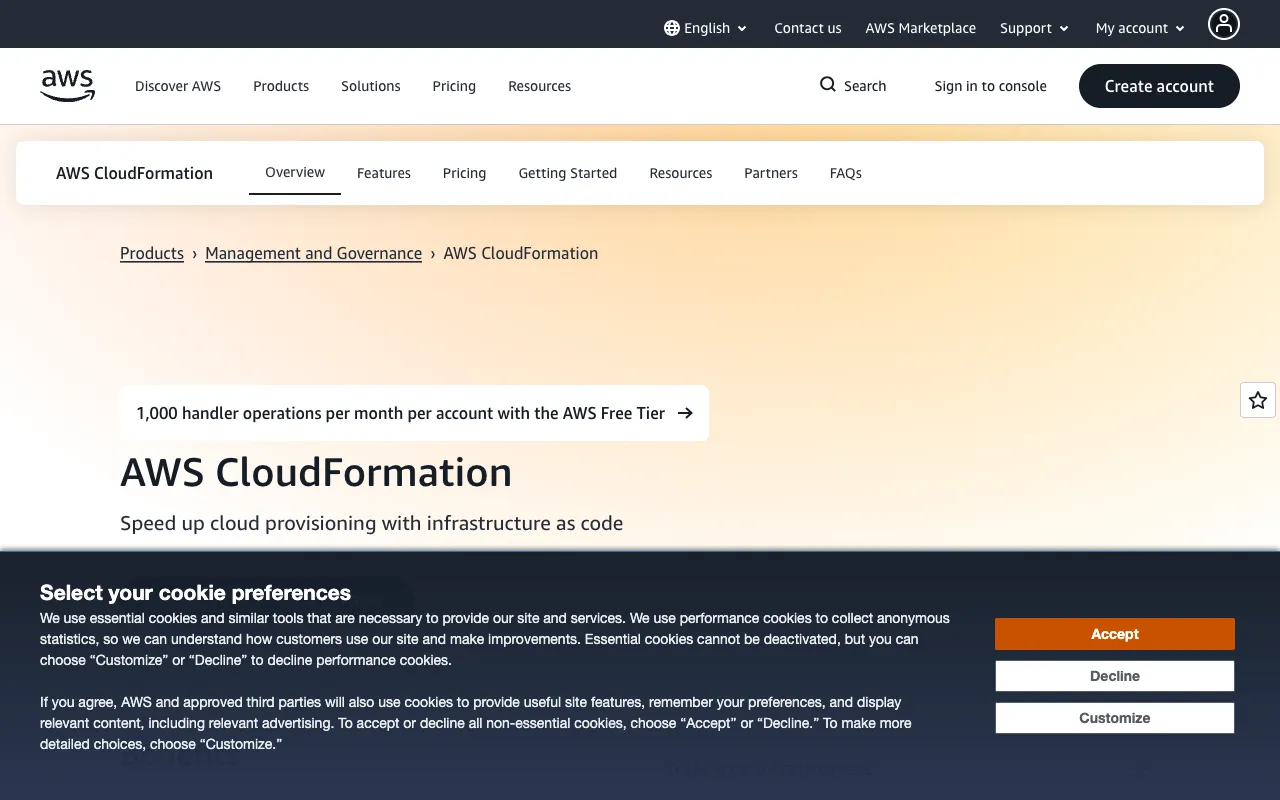
AWS CloudFormation – Best Infrastructure as Code Tool for DevOps Engineers
AWS CloudFormation is the definitive Infrastructure as Code (IaC) service for AWS, allowing DevOps engineers to define, deploy, and manage cloud resources using declarative templates. Instead of manually configuring services through the console, CloudFormation automates the entire lifecycle of your AWS infrastructure—ensuring consistency, repeatability, and version control for complex multi-service architectures.
What is AWS CloudFormation?
AWS CloudFormation is a fully managed service that provides DevOps teams with a common language to model and provision AWS application resources in a predictable and repeatable way. Using simple text files written in JSON or YAML format, engineers can describe the desired state of their AWS environment—including EC2 instances, S3 buckets, RDS databases, IAM roles, and networking components. CloudFormation then takes care of provisioning and configuring those resources in the correct order with built-in dependency management. This Infrastructure as Code approach transforms cloud management from a manual, error-prone process into an automated, version-controlled workflow integral to modern CI/CD pipelines.
Key Features of AWS CloudFormation
Declarative Template-Based Provisioning
CloudFormation uses human-readable templates that specify exactly what resources you want, without defining the step-by-step procedures to create them. This declarative model means you describe the desired end state, and AWS handles the underlying API calls, resource ordering, and error handling automatically.
Resource Dependency Management
The service automatically detects and manages dependencies between AWS resources. For example, CloudFormation knows to create a security group before an EC2 instance that references it, and to create a VPC before subnets. This eliminates manual sequencing errors in complex deployments.
Stack Management and Updates
CloudFormation groups resources into 'stacks'—single units you can create, update, or delete as a collection. When you update a template, CloudFormation calculates the changeset and applies only the necessary modifications, helping to minimize disruption and maintain resource integrity.
Rollback and Drift Detection
If a stack creation or update fails, CloudFormation automatically rolls back to the previous stable state, preventing partially configured environments. Drift detection continuously monitors whether deployed resources have been manually modified outside of CloudFormation, alerting teams to configuration drift.
Cross-Account and Cross-Region Deployments
Using StackSets, DevOps teams can provision CloudFormation stacks across multiple AWS accounts and regions from a single template. This enables consistent governance, security baselines, and application deployments at enterprise scale.
Who Should Use AWS CloudFormation?
AWS CloudFormation is essential for DevOps engineers, Site Reliability Engineers (SREs), cloud architects, and platform teams managing AWS environments. It's particularly valuable for organizations practicing Infrastructure as Code, implementing CI/CD pipelines, managing multi-account AWS landscapes, or requiring compliance and audit trails for resource changes. Development teams benefit from consistent environment replication for staging and testing, while operations teams gain predictable deployment patterns and disaster recovery capabilities.
AWS CloudFormation Pricing and Free Tier
AWS CloudFormation itself is free—you pay only for the AWS resources (like EC2 instances or S3 storage) that CloudFormation provisions and manages. There are no additional charges for using the CloudFormation service, making it a cost-effective choice for infrastructure automation. The service includes comprehensive free tier usage for template development, testing, and management operations, allowing teams to adopt Infrastructure as Code practices without upfront investment in tool licensing.
Common Use Cases
- Automated production environment deployment for microservices architecture
- Disaster recovery and region failover with reproducible infrastructure templates
- Creating consistent development and testing environments for software teams
- Implementing security and compliance baselines across multiple AWS accounts
Key Benefits
- Eliminates manual configuration errors through standardized template-driven deployments
- Accelerates infrastructure provisioning from days to minutes for faster time-to-market
- Provides complete version history and change audit trails for compliance requirements
- Enables infrastructure reuse and sharing across teams and projects
Pros & Cons
Pros
- Native AWS integration with support for all AWS services
- No additional cost beyond provisioned resources
- Automatic dependency management and error handling
- Enterprise-scale management through StackSets
Cons
- Steep learning curve for complex template authoring
- AWS-only solution without multi-cloud support
- Template updates can be slow for large, complex stacks
- Limited third-party resource support compared to Terraform
Frequently Asked Questions
Is AWS CloudFormation free to use?
Yes, AWS CloudFormation is a free service. You only pay for the AWS resources (like EC2 instances, RDS databases, or S3 storage) that CloudFormation provisions and manages on your behalf. There are no licensing fees or per-use charges for the CloudFormation service itself.
Is AWS CloudFormation good for DevOps engineers?
AWS CloudFormation is essential for DevOps engineers working with AWS. It enables true Infrastructure as Code practices, integrates seamlessly with CI/CD pipelines, provides version control for infrastructure, and automates environment provisioning—all critical capabilities for modern DevOps workflows. While alternatives like Terraform offer multi-cloud support, CloudFormation's deep AWS integration makes it the preferred choice for AWS-focused teams.
What's the difference between CloudFormation and Terraform?
AWS CloudFormation is AWS's native Infrastructure as Code service, offering deep integration with AWS services and features. Terraform by HashiCorp is a multi-cloud tool that supports AWS, Azure, Google Cloud, and hundreds of other providers. CloudFormation templates are specific to AWS, while Terraform uses its own HCL language. Many organizations use both: CloudFormation for AWS-specific deployments and Terraform for multi-cloud or hybrid scenarios.
Can I use CloudFormation with existing manually created resources?
Yes, through 'import' functionality, CloudFormation can bring existing AWS resources under its management. You create a template that describes the existing resource, then use the import workflow to add it to a CloudFormation stack. This allows teams to gradually adopt Infrastructure as Code without recreating their entire AWS environment from scratch.
Conclusion
For DevOps teams committed to AWS, CloudFormation represents the gold standard for Infrastructure as Code implementation. Its native AWS integration, comprehensive resource coverage, and automated lifecycle management provide unmatched efficiency for cloud resource provisioning. While tools like Terraform offer compelling multi-cloud capabilities, CloudFormation's zero-cost model and deep AWS feature support make it indispensable for organizations standardizing on AWS. As cloud environments grow in complexity, CloudFormation transforms infrastructure management from an operational burden into a strategic advantage—enabling faster deployments, consistent environments, and reliable disaster recovery through code-defined infrastructure.