Go back
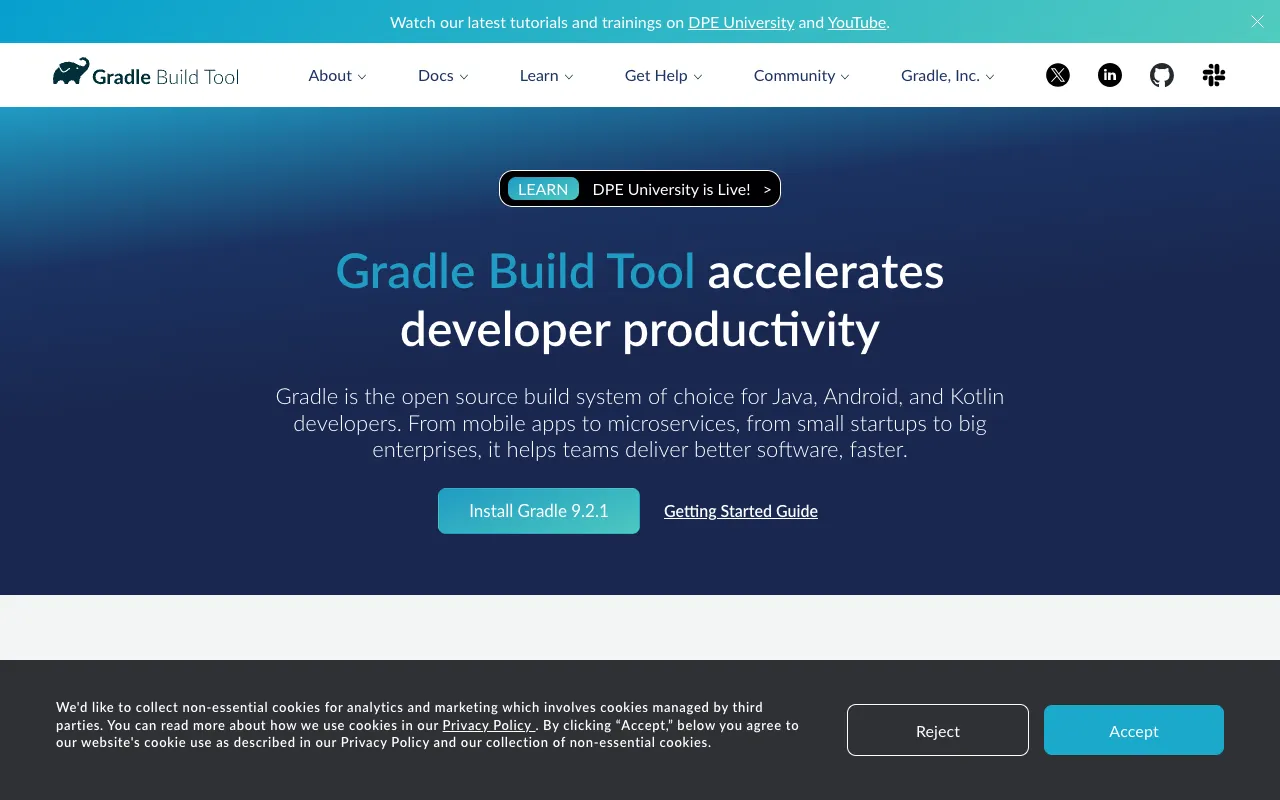
Image of Gradle – The Essential Build Automation Tool for DevOps Engineers

Gradle – The Essential Build Automation Tool for DevOps Engineers

In the fast-paced world of DevOps, build automation is the critical link between code and deployment. Gradle stands out as the premier build tool designed for the demands of modern software engineering. It goes beyond simple compilation, offering a declarative, Groovy or Kotlin-based DSL (Domain-Specific Language) that gives DevOps teams unprecedented control, speed, and flexibility over their entire build lifecycle. Whether you're managing monolithic Java applications, complex multi-language microservices, or mobile projects, Gradle provides the performance and reliability needed to accelerate CI/CD pipelines and ensure consistent, reproducible builds.

What is Gradle?

Gradle is an advanced, open-source build automation system that fundamentally changes how development and DevOps teams approach project builds. At its core, Gradle combines the power of Apache Ant's flexibility with Apache Maven's convention-over-configuration approach, but without their limitations. It uses a directed acyclic graph (DAG) to determine the order of task execution, running only what is necessary for a given build, which dramatically increases build speed. Unlike its predecessors, Gradle's build logic is expressed in a full-featured programming language (Groovy or Kotlin), allowing for highly customizable and maintainable build scripts that can adapt to any project structure or technology stack.

Key Features of Gradle

Incremental Builds

Gradle's most significant performance feature is its incremental build capability. By tracking task inputs and outputs, Gradle can skip tasks whose sources haven't changed since the last execution. This results in dramatically faster build times, especially for large projects, which is crucial for rapid iteration in DevOps CI/CD pipelines.

Multi-Language & Multi-Platform Support

Gradle is not limited to a single ecosystem. It provides first-class support for building Java, Kotlin, Groovy, Scala, C/C++, and JavaScript projects. With plugins, it seamlessly handles Android, iOS, and other platforms, making it the ideal single tool for organizations with diverse technology stacks.

Declarative Build Scripts with Kotlin DSL

Move beyond XML with Gradle's Kotlin DSL, which offers type-safe build configuration, superior IDE support with auto-completion and navigation, and easier refactoring. This makes build scripts more readable, maintainable, and less error-prone, a key advantage for DevOps teams managing complex build logic.

Powerful Dependency Management

Gradle offers a robust and flexible dependency management system compatible with Maven and Ivy repositories. It supports dynamic versions, conflict resolution, and composite builds, giving DevOps engineers fine-grained control over project dependencies and ensuring build reproducibility and security.

Build Cache & Daemon

The Gradle Daemon keeps a hot JVM instance running in the background to eliminate JVM startup costs for subsequent builds. When combined with local and remote build caches, teams can share build outputs, leading to near-instantaneous builds for developers and in CI environments.

Who Should Use Gradle?

Gradle is the strategic choice for forward-thinking DevOps engineers, platform teams, and development organizations. It is particularly essential for: DevOps teams managing polyglot microservices architectures who need a unified build system; Enterprises scaling their CI/CD pipelines who require fast, reliable, and cacheable builds; Mobile development teams (Android) where Gradle is the official build system; Organizations transitioning from Maven or Ant who need more power and flexibility; and any team prioritizing developer productivity through faster feedback loops and automated, consistent build processes.

Gradle Pricing and Free Tier

Gradle Build Tool is completely free and open-source (Apache License 2.0), making it accessible for individual developers, startups, and large enterprises alike. For organizations requiring advanced enterprise features—such as performance analytics (Build Scans), historical build trend analysis, and expert support—Gradle offers Gradle Enterprise. This commercial product provides deep insights into build performance and failures, helping large-scale DevOps teams optimize their pipelines and improve developer productivity.

Common Use Cases

Key Benefits

Pros & Cons

Pros

  • Unmatched build performance and speed for large, complex projects
  • Extreme flexibility and customization via a full programming language DSL
  • Excellent support for a wide variety of languages and platforms
  • Strong community and ecosystem with a vast library of plugins
  • Seamless integration with all major CI/CD and DevOps tooling

Cons

  • Initial learning curve is steeper compared to simpler tools like Maven due to its flexibility
  • Build scripts can become complex if not structured properly, requiring good design practices

Frequently Asked Questions

Is Gradle free to use?

Yes, absolutely. The core Gradle Build Tool is 100% free and open-source under the Apache 2.0 license. You can use it for personal projects, commercial software, and enterprise applications without any cost. Paid offerings like Gradle Enterprise are optional for teams needing advanced analytics and support.

Is Gradle better than Maven for DevOps?

For modern DevOps practices, Gradle often provides significant advantages. Its incremental builds and caching lead to much faster CI/CD pipeline execution. The flexibility of its Kotlin/Groovy DSL allows DevOps engineers to write more powerful, maintainable, and customized build logic compared to Maven's XML-based approach. While Maven is excellent for convention-based Java projects, Gradle's performance and adaptability make it the superior choice for complex, multi-language, and high-performance DevOps environments.

How does Gradle improve CI/CD pipeline performance?

Gradle supercharges CI/CD pipelines through three key mechanisms: 1) **Incremental Builds:** It skips unchanged tasks, running only what's necessary. 2) **Build Cache:** It reuses outputs from previous builds, even from other machines (with a remote cache), making clean builds extremely fast. 3) **Gradle Daemon:** It keeps a hot JVM running, eliminating startup overhead. These features collectively slash build times, enabling faster feedback loops and more efficient use of CI server resources.

Can Gradle handle both Java and front-end JavaScript projects?

Yes, Gradle is uniquely positioned as a unified build tool. For Java/Kotlin backends, it's the industry leader. For front-end projects, Gradle can efficiently manage JavaScript/TypeScript builds using plugins like the Gradle Node Plugin, which can run npm/yarn scripts, webpack, and other front-end tooling. This allows DevOps teams to manage a full-stack application's build process with a single, consistent tool, simplifying the pipeline and infrastructure.

Conclusion

For DevOps engineers tasked with building scalable, efficient, and reliable software delivery pipelines, Gradle is not just another tool—it's a strategic investment. Its unparalleled performance, flexibility across languages, and deep integration with the modern DevOps toolkit make it the definitive choice for automating complex builds. While the initial configuration may require more thought than simpler alternatives, the long-term payoff in faster build times, reduced maintenance, and empowered developers is immense. Adopt Gradle to transform your build process from a necessary chore into a competitive advantage that accelerates your entire software delivery lifecycle.