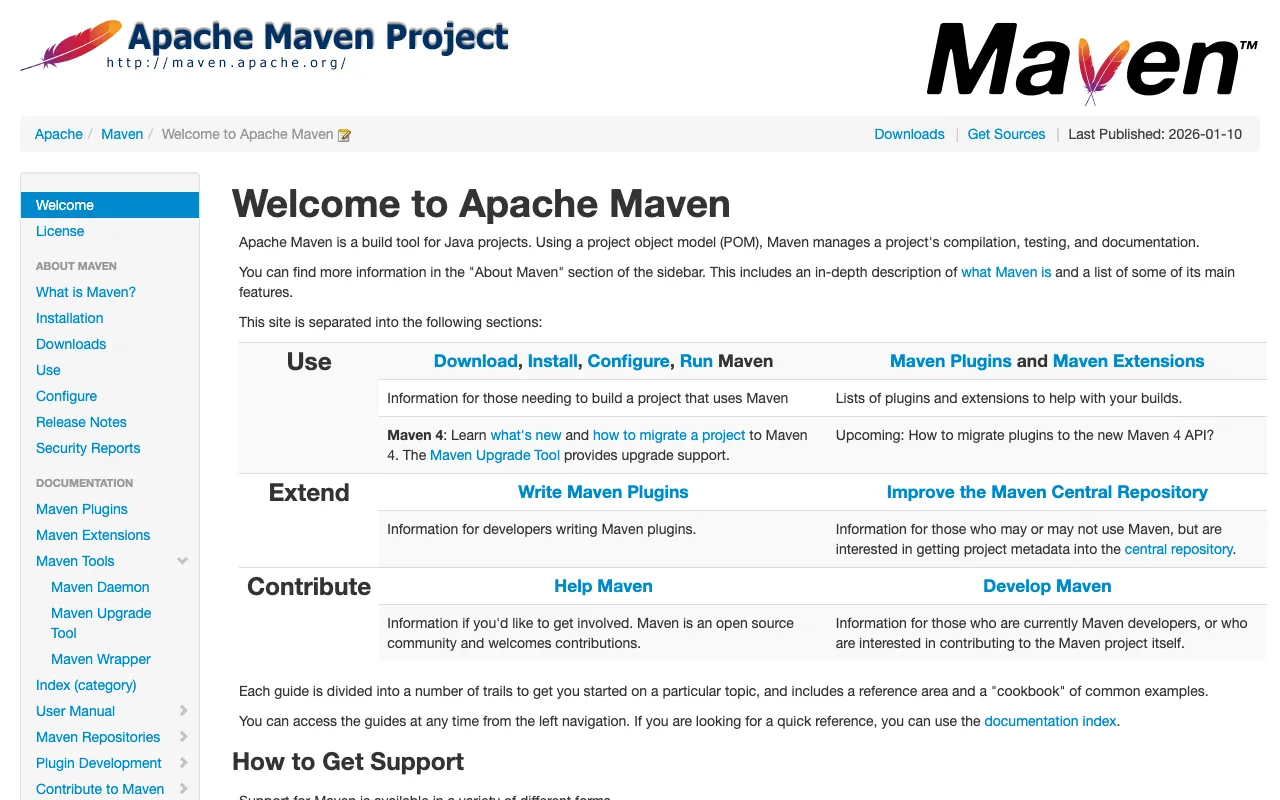
Apache Maven – The Premier Build Automation Tool for Java DevOps
Apache Maven stands as the cornerstone of modern Java development and DevOps automation. More than just a build tool, Maven provides a complete project management framework that standardizes development workflows, manages complex dependencies, and automates the entire software build lifecycle. For DevOps engineers working with Java ecosystems, Maven delivers consistency, repeatability, and efficiency across development, testing, and deployment pipelines.
What is Apache Maven?
Apache Maven is an open-source build automation and project comprehension tool used primarily for Java projects. It provides a uniform build system through its Project Object Model (POM) concept, allowing DevOps teams to manage a project's build lifecycle, reporting, and documentation from a central configuration file. Unlike traditional build tools that focus solely on compilation, Maven manages the entire process from source code to deployment, handling dependencies, documentation generation, testing, and packaging. Its declarative approach eliminates the need for complex build scripts, making projects more maintainable and portable across different environments.
Key Features of Apache Maven
Project Object Model (POM)
Maven's core is the POM XML file, which serves as a single source of truth for your project. It defines project dependencies, build plugins, goals, and the entire project structure. This standardized configuration ensures builds are consistent, reproducible, and easily understood by any team member, eliminating 'works on my machine' problems in DevOps pipelines.
Powerful Dependency Management
Maven automatically downloads required libraries (JAR files) from remote repositories like Maven Central, managing transitive dependencies and version conflicts. This eliminates manual jar file management, ensures consistent library versions across environments, and significantly speeds up project setup and build processes for DevOps engineers.
Build Lifecycle & Phases
Maven uses a predefined build lifecycle with standard phases like compile, test, package, verify, install, and deploy. This lifecycle model provides a consistent workflow that integrates seamlessly with CI/CD tools like Jenkins, GitLab CI, and GitHub Actions, allowing DevOps teams to automate the entire software delivery process.
Vast Plugin Ecosystem
Thousands of plugins extend Maven's functionality for virtually any task—from compiling code and running tests to generating reports, creating Docker images, and deploying to cloud platforms. This extensibility makes Maven adaptable to complex enterprise DevOps requirements without custom scripting.
Who Should Use Apache Maven?
Apache Maven is essential for DevOps engineers, Java developers, and software teams building enterprise applications. It's particularly valuable for teams managing microservices architectures, where consistent builds and dependency management across multiple services are critical. Organizations with complex CI/CD pipelines benefit from Maven's standardized lifecycle, which integrates smoothly with automation servers. While primarily for Java, Maven also supports projects in Scala, Kotlin, C#, and Ruby, making it versatile for polyglot development environments managed by modern DevOps practices.
Apache Maven Pricing and Free Tier
Apache Maven is completely free and open-source software released under the Apache License 2.0. There are no licensing fees, subscription costs, or premium tiers—all features are available to everyone. The tool is maintained by the Apache Software Foundation and supported by a massive global community. This makes Maven an incredibly cost-effective choice for startups, enterprises, and individual developers alike, with no hidden costs for enterprise features or scalability.
Common Use Cases
- Automating Java application builds in continuous integration pipelines
- Managing library dependencies for enterprise microservices architecture
- Standardizing build processes across large development teams
Key Benefits
- Eliminates manual dependency management, saving developers hours per week
- Provides consistent, reproducible builds that work across all environments
- Reduces onboarding time for new team members with standardized project structures
Pros & Cons
Pros
- Industry standard with massive community support and documentation
- Excellent dependency management with automatic transitive resolution
- Seamless integration with major CI/CD tools and IDEs
- Declarative configuration reduces custom scripting and maintenance
Cons
- XML-based configuration can become verbose for complex projects
- Initial learning curve for understanding lifecycle and plugin systems
- Builds can be slower than newer tools like Gradle for very large projects
Frequently Asked Questions
Is Apache Maven free to use?
Yes, Apache Maven is completely free and open-source. There are no licensing fees, subscription models, or premium tiers. All features are available under the Apache License 2.0, making it accessible for individual developers, startups, and large enterprises alike.
Is Apache Maven good for DevOps engineers?
Absolutely. Apache Maven is a foundational tool for Java DevOps. Its standardized build lifecycle integrates perfectly with CI/CD pipelines, its dependency management ensures consistent environments, and its plugin ecosystem supports automation of testing, packaging, and deployment tasks. For managing Java-based applications in production, Maven provides the reliability and automation that DevOps teams require.
What's the difference between Maven and Gradle?
Maven uses declarative XML configuration and follows a rigid, convention-over-configuration approach with a predefined lifecycle. Gradle uses a Groovy/Kotlin DSL, offers more flexibility with a programmable build script, and can be faster for incremental builds. Maven excels at standardization and has a larger ecosystem, while Gradle offers more customization for complex build logic. Many DevOps teams use Maven for its predictability in CI/CD environments.
How does Maven help with microservices?
Maven provides consistent build configurations across multiple microservices through parent POMs and dependency management. This ensures all services use compatible library versions, have standardized build processes, and can be deployed uniformly. For DevOps teams, this means predictable builds and easier management of complex microservices architectures with dozens or hundreds of services.
Conclusion
Apache Maven remains an indispensable tool in the Java DevOps ecosystem. Its robust dependency management, standardized build lifecycle, and extensive plugin support make it the go-to solution for enterprises seeking reliable, repeatable build automation. While newer tools offer alternative approaches, Maven's maturity, vast community, and seamless CI/CD integration ensure it will continue to power Java applications for years to come. For DevOps engineers building and maintaining Java-based systems, mastering Maven is not just an advantage—it's a fundamental requirement for efficient, scalable software delivery.