Nagios – Best Open-Source Monitoring Tool for DevOps Engineers
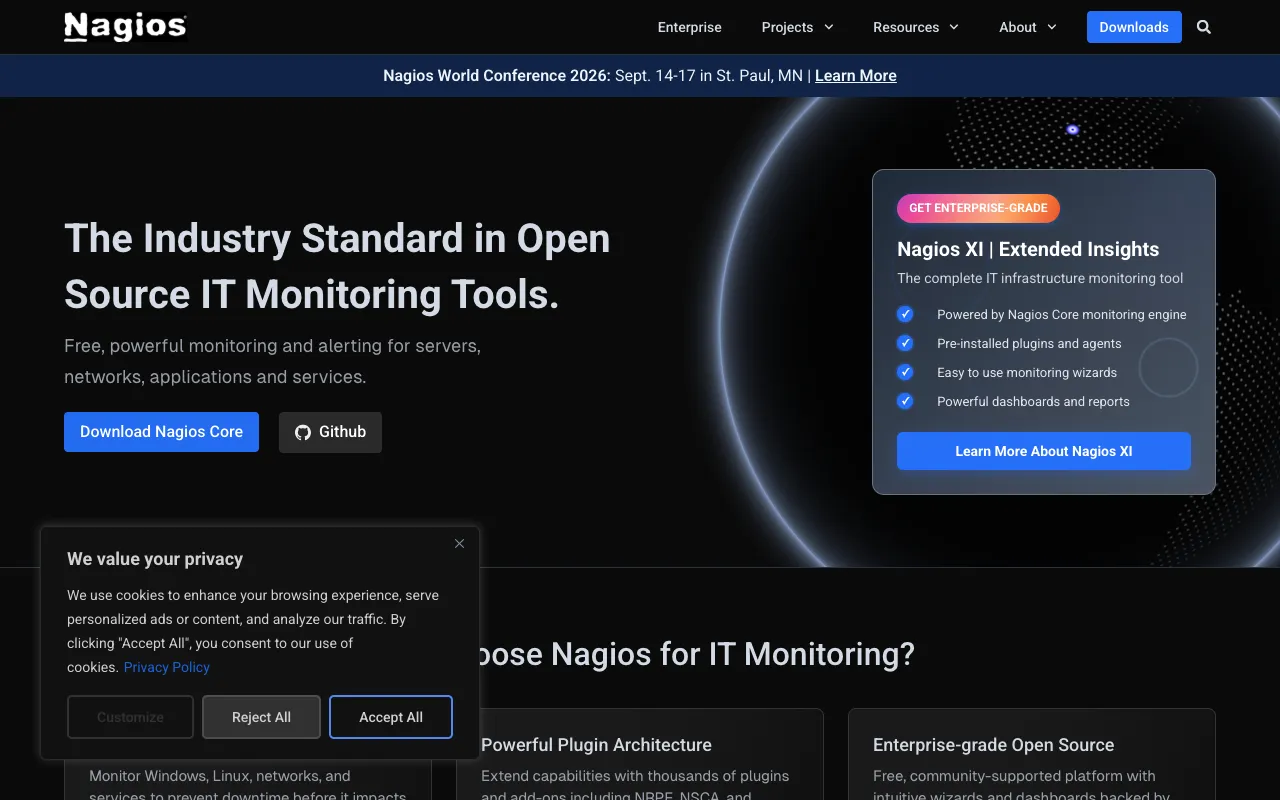
Nagios is the industry-standard open-source monitoring solution trusted by DevOps engineers and system administrators worldwide. It provides comprehensive monitoring of your entire IT infrastructure—servers, network devices, applications, and services—delivering real-time alerts and detailed performance reports. As a proven, extensible platform, Nagios helps you ensure system availability, prevent downtime, and maintain optimal performance across complex, hybrid environments.
What is Nagios?
Nagios is a robust, open-source monitoring framework designed for IT infrastructure management. At its core, Nagios continuously checks the health and status of your critical systems, including servers, switches, applications, and services. It functions as a central surveillance console, alerting technical staff immediately when problems arise and again when issues are resolved. This proactive monitoring approach allows DevOps teams to detect failures in network services, server resources, or host availability before they escalate into major outages, making it an essential tool for maintaining service level agreements (SLAs) and operational efficiency.
Key Features of Nagios
Comprehensive Infrastructure Monitoring
Monitor virtually any IT component: server load (CPU, RAM, disk), network services (HTTP, SMTP, DNS), network devices (routers, switches), and environmental metrics. Nagios supports monitoring of Windows, Linux, and Unix servers, as well as network protocols like SNMP.
Powerful Alerting & Notification System
Receive instant alerts via email, SMS, or custom notifications when service problems are detected, hosts go down, or performance thresholds are breached. Configure escalation policies to ensure the right team members are notified based on severity and time.
Extensive Plugin Architecture
Nagios boasts a vast ecosystem of thousands of community-developed plugins. This allows you to extend its monitoring capabilities to virtually any application, service, or custom metric, from databases and web applications to cloud services and APIs.
Detailed Reporting & Visualization
Gain insights through historical logs, availability reports, trend graphs, and capacity planning data. Nagios provides visual dashboards that display network maps, service statuses, and historical trends to help identify recurring issues and plan for growth.
Scalable Distributed Monitoring
Designed to scale from small networks to enterprise-level deployments. Use a distributed monitoring setup with a central server and remote pollers to efficiently monitor thousands of nodes across multiple locations or data centers.
Who Should Use Nagios?
Nagios is ideal for DevOps engineers, Site Reliability Engineers (SREs), system administrators, network engineers, and IT operations teams responsible for ensuring the uptime and performance of critical business infrastructure. It's particularly valuable for organizations running on-premises data centers, hybrid cloud environments, or managing complex application stacks that require granular visibility and control. Companies ranging from startups to large enterprises use Nagios to maintain their IT service management (ITSM) and achieve proactive, rather than reactive, operations.
Nagios Pricing and Free Tier
Nagios offers a powerful, completely free and open-source core product (Nagios Core) under the GPL license. This provides all the essential monitoring, alerting, and reporting features needed for most deployments. For organizations requiring a more streamlined setup with a web-based configuration interface, advanced dashboards, and commercial support, Nagios LLC offers Nagios XI, a commercial product with tiered pricing based on the number of nodes to monitor. The enduring availability of the free, open-source version makes Nagios an accessible and cost-effective entry point for any DevOps team.
Common Use Cases
- Proactive server health and performance monitoring for Linux and Windows environments
- Monitoring network device availability and bandwidth usage for routers and switches
- Ensuring uptime and response time for critical web applications and APIs
Key Benefits
- Prevent costly downtime by detecting infrastructure issues before they impact users
- Reduce mean time to resolution (MTTR) with instant, targeted alerts sent to on-call staff
- Gain complete visibility and historical data for capacity planning and infrastructure audits
Pros & Cons
Pros
- Mature, battle-tested open-source platform with a massive community and plugin library
- Extremely flexible and customizable to monitor virtually any device, service, or metric
- Zero-cost entry point with Nagios Core, making it accessible for teams of all sizes
- Excellent for building a foundational understanding of system monitoring principles
Cons
- Initial configuration of Nagios Core can be complex and file-based, requiring CLI knowledge
- The default web interface for Nagios Core is functional but less modern than some SaaS alternatives
- Scaling to very large, distributed environments requires careful planning and architecture
Frequently Asked Questions
Is Nagios free to use?
Yes, the core monitoring engine, Nagios Core, is completely free and open-source software released under the GPL license. It provides all the essential features for monitoring IT infrastructure. A commercial version, Nagios XI, is available with a graphical configuration interface and enterprise support.
Is Nagios good for DevOps and infrastructure monitoring?
Absolutely. Nagios is a foundational tool in the DevOps and SRE toolkit. Its proactive alerting, extensive plugin ecosystem, and focus on automation align perfectly with DevOps practices. It provides the granular visibility needed to maintain system reliability, enforce SLAs, and perform root cause analysis during incidents.
What is the difference between Nagios Core and Nagios XI?
Nagios Core is the free, open-source command-line driven monitoring engine. Nagios XI is the commercial edition that builds upon Core, adding a web-based configuration wizard, advanced visualization dashboards, capacity planning reports, and official commercial support. Core is highly flexible for experts, while XI offers faster setup and management.
Can Nagios monitor cloud services like AWS or Azure?
Yes, through its extensive plugin system. You can use community or custom plugins to monitor cloud metrics, API endpoints, and service statuses for AWS, Azure, Google Cloud, and other platforms. This allows Nagios to serve as a unified monitoring console for hybrid on-premises and cloud infrastructure.
Conclusion
For DevOps engineers and IT teams seeking a powerful, reliable, and cost-effective monitoring solution, Nagios remains a top-tier choice. Its open-source foundation offers unparalleled flexibility and a proven track record for safeguarding critical infrastructure. While the initial learning curve exists, the payoff is a deeply customizable monitoring system that can grow with your organization's needs. Whether you start with the free Nagios Core or opt for the commercial XI, implementing Nagios is a strategic move towards achieving operational excellence, proactive incident management, and robust system reliability.