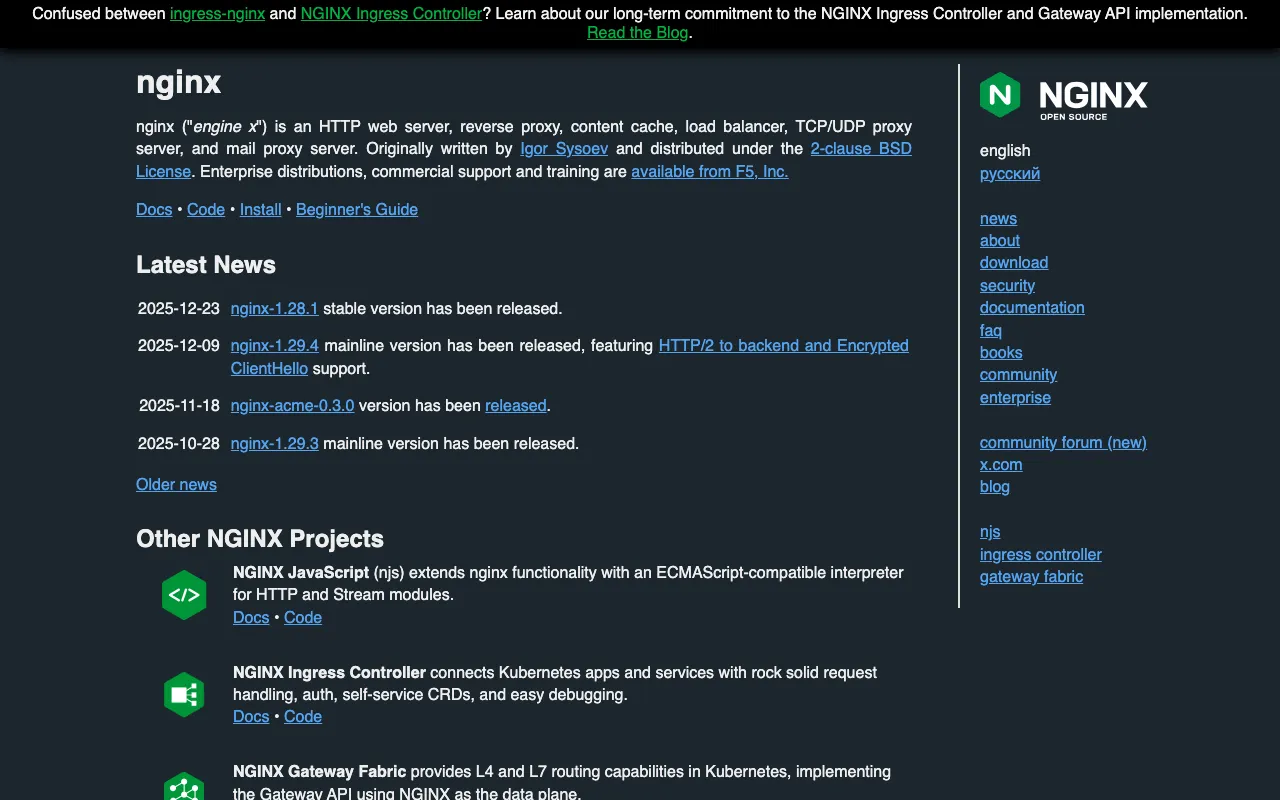
Nginx – The Essential Web Server & Reverse Proxy for DevOps
Nginx is the cornerstone of modern web infrastructure. More than just a web server, it's a powerful, event-driven reverse proxy, intelligent load balancer, and efficient HTTP cache. DevOps engineers choose Nginx for its unparalleled performance, stability, and scalability, making it the go-to solution for handling high-traffic websites, microservices architectures, and API gateways. Its lightweight resource footprint and flexible configuration allow teams to build resilient, fast, and secure application delivery networks.
What is Nginx?
Nginx is an open-source, high-performance HTTP server and reverse proxy software. Originally created to solve the C10K problem (handling 10,000 concurrent connections), it has evolved into a full-featured platform for serving web content, distributing traffic, caching responses, and securing applications. Its asynchronous, non-blocking architecture makes it exceptionally efficient under heavy load, consuming less memory than traditional threaded servers. For DevOps professionals, Nginx is not just a tool but a critical infrastructure component for building scalable, performant, and reliable systems.
Key Features of Nginx
High-Performance Reverse Proxy
Nginx excels as a reverse proxy, sitting in front of backend application servers (like Node.js, Python, or Java apps). It terminates client connections, forwards requests to the appropriate backend, and returns the response. This offloads SSL/TLS termination, compression, and connection management from application servers, improving security and freeing up backend resources for core business logic.
Advanced Load Balancing
Distribute incoming traffic across multiple backend servers using Nginx's robust load balancing algorithms, including round-robin, least connections, and IP hash. This ensures high availability, prevents any single server from becoming a bottleneck, and allows for graceful server maintenance without downtime—crucial for zero-downtime deployments.
Intelligent HTTP Caching
Drastically reduce response times and backend load with Nginx's built-in HTTP cache. It can cache static and dynamic content at the edge, serving repeated requests from memory instead of hitting origin servers. This feature is essential for accelerating websites, APIs, and microservices, leading to a better user experience and lower infrastructure costs.
Modular & Extensible Architecture
While the core Nginx is lean and fast, its functionality can be extended through modules. From security (ModSecurity integration) to real-time communication (WebSocket proxying) and media streaming, modules allow DevOps teams to tailor Nginx to their exact needs without bloat.
Who Should Use Nginx?
Nginx is indispensable for DevOps engineers, SREs (Site Reliability Engineers), cloud architects, and backend developers. It's the ideal solution for teams managing high-traffic websites, e-commerce platforms, SaaS applications, and microservices-based architectures. If you need to improve application performance, implement a robust API gateway, achieve fault tolerance through load balancing, or secure your application layer, Nginx provides the battle-tested foundation. It's equally valuable for startups scaling their infrastructure and large enterprises managing global traffic.
Nginx Pricing and Free Tier
Nginx offers a completely free, open-source version (NGINX Open Source) under a 2-clause BSD license. This version includes all core features like HTTP/HTTPS serving, reverse proxy, load balancing, and caching—more than enough for most use cases. For organizations requiring advanced support, security modules, API management, and load balancing analytics, F5 Networks (the steward of Nginx) offers commercial products: NGINX Plus (subscription-based) and NGINX Controller. The robust free tier makes Nginx an accessible and powerful entry point for any DevOps stack.
Common Use Cases
- Using Nginx as a reverse proxy for a Node.js microservices backend
- Implementing Nginx load balancing for a high-availability Kubernetes cluster
- Setting up Nginx HTTP caching to speed up a WordPress or Drupal website
Key Benefits
- Dramatically improves website and API response times through efficient serving and caching
- Increases application resilience and uptime with intelligent traffic distribution and failover
- Reduces infrastructure costs by handling more concurrent connections with fewer server resources
Pros & Cons
Pros
- Exceptional performance and low memory footprint under high concurrent loads
- Extremely flexible configuration for complex routing, rewriting, and security rules
- Mature, stable, and widely adopted with extensive community and commercial support
Cons
- Configuration syntax has a learning curve and can be complex for advanced scenarios
- Dynamic module loading is less straightforward compared to some alternatives (though improving)
Frequently Asked Questions
Is Nginx free to use?
Yes, the core Nginx software (NGINX Open Source) is completely free and open-source. It includes the essential features for web serving, reverse proxying, load balancing, and caching, making it suitable for the vast majority of production deployments.
Is Nginx a good tool for DevOps engineers?
Absolutely. Nginx is a fundamental DevOps tool. It directly addresses core DevOps concerns: automation (via configuration-as-code), reliability (through load balancing and health checks), performance (with caching and efficient connection handling), and scalability. Mastery of Nginx is a highly valuable skill for any DevOps professional.
What's the difference between Nginx and Apache?
While both are powerful web servers, they use different architectural models. Apache typically uses a process-or thread-per-connection model, which can consume more memory under heavy load. Nginx uses an asynchronous, event-driven model, making it more efficient at handling thousands of concurrent connections with a smaller memory footprint. Nginx is often preferred as a reverse proxy and load balancer, while Apache is praised for its .htaccess flexibility and module ecosystem.
Can Nginx be used with Docker and Kubernetes?
Yes, Nginx is a first-class citizen in containerized environments. It's commonly used as an Ingress Controller in Kubernetes to manage external access to services, providing load balancing, SSL termination, and name-based virtual hosting. Lightweight Nginx containers are also perfect for serving static content or acting as a sidecar proxy in microservices architectures.
Conclusion
For DevOps engineers building the backbone of modern web applications, Nginx remains an non-negotiable component of the tech stack. Its proven ability to serve, secure, and scale applications—coupled with a powerful free and open-source offering—makes it a top-tier choice. Whether you're deploying a simple blog or a complex global platform, implementing Nginx as your web server, reverse proxy, or load balancer is a strategic decision that delivers immediate performance gains and long-term architectural resilience.