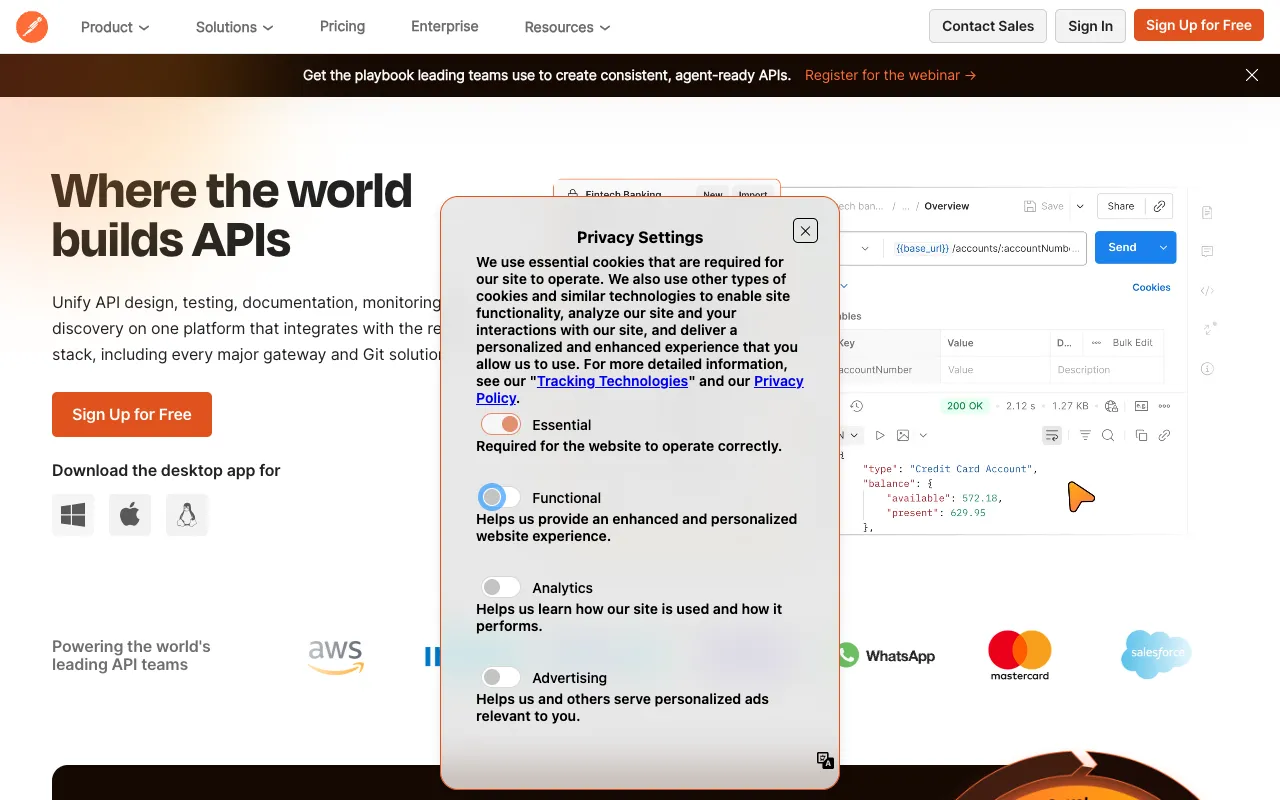
Postman – The Essential API Platform for DevOps Engineers
Postman has evolved from a simple API testing tool into the industry-standard platform for the entire API lifecycle. For DevOps engineers, it's an indispensable hub that bridges the gap between development, testing, and operations. It streamlines API workflows, enforces consistency, and enables seamless collaboration across teams, making it the top choice for building reliable, scalable, and well-documented APIs in modern software development pipelines.
What is Postman?
Postman is a feature-rich API platform designed to simplify every stage of the API lifecycle. It provides a unified workspace where DevOps engineers, developers, and QA teams can collaboratively design APIs, create and automate comprehensive test suites, generate interactive documentation, mock endpoints before they're built, and monitor API performance and reliability in production. By centralizing API development and testing, Postman eliminates silos, reduces friction, and significantly accelerates the delivery of high-quality software.
Key Features of Postman for DevOps
API Client and Request Builder
The core of Postman is its intuitive API client, allowing you to send HTTP requests (GET, POST, PUT, DELETE, etc.) with ease. Configure headers, authentication (OAuth, API keys, JWT), parameters, and body data in a clean interface. Save requests into organized collections for reuse, making it perfect for testing endpoints during development and integration.
Automated Testing and CI/CD Integration
Write powerful test scripts in JavaScript using the built-in Chai assertion library (BDD/TDD style). Automate validation of API responses, status codes, and performance. Seamlessly integrate these tests into your CI/CD pipelines (Jenkins, GitLab CI, GitHub Actions, CircleCI) using the Postman CLI tool Newman, ensuring APIs meet quality standards with every code change.
API Monitoring and Performance Testing
Schedule automated monitoring for your critical API endpoints from Postman's global infrastructure. Receive alerts for downtime, slow response times, or failed assertions. Run performance tests to understand how your API behaves under load, identifying bottlenecks before they impact users in production environments.
Workspaces and Team Collaboration
Move beyond individual tools with shared workspaces. Teams can collaborate on API collections, design specs, environments, and mock servers. Version control, change history, and role-based permissions ensure everyone is aligned, making it ideal for DevOps cultures that emphasize transparency and shared ownership.
API Documentation and Mock Servers
Generate beautiful, interactive, and always up-to-date documentation automatically from your collections or OpenAPI specifications. Create mock servers to simulate API behavior before the backend is complete, enabling frontend and mobile teams to develop in parallel without blocking dependencies.
Who Should Use Postman?
Postman is essential for DevOps Engineers, API Developers, Backend Engineers, QA Automation Specialists, and Technical Product Managers. It's particularly valuable for teams practicing Agile, CI/CD, and microservices architectures. Any professional involved in building, integrating, testing, or maintaining web services will find Postman dramatically improves their workflow efficiency, code quality, and cross-team communication.
Postman Pricing and Free Tier
Postman offers a robust Free tier perfect for individuals and small teams, providing core API client features, limited collections, basic monitoring, and individual mock servers. For advanced collaboration, enterprise-scale API governance, advanced monitoring, and dedicated support, Postman provides paid Professional, Enterprise, and Business Critical plans. The free tier makes it easy to start and evaluate its core value proposition at no cost.
Common Use Cases
- Automating API regression tests in a Jenkins CI/CD pipeline
- Collaboratively designing and documenting a new microservice API with OpenAPI
- Monitoring production API health and performance from multiple geographic regions
Key Benefits
- Accelerates API development and testing cycles by up to 50%, reducing time-to-market
- Improves software quality and reliability through automated, integrated API testing
- Enhances team collaboration and reduces miscommunication with a single source of truth for APIs
Pros & Cons
Pros
- Unmatched ease of use for both simple requests and complex testing scenarios
- Comprehensive feature set covering the entire API lifecycle in one platform
- Strong collaboration tools and integrations with popular DevOps toolchains
- Powerful free tier that provides significant value for individual users and small teams
Cons
- Advanced features and higher usage limits require a paid subscription
- The extensive feature set can have a learning curve for complete beginners
- Desktop application performance can vary on lower-spec machines with very large collections
Frequently Asked Questions
Is Postman free to use for DevOps?
Yes, Postman offers a powerful Free plan that is more than sufficient for individual DevOps engineers. It includes the core API client, automated testing, basic monitoring, mock servers, and collaboration for small teams. You can integrate it with CI/CD and start automating API tests without any cost.
Why is Postman considered a top tool for DevOps engineers?
Postman is a top DevOps tool because it directly supports key DevOps principles: automation (via CI/CD-integrated testing), collaboration (through shared workspaces), and monitoring (of production APIs). It shifts API testing and quality left in the development cycle, enabling faster, more reliable releases—a core goal of any DevOps practice.
Can Postman replace other testing tools?
Postman excels at API-level testing (integration, contract, and some performance testing). It is often the primary tool for these purposes. However, it complements rather than replaces unit testing frameworks (like JUnit, pytest) for code logic or specialized end-to-end UI testing tools (like Selenium, Cypress). It's a central pillar in a modern testing strategy.
Conclusion
For DevOps engineers focused on building resilient and scalable systems, Postman is far more than a utility—it's a strategic platform that unifies and automates the API lifecycle. Its ability to integrate testing directly into CI/CD pipelines, foster collaboration, and provide visibility into API health makes it indispensable. Whether you're managing a handful of services or a complex microservices ecosystem, starting with Postman's free tier is a straightforward decision that will pay immediate dividends in productivity and software quality.