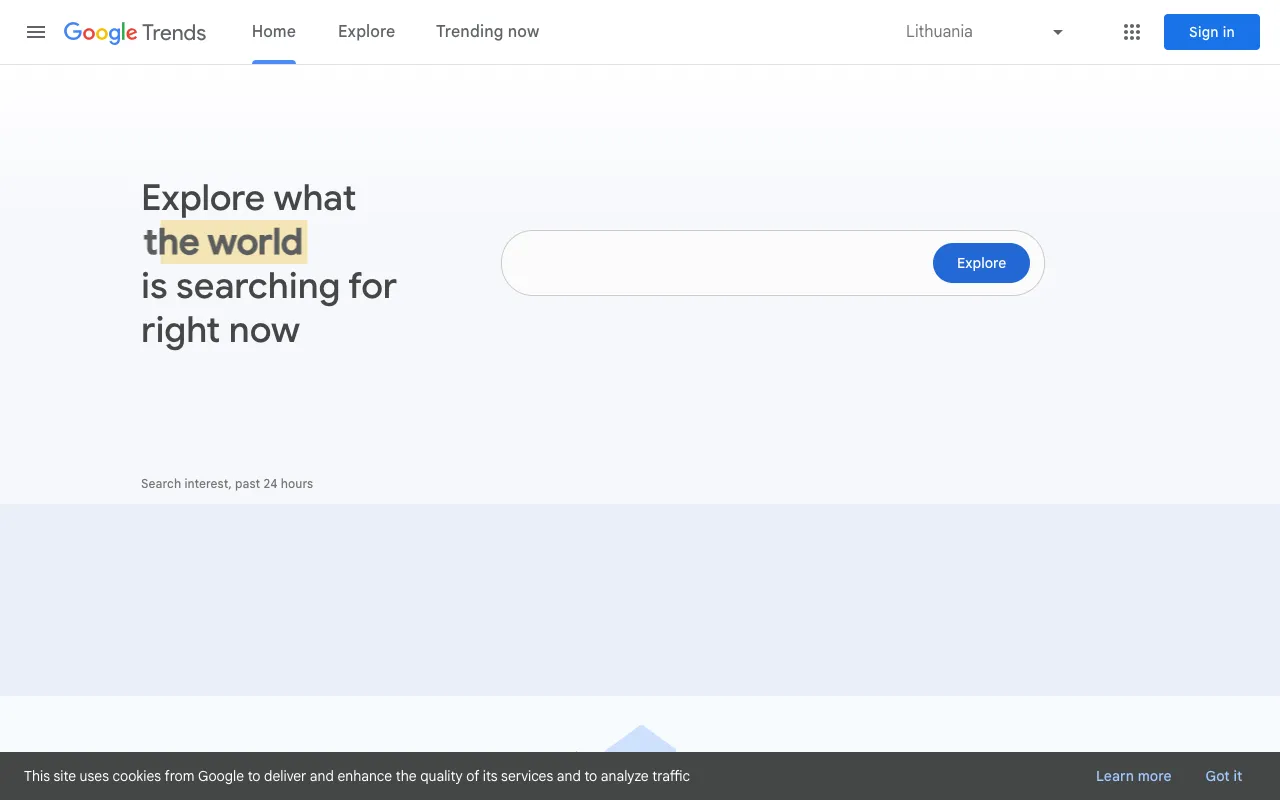
Google Trends – The Essential Content Research Tool for Freelance Writers
For freelance writers, finding profitable, in-demand topics is half the battle. Google Trends is your free, authoritative weapon for winning it. This powerful tool from Google provides real-time data on what the world is searching for, allowing you to move beyond guesswork and create content aligned with genuine audience interest. Whether you're pitching clients, planning a content calendar, or optimizing existing articles, Google Trends delivers the search volume insights needed to write with confidence and commercial intent.
What is Google Trends?
Google Trends is a public web facility that analyzes a sample of Google web searches to compute how often specific terms are searched relative to the total search volume across various regions, languages, and time frames. For freelance writers, it transforms from a simple data explorer into a strategic content intelligence platform. It answers critical questions: Is interest in a topic growing or fading? Where is it most popular? What related queries are audiences asking? By visualizing search popularity over time, you gain an evidence-based foundation for every piece you write, ensuring your work resonates with current market demand.
Key Features of Google Trends for Writers
Interest Over Time Analysis
Track the ebb and flow of search interest for any keyword or topic. Identify seasonal peaks (perfect for evergreen content planning), spot emerging trends before they peak, and avoid writing about topics in permanent decline. This feature helps you time your publications for maximum impact and relevance.
Geographic Interest Breakdown
See exactly where in the world (or within a country) a topic is most searched. This is invaluable for writers targeting specific local markets, crafting regionally-focused content for clients, or understanding the cultural nuances of a subject. It helps tailor your angle and examples to the most engaged audience.
Related Queries & Topics
Discover semantically connected search terms. The 'Rising' related queries are particularly gold for finding new, burgeoning angles and sub-topics that haven't been saturated. This feature fuels content expansion, helps with keyword clustering for comprehensive articles, and reveals the specific questions your target readers are asking.
Category and Search Type Filters
Refine your analysis by industry categories (e.g., Business, Health) and search types (Web Search, Image Search, YouTube Search). This allows for incredibly niche research. A health writer can isolate trends in YouTube searches for 'home workouts,' while a tech writer can analyze web search interest for 'AI tools.'
Real-Time and Historical Data
Access daily search trends for the past 7 days for breaking news and viral content ideas, or pull data going back to 2004 for long-term trend analysis. This dual perspective allows you to react quickly to hot topics while also building authority on subjects with sustained, long-term interest.
Who Should Use Google Trends?
Google Trends is indispensable for any freelance writer whose success depends on understanding audience demand. It is especially critical for: Content Marketers and SEO Writers who need to justify topic choices with data and target high-intent keywords. Bloggers and Niche Website Owners planning their editorial calendars. Journalists and News Writers identifying rising stories and public interest angles. Copywriters and Brand Journalists seeking culturally relevant hooks for campaigns. Technical and B2B Writers validating the commercial interest in complex subjects before investing research time. Essentially, if you write for an online audience and want that content to be found, Google Trends should be in your core toolkit.
Google Trends Pricing and Free Tier
Google Trends is completely free to use. There is no sign-up required, no subscription fee, and no limit on the number of searches or comparisons you can perform. The data is accessible to anyone with an internet connection. This makes it one of the most powerful and democratized research tools available, placing enterprise-level search trend insights into the hands of every freelance writer, regardless of budget.
Common Use Cases
- Using Google Trends to identify seasonal content ideas for a lifestyle blog before peak search periods
- Leveraging geographic data in Google Trends to write locally-optimized articles for small business clients
- Analyzing related rising queries on Google Trends to find untapped angles for a competitive product review
Key Benefits
- Eliminate content guesswork by basing topics on proven search demand data.
- Increase the commercial viability of your pitches and articles by demonstrating trend alignment to clients.
- Improve content planning efficiency by identifying long-term trends and seasonal patterns in advance.
Pros & Cons
Pros
- Completely free with no usage limits or paywalls.
- Provides direct data from the world's largest search engine, ensuring high relevance.
- Intuitive visual interface (charts, graphs, maps) that's easy to interpret and present.
- Excellent for comparative analysis (e.g., Topic A vs. Topic B).
- Powerful for uncovering regional and demographic insights.
Cons
- Data is relative (popularity scored from 0-100), not absolute search volume numbers.
- Can be noisy for very niche or long-tail keywords with low overall search activity.
- Requires interpretation and cross-referencing with other tools (like keyword planners) for a complete SEO picture.
Frequently Asked Questions
Is Google Trends free to use for freelance writers?
Yes, absolutely. Google Trends is a 100% free public tool. You do not need a Google account to access basic trend data, making it an invaluable, zero-cost resource for content research and ideation.
Is Google Trends good for freelance writer content research?
Google Trends is one of the best free tools for high-level content research. It excels at identifying trends, understanding seasonality, and comparing topic interest. For freelance writers, it's perfect for validating topic ideas, finding fresh angles, and demonstrating data-driven reasoning to clients, though it should often be supplemented with a keyword tool for specific volume metrics.
How accurate is Google Trends data?
Google Trends data is highly reliable for showing the relative popularity and direction of search interest. It is based on a massive, anonymized sample of real Google searches. While it doesn't show exact search numbers, its patterns and comparisons are accurate reflections of real-world user behavior, making it excellent for trend analysis.
Can I use Google Trends to find low-competition keywords?
Indirectly, yes. By analyzing 'Rising' related queries and identifying topics where interest is growing but mainstream content may not yet be saturated, you can uncover lower-competition opportunities. It helps you get ahead of trends rather than chasing highly competitive, established keywords.
Conclusion
For the freelance writer, Google Trends is more than a tool—it's a strategic advantage. In a landscape where relevance and timing are everything, it provides the empirical evidence needed to write content that connects. Its power lies in transforming subjective hunches into data-driven decisions, making your pitches more compelling and your published work more likely to succeed. While it's just one part of a complete SEO and research workflow, its unique, free access to Google's own trend data makes it an non-negotiable starting point for any writer serious about creating in-demand, authoritative content.