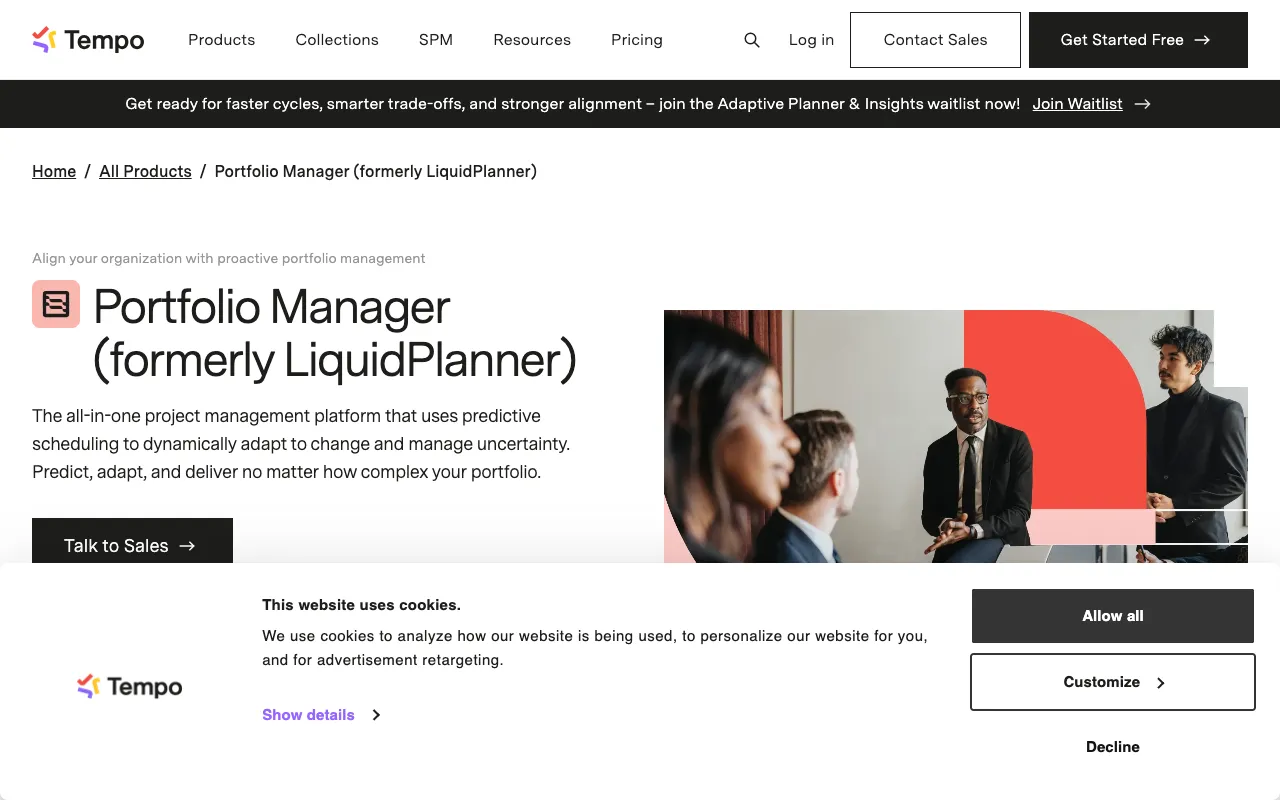
LiquidPlanner – The Best Predictive Project Management Tool
LiquidPlanner is a transformative project management solution designed for teams that operate in reality, not theory. Unlike static Gantt charts, LiquidPlanner uses a unique, predictive scheduling engine that accounts for task priority, resource availability, and inherent uncertainty to forecast realistic project finish dates. It's the definitive tool for project managers, product teams, and service delivery leaders who need to navigate complexity and deliver reliable timelines to stakeholders.
What is LiquidPlanner?
LiquidPlanner is a sophisticated, web-based project management platform built on the principle of predictive scheduling. It moves beyond traditional task lists and fixed timelines by using a priority-based algorithm that continuously recalculates project forecasts. By inputting best-case and worst-case estimates for tasks, the tool generates probabilistic finish dates, giving managers a data-driven range of outcomes. This makes it exceptionally powerful for managing software development, IT projects, consulting engagements, and any initiative where scope, resources, and priorities are in constant flux.
Key Features of LiquidPlanner
Predictive Priority-Based Scheduling
The core engine automatically schedules tasks based on their priority order, not just start dates. When priorities shift or work takes longer than expected, the entire project schedule dynamically adjusts, providing an always-accurate forecast.
Range-Based Estimation & Monte Carlo Simulation
Instead of single-point estimates, teams provide low and high effort ranges. LiquidPlanner uses this data in a Monte Carlo simulation to calculate confidence intervals for project completion, visually showing the probability of hitting a deadline.
Dynamic Dashboards & Real-Time Analytics
Gain instant visibility into project health, resource workload, and portfolio performance. Customizable dashboards highlight risks, bottlenecks, and slippage, enabling proactive management.
Integrated Time Tracking & Resource Management
Track time directly against tasks for accurate progress reporting. The system automatically factors in team capacity, vacations, and non-project work to create realistic, workload-balanced schedules.
Who Should Use LiquidPlanner?
LiquidPlanner is ideal for project managers and teams in dynamic, knowledge-work environments. Primary users include: Software Development Managers needing accurate sprint and release forecasts; IT Project Directors managing infrastructure rollouts with many dependencies; Consulting Firm Leads who must provide clients with reliable delivery dates; and Product Managers juggling multiple feature pipelines with shifting business priorities. It's less suited for very simple, linear projects with fixed, unchanging steps.
LiquidPlanner Pricing and Free Tier
LiquidPlanner operates on a subscription-based pricing model and does not offer a permanent free tier. They typically provide a free trial period (often 14-30 days) for prospective users to evaluate the platform. Pricing is generally tiered based on the number of users and the feature set required, such as advanced analytics, portfolio management, and enterprise security controls. For the most current pricing details and potential educational or non-profit discounts, visit the official LiquidPlanner website.
Common Use Cases
- Managing agile software development projects with unpredictable task durations
- Forecasting accurate delivery dates for client services and consulting engagements
- Portfolio management for IT departments with shared resources and changing priorities
Key Benefits
- Deliver more reliable project forecasts to stakeholders, building trust and credibility
- Proactively identify schedule risks and resource bottlenecks before they cause delays
- Improve team productivity by dynamically scheduling work based on real-time priority and capacity
Pros & Cons
Pros
- Unmatched predictive scheduling that realistically models project uncertainty
- Dynamic recalculation keeps forecasts accurate as priorities change
- Powerful analytics and dashboards for data-driven project decisions
- Excellent for managing complex projects with interdependent tasks and shared resources
Cons
- Steeper learning curve compared to simpler task management tools like Trello
- No permanent free plan, which may deter very small teams or individual users
- Can be feature-heavy for teams that only need basic task tracking and collaboration
Frequently Asked Questions
Is LiquidPlanner free to use?
No, LiquidPlanner does not offer a permanent free plan. It is a premium project management solution. However, they typically provide a full-featured free trial so teams can thoroughly test the predictive scheduling engine before committing to a paid subscription.
Is LiquidPlanner good for agile project management?
Yes, LiquidPlanner is excellent for agile and hybrid methodologies. Its ability to handle range estimates, reprioritize work dynamically, and forecast release dates based on actual team velocity and capacity aligns perfectly with agile principles of adapting to change and delivering predictably.
How does LiquidPlanner differ from tools like Jira or Asana?
While Jira and Asana excel at task tracking and workflow automation, LiquidPlanner's unique differentiator is its predictive scheduling core. It focuses less on 'what' needs to be done and more on 'when' it will realistically be done, factoring in uncertainty and priority in a way that static timeline tools cannot.
Conclusion
For project managers tired of unreliable forecasts and constant schedule surprises, LiquidPlanner offers a fundamentally better approach. By embracing the inherent uncertainty in complex projects and using data to model probabilities, it transforms project management from a reactive guessing game into a proactive, predictive science. If your team's success depends on delivering accurate timelines in a dynamic environment, LiquidPlanner is not just another tool—it's the strategic advantage you need to build confidence, manage stakeholder expectations, and ship on time.