Go back
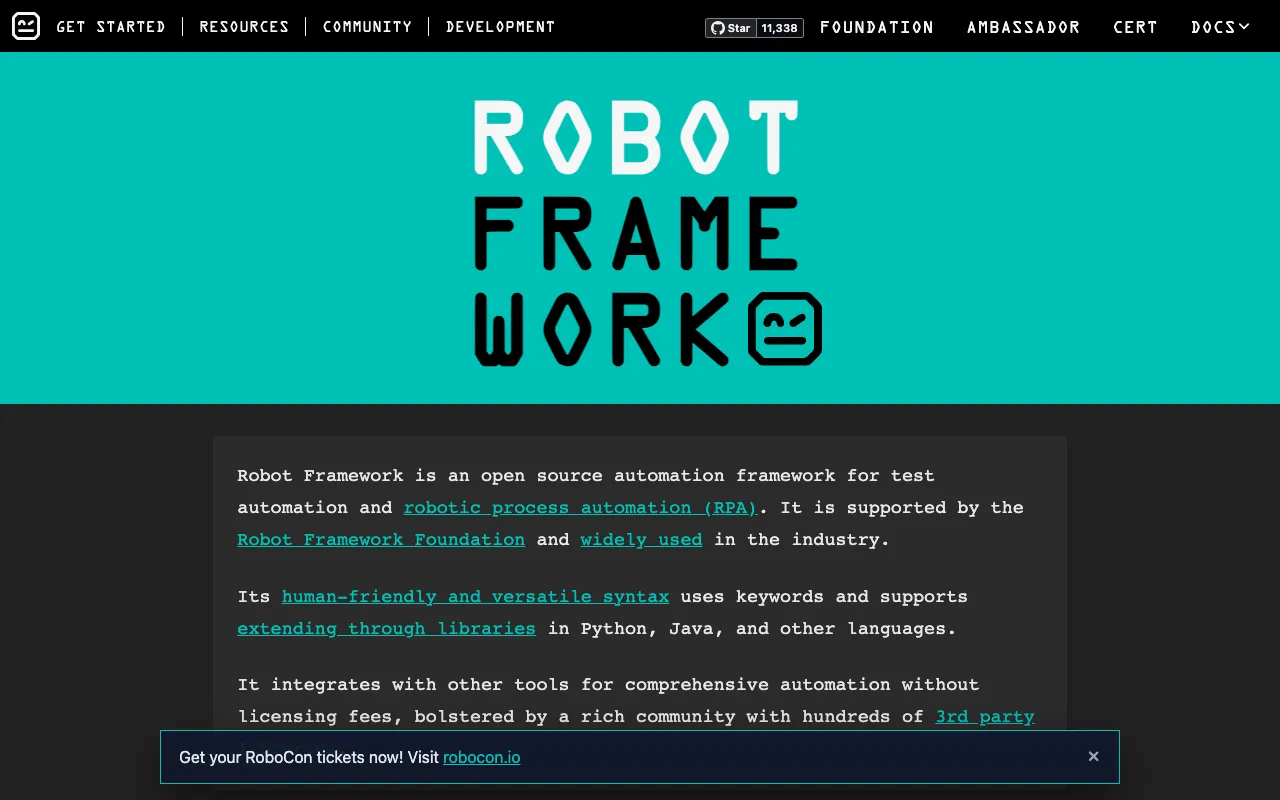
Image of Robot Framework – Best Test Automation Tool for QA Testers

Robot Framework – Best Test Automation Tool for QA Testers

Robot Framework is a powerful, open-source, and generic test automation framework that empowers QA testers and developers to automate acceptance testing, robotic process automation (RPA), and functional testing with ease. Built on a simple, keyword-driven syntax, it lowers the barrier to entry for test automation while offering extensibility for complex scenarios. Whether you're validating web applications, mobile apps, APIs, or desktop software, Robot Framework provides a structured, readable, and maintainable approach to automated testing, making it a top choice for agile teams and continuous integration pipelines.

What is Robot Framework?

Robot Framework is a versatile, open-source automation framework primarily used for acceptance testing, acceptance test-driven development (ATDD), and robotic process automation (RPA). Its core philosophy is simplicity and extensibility. Unlike code-heavy frameworks, Robot Framework uses a human-readable, keyword-driven syntax. This means tests are written in a tabular format using plain English (or other language) keywords, making test cases understandable even for non-technical stakeholders like product owners and business analysts. It operates on a library-based architecture, allowing it to interact with various systems—from web browsers via Selenium to databases, mobile devices, and mainframes—through external libraries. This generic nature makes it a true 'Swiss Army knife' for QA automation, suitable for end-to-end testing, API testing, and desktop application automation.

Key Features of Robot Framework

Keyword-Driven Syntax

The hallmark of Robot Framework is its easy-to-read, keyword-driven test syntax. Tests are written in simple, tabular format, promoting clarity and collaboration between technical and non-technical team members. This reduces the learning curve and accelerates test case creation and maintenance.

Rich Ecosystem of Libraries

Extend Robot Framework's capabilities with a vast collection of external libraries. Use SeleniumLibrary for web testing, RequestsLibrary for API testing, AppiumLibrary for mobile automation, and DatabaseLibrary for database validation. This modularity lets you build a tailored automation suite for any technology stack.

Detailed Logging and Reporting

Get instant, comprehensive insights into test execution. Robot Framework automatically generates detailed HTML reports and logs, including pass/fail status, execution times, and error messages with screenshots (when configured). This transparency is crucial for debugging and stakeholder reporting.

Platform and Application Independence

As a generic framework, Robot Framework is not tied to any specific application type. It can automate testing for web, mobile, desktop, and mainframe applications, as well as orchestrate RPA workflows. It runs on Python, Jython (Java), and IronPython (.NET), offering cross-platform compatibility.

Who Should Use Robot Framework?

Robot Framework is ideal for QA engineers, software developers in test (SDETs), and automation specialists in agile and DevOps environments. It's particularly valuable for teams practicing ATDD or BDD (Behavior-Driven Development) who need clear, executable specifications. Its readability makes it perfect for organizations where business analysts or product managers are involved in defining acceptance criteria. RPA developers also leverage its robust keyword-based structure for automating repetitive business processes. Whether you're a startup building a test automation strategy from scratch or an enterprise scaling automated regression suites, Robot Framework offers the right balance of simplicity and power.

Robot Framework Pricing and Free Tier

Robot Framework is completely free and open-source, released under the Apache License 2.0. There is no paid tier, subscription, or enterprise license fee. This zero-cost model includes the core framework, its standard libraries, and most external libraries developed by the community. The free tier offers full functionality—unlimited test creation, access to all libraries, and comprehensive reporting. Commercial support and advanced training are available from various consulting firms and partners within the ecosystem, but the software itself remains free to use for any purpose, including commercial projects.

Common Use Cases

Key Benefits

Pros & Cons

Pros

  • 100% free and open-source with a permissive license.
  • Extremely readable syntax improves team communication and test maintenance.
  • Highly extensible via a rich ecosystem of libraries for nearly any technology.
  • Excellent, built-in reporting and logging out of the box.
  • Strong community support and widespread industry adoption.

Cons

  • Can be slower for very complex, logic-heavy test scenarios compared to pure code frameworks.
  • Custom keyword creation requires Python/Java knowledge, adding a learning step for advanced users.
  • The initial setup and library configuration might have a steeper learning curve for complete beginners.

Frequently Asked Questions

Is Robot Framework free to use?

Yes, Robot Framework is completely free and open-source. It is licensed under the Apache License 2.0, which allows for free use, modification, and distribution, even in commercial projects. There are no hidden costs or required paid plans.

Is Robot Framework good for API testing?

Absolutely. Robot Framework is an excellent tool for API testing. When combined with libraries like `RequestsLibrary` or `RESTinstance`, it provides a powerful, readable, and maintainable way to automate REST, SOAP, and other web service validations, including status codes, response bodies, and performance checks.

What's the difference between Robot Framework and Selenium?

Selenium is a library specifically for automating web browsers. Robot Framework is a generic test automation framework that can use Selenium (via SeleniumLibrary) as one of its many tools. Think of Robot Framework as the orchestra conductor that can command Selenium for web tests, other libraries for API tests, and more, all within a unified, readable syntax and reporting structure.

Do I need to know programming to use Robot Framework?

Basic test creation in Robot Framework requires minimal programming knowledge due to its keyword-driven syntax. However, to create custom keywords, integrate complex logic, or debug advanced issues, a foundational understanding of Python (or Java/Jython) is highly beneficial and often necessary for full utilization of the framework's power.

Conclusion

For QA testers and automation engineers seeking a robust, versatile, and cost-effective automation solution, Robot Framework stands out as a premier choice. Its unique combination of a gentle learning curve, exceptional readability, and virtually limitless extensibility through libraries makes it suitable for projects of any scale and complexity. By choosing Robot Framework, you invest in a framework that not only automates tests but also fosters collaboration, improves maintainability, and provides deep insights through world-class reporting. It is the definitive tool for teams that value clarity, efficiency, and open-source innovation in their test automation and RPA endeavors.