Go back
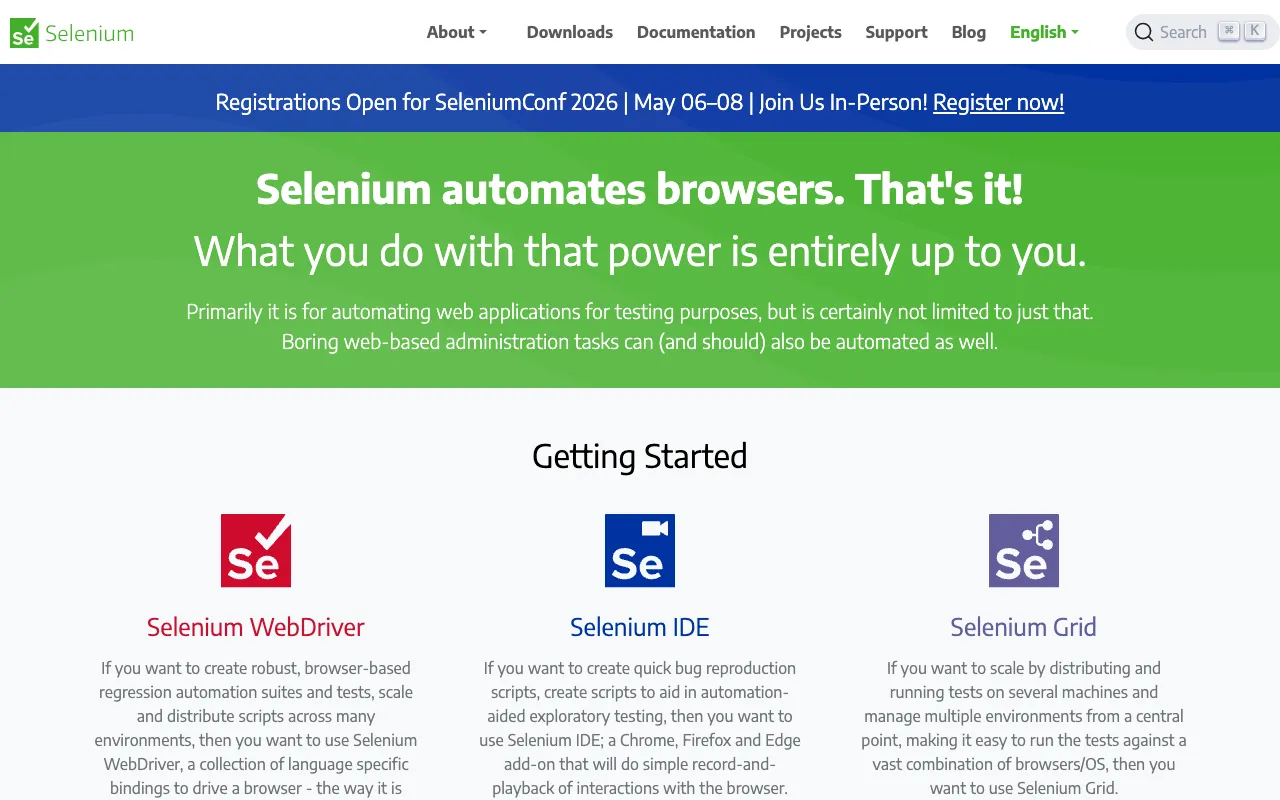
Image of Selenium – The Industry Standard for Web Test Automation

Selenium – The Industry Standard for Web Test Automation

Selenium is the foundational open-source framework for automating web browsers, empowering QA testers and developers to build reliable, repeatable tests. As the de facto standard for web automation, it supports a vast ecosystem of browsers—including Chrome, Firefox, Safari, and Edge—and integrates seamlessly with popular programming languages like Java, Python, C#, and JavaScript. Whether you're building end-to-end tests, regression suites, or complex workflow validations, Selenium provides the robust, scalable foundation needed for modern QA automation.

What is Selenium?

Selenium is not a single tool but a comprehensive suite of software tools designed to automate web browsers. At its core, Selenium WebDriver provides a programming interface to create and execute browser automation scripts, simulating real user interactions. It's the engine behind countless automated testing frameworks and CI/CD pipelines, enabling teams to verify application functionality, performance, and cross-browser compatibility efficiently. Its open-source nature and massive community have cemented its position as the most widely adopted solution for web-based QA automation.

Key Features of Selenium

Cross-Browser Compatibility

Execute your automation scripts across all major web browsers—Chrome, Firefox, Edge, Safari, and Opera—without modifying your core test logic. This ensures your web application delivers a consistent user experience regardless of the user's browser choice.

Multi-Language Support

Write tests in the language your team knows best. Selenium officially supports bindings for Java, Python, C#, Ruby, JavaScript (Node.js), and Kotlin, offering unparalleled flexibility and integration with existing development ecosystems.

Selenium WebDriver

The heart of modern Selenium automation. WebDriver provides a clean, object-oriented API for controlling browsers directly at the OS level. It communicates natively with each browser, offering faster and more stable automation compared to older, JavaScript-based methods.

Selenium Grid

Scale your test execution by running tests in parallel across multiple machines and browsers. Selenium Grid dramatically reduces feedback time, enabling massive test suites to run concurrently and accelerating your release cycles.

Extensive Ecosystem & Integration

Selenium integrates effortlessly with major testing frameworks (JUnit, TestNG, pytest, Mocha), build tools (Maven, Gradle), and CI/CD platforms (Jenkins, GitLab CI, GitHub Actions). This makes it the perfect cornerstone for a fully automated DevOps pipeline.

Who Should Use Selenium?

Selenium is ideal for QA Automation Engineers, SDETs (Software Development Engineers in Test), and developers responsible for ensuring web application quality. It's particularly valuable for teams building enterprise-scale web applications, SaaS platforms, or any product requiring rigorous cross-browser and regression testing. If your goal is to move from manual testing to automation, establish a continuous testing strategy, or build a robust, maintainable test suite, Selenium provides the proven foundation.

Selenium Pricing and Free Tier

Selenium is completely free and open-source, released under the Apache 2.0 license. There is no paid tier, enterprise license, or hidden costs. The entire framework—including Selenium WebDriver, Selenium Grid, and the IDE—is available for commercial and personal use without restriction. Its sustainability and development are driven by a massive, active global community and corporate contributions.

Common Use Cases

Key Benefits

Pros & Cons

Pros

  • Completely free and open-source with a permissive license for commercial use
  • Unmatched community support, extensive documentation, and vast learning resources
  • Industry-standard tool with proven reliability in thousands of production environments
  • Highly flexible and extensible, capable of automating the most complex web interactions

Cons

  • Requires programming knowledge to use WebDriver effectively, presenting a learning curve
  • Primarily designed for web UI automation; not suitable for desktop or mobile app testing (without additional tools)
  • Test maintenance can be challenging with dynamic web elements; requires good coding practices

Frequently Asked Questions

Is Selenium free to use?

Yes, Selenium is 100% free and open-source. The entire framework, including all its components (WebDriver, Grid, IDE), is available under the Apache 2.0 license with no cost for personal or commercial use.

Is Selenium good for QA automation?

Selenium is the leading tool for web-based QA automation. It is the industry standard for a reason: its robustness, cross-browser support, and integration capabilities make it the best foundational choice for building professional, scalable test automation suites for web applications.

What programming language is best for Selenium?

Selenium supports multiple languages. The 'best' choice depends on your team's expertise and tech stack. Java and Python are the most popular due to their extensive community support and integration with testing frameworks like TestNG/JUnit and pytest.

Can Selenium automate login and form submissions?

Absolutely. Selenium excels at automating complex user workflows, including logging into applications, filling out multi-step forms, uploading files, and navigating through dynamic web pages—making it perfect for end-to-end testing scenarios.

Conclusion

For any QA professional or development team serious about web automation, Selenium remains the indispensable, foundational tool. Its open-source nature, unparalleled browser support, and massive ecosystem provide a level of power and flexibility that proprietary tools struggle to match. While it demands an investment in programming skills, the payoff is a robust, scalable, and future-proof automation framework. For automating web applications reliably and at scale, Selenium is not just a good choice—it's the standard against which all others are measured.