Go back
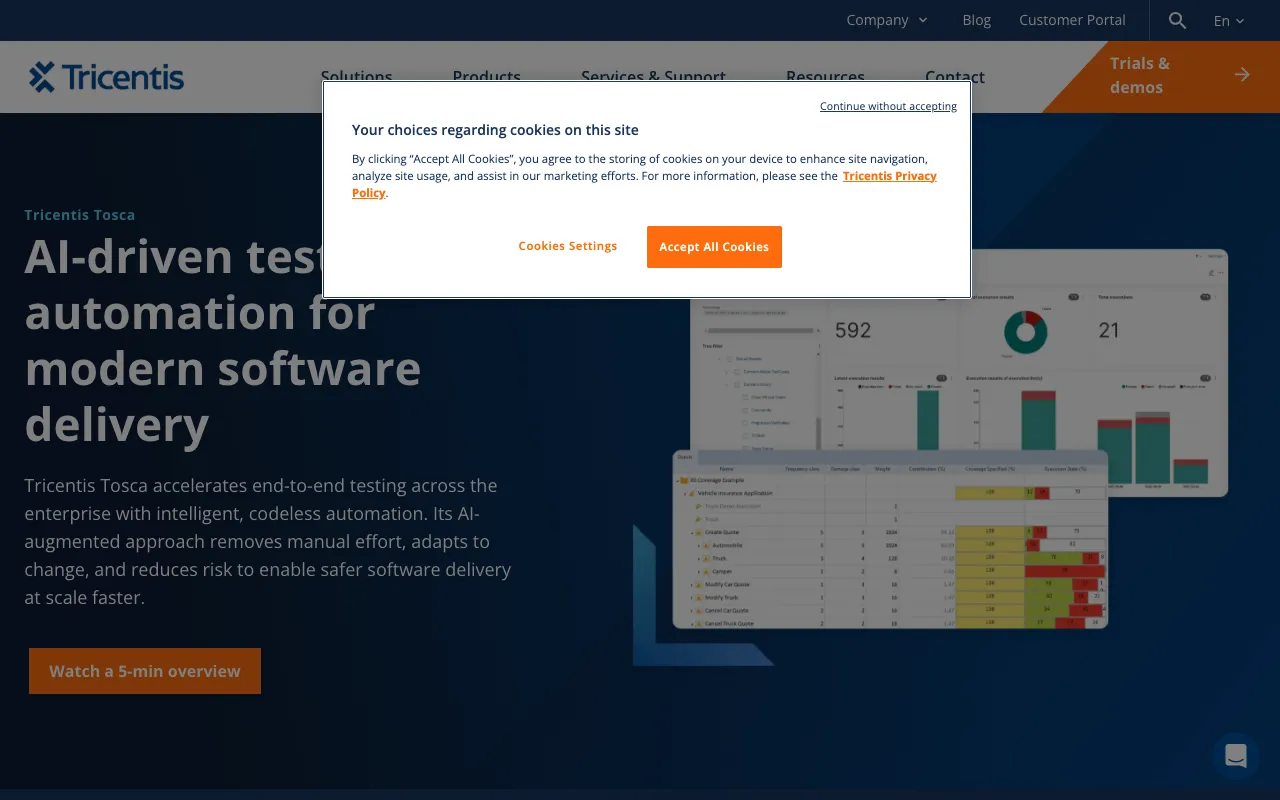
Image of Tricentis Tosca – Premier Model-Based Test Automation Suite

Tricentis Tosca – Premier Model-Based Test Automation Suite

Tricentis Tosca is a leading enterprise-grade, model-based test automation suite designed for QA testers and DevOps teams. It enables continuous testing of complex business applications through a codeless, AI-powered approach. By abstracting technical complexities, Tosca empowers teams to achieve greater test coverage, accelerate release cycles, and ensure application resilience, making it a cornerstone tool for modern software quality assurance.

What is Tricentis Tosca?

Tricentis Tosca is a comprehensive test automation platform built on a model-based methodology. Instead of scripting tests line-by-line, users create dynamic models of their application's structure and business logic. This model serves as a single source of truth for test cases, which Tosca automatically generates and executes. It specializes in end-to-end testing across a wide array of technologies—including web, mobile, APIs, mainframes, and packaged applications like SAP and Salesforce—making it ideal for large-scale, integrated enterprise environments where traditional automation tools struggle.

Key Features of Tricentis Tosca

Model-Based Test Automation

The core of Tosca's power lies in its model-based approach. You visually model application screens, elements, and data. Tosca's AI engine (Tosca Commander) then uses this model to auto-generate and maintain test cases. This drastically reduces script creation and maintenance time, increases reusability, and makes test automation accessible to non-technical team members.

End-to-End Continuous Testing

Tosca provides a unified platform for testing the entire application landscape. It integrates seamlessly into CI/CD pipelines (like Jenkins, Azure DevOps) to enable shift-left testing. Its distributed execution capabilities allow for parallel test runs across thousands of scenarios, providing fast feedback on application health with every build.

Risk-Based Testing & Analytics

Tosca goes beyond execution with integrated risk-based testing. It helps prioritize test cases based on business risk and code changes. Coupled with detailed analytics dashboards, teams gain actionable insights into test coverage, defect trends, and release readiness, enabling data-driven decisions about software quality.

Codeless Interface & SAP/Salesforce Specialization

With its drag-and-drop, codeless interface, Tosca lowers the barrier to advanced test automation. It offers deep, pre-built integrations and optimizations for enterprise resource planning (ERP) and CRM platforms like SAP and Salesforce, allowing for robust testing of complex business workflows without custom coding.

Who Should Use Tricentis Tosca?

Tricentis Tosca is engineered for medium to large enterprises with complex, multi-technology application stacks. It is the tool of choice for: Enterprise QA teams managing testing for large-scale SAP, Oracle, or Salesforce implementations; DevOps and CI/CD teams needing robust, pipeline-integrated automation for continuous delivery; Organizations facing challenges with test maintenance, seeking to move from fragile script-based automation to resilient model-based testing; and Business analysts or subject matter experts who need to contribute to test creation without learning programming languages.

Tricentis Tosca Pricing and Free Tier

Tricentis Tosca is a premium enterprise software solution and does not offer a traditional free tier or open-source version. Pricing is customized based on the specific modules required (e.g., Tosca Commander, Distributed Execution, API Testing), the scale of deployment, and the number of users. Prospective customers must contact Tricentis sales directly for a quote. They typically offer proof-of-concept engagements and detailed demonstrations to illustrate the platform's value and ROI for your specific testing environment.

Common Use Cases

Key Benefits

Pros & Cons

Pros

  • Powerful model-based automation drastically reduces script creation and maintenance effort
  • Exceptional support for complex enterprise environments, especially SAP and Salesforce
  • Comprehensive end-to-end testing capabilities across UI, API, and backend systems
  • Strong integration with CI/CD tools for seamless DevOps adoption

Cons

  • High cost and enterprise-focused pricing model can be prohibitive for small teams or startups
  • Steep initial learning curve associated with mastering the model-based paradigm and platform
  • Primarily a Windows-based desktop application, with less native support for macOS or Linux ecosystems

Frequently Asked Questions

Is Tricentis Tosca free to use?

No, Tricentis Tosca is not free. It is a commercial, enterprise-grade test automation suite with customized pricing. There is no public free tier or community edition. Interested organizations must contact Tricentis sales for a demonstration and pricing quote based on their specific needs.

Is Tricentis Tosca good for Agile and DevOps teams?

Yes, Tricentis Tosca is highly regarded for Agile and DevOps environments. Its model-based approach promotes reusability and faster test case creation, while its robust integrations with CI/CD tools (like Jenkins, Azure DevOps, GitLab) enable true continuous testing. Features like distributed execution and risk-based analysis help Agile teams get fast, actionable feedback on every build.

How does model-based testing in Tosca differ from Selenium?

While Selenium is a library for browser automation requiring manual scripting in languages like Java or Python, Tosca uses a visual, model-based approach. In Tosca, you model the application structure, and the tool auto-generates the test scripts. This makes Tosca tests generally more resilient to UI changes and accessible to non-coders, whereas Selenium offers more low-level control but requires more technical skill and maintenance effort.

Can Tricentis Tosca test mobile applications?

Yes, Tricentis Tosca includes capabilities for mobile application testing. It supports testing native, hybrid, and mobile web applications on both Android and iOS platforms. Testing can be performed on simulators, emulators, and real physical devices, integrating mobile tests into the same end-to-end business process workflows tested on web and desktop applications.

Conclusion

For QA testers and enterprise teams grappling with the complexity of testing large-scale, integrated applications, Tricentis Tosca stands as a powerful, strategic solution. Its model-based automation paradigm addresses the critical pain points of maintenance and scalability that plague traditional scripting tools. While the investment and learning curve are significant, the payoff in accelerated release velocity, comprehensive test coverage, and reduced long-term costs makes Tosca a top-tier choice for organizations committed to serious, continuous quality assurance. It is best suited for enterprises where software quality is directly tied to business risk and operational continuity.