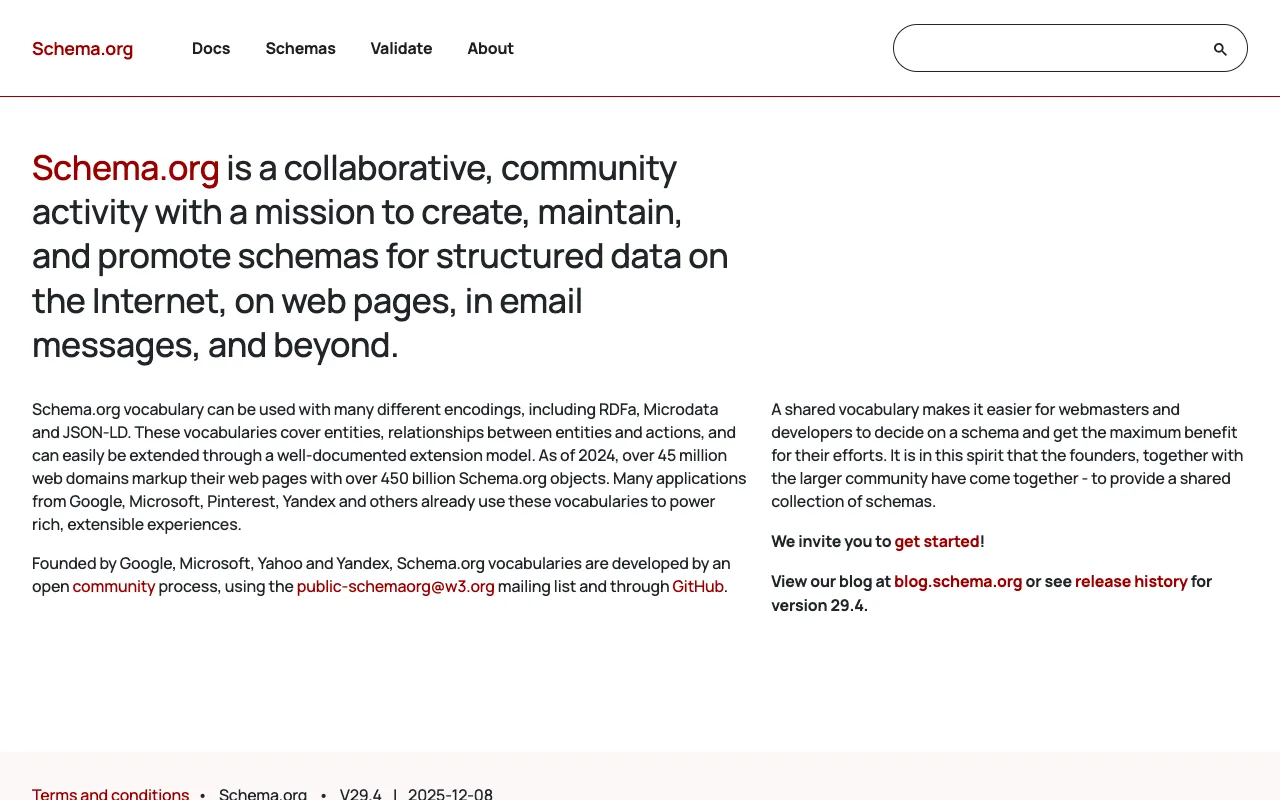
Schema.org – The Essential Vocabulary for SEO & Structured Data
Schema.org is the foundational vocabulary for implementing structured data markup on the web. This collaborative, open-source project provides the standardized schemas (types and properties) that search engines like Google, Bing, and Yahoo rely on to understand your content. For SEO specialists, mastering Schema.org is non-negotiable for unlocking rich results, improving click-through rates, and building a data-rich web presence that stands out in SERPs.
What is Schema.org?
Schema.org is not a software tool but a universal vocabulary for structured data. It is a collaborative initiative founded by Google, Microsoft, Yahoo, and Yandex to create, maintain, and promote schemas for markup on web pages. These schemas—like Article, Product, LocalBusiness, Event, and FAQPage—provide a common language that helps search engines interpret the context and meaning of your content. By implementing Schema.org markup (typically in JSON-LD format), you directly communicate the 'what' and 'how' of your content to search engines, enabling enhanced search features and improved organic performance.
Key Features of Schema.org for SEO
Comprehensive, Standardized Vocabulary
Schema.org offers an extensive, hierarchical library of schemas covering everything from creative works and organizations to products and events. This standardization ensures consistency and reliability across the web, giving search engines a trusted framework to parse your data.
Direct Path to Rich Results
Proper implementation of Schema.org markup is the primary requirement for generating rich snippets, rich cards, and knowledge panels in search results. This includes star ratings, product prices, event dates, recipe cook times, and FAQ accordions, which dramatically increase visibility and click-through rates.
Collaborative & Continuously Updated
As a community-driven project, Schema.org evolves with the web. New schemas and properties are regularly proposed and added based on real-world needs, ensuring the vocabulary remains relevant for modern SEO challenges and emerging content types.
Free and Open-Source Foundation
Schema.org is a completely free, open-access resource. There are no licenses, fees, or proprietary barriers. This openness has cemented its position as the de facto global standard for structured data, making it accessible to every developer and SEO professional.
Who Should Use Schema.org?
Schema.org is indispensable for SEO specialists, technical SEOs, web developers, and content marketers. It is critical for any business or website owner seeking to improve their search visibility through enhanced listings. E-commerce sites use Product and Offer schemas; local businesses implement LocalBusiness and OpeningHours; publishers rely on Article and NewsArticle; and service-based sites benefit from FAQPage and HowTo schemas. If your goal is to appear in rich results, feed knowledge graphs, or simply make your site's content machine-readable, Schema.org is your starting point.
Schema.org Pricing and Free Tier
Schema.org is a 100% free, open-source community project. There is no paid tier, subscription, or premium version. The entire vocabulary, documentation, and community resources are available at no cost. Its funding and stewardship come from the founding search engines and community contributions, ensuring it remains a free public good for the entire web ecosystem.
Common Use Cases
- Implementing local business Schema markup for better Google Business Profile integration
- Adding Product schema with price and availability for e-commerce rich snippets
- Using Article and NewsArticle schema to qualify for Top Stories carousel and enhanced headlines
- Structuring FAQ content with FAQPage schema to generate rich FAQ results in SERPs
- Marking up events with Event schema for prominent date and location display in search
Key Benefits
- Increases search visibility through eye-catching rich results and snippets
- Improves click-through rates (CTR) by providing more information directly in SERPs
- Helps search engines understand context and entity relationships on your pages
- Provides a direct communication channel to search engine algorithms
- Future-proofs your site for voice search and AI-driven search experiences
Pros & Cons
Pros
- Universally adopted standard supported by all major search engines
- Completely free and open-source with no usage limitations
- Extensive, well-documented vocabulary covering countless content types
- Directly enables rich results that improve CTR and organic performance
- Continuously updated by a collaborative community
Cons
- Requires technical implementation (JSON-LD, Microdata, or RDFa) which can be complex for beginners
- Is a vocabulary, not a tool—requires separate generators or manual coding for implementation
- Markup errors can occur and must be validated regularly using tools like Google's Rich Results Test
Frequently Asked Questions
Is Schema.org free to use?
Yes, absolutely. Schema.org is a free, open-source project. The entire vocabulary, documentation, and community resources are available at no cost. It is maintained as a public good by a collaborative community including major search engines.
Is Schema.org good for local SEO?
Essential. Implementing LocalBusiness schema with properties like name, address, phone number, opening hours, and geo-coordinates helps search engines verify and display your business information accurately. It strengthens your local SEO foundation and integrates with Google Business Profile data.
What's the difference between Schema.org and JSON-LD?
Schema.org is the vocabulary—the dictionary of available types (e.g., 'Product') and properties (e.g., 'price'). JSON-LD is one of the recommended formats (alongside Microdata and RDFa) for implementing that vocabulary on a web page. Think of Schema.org as the words and JSON-LD as the sentence structure.
Do I need to be a developer to use Schema.org?
While a technical understanding is beneficial for manual implementation, many tools and plugins (like SEO plugins for WordPress, Shopify apps, or online schema generators) can create the markup for you based on form inputs. However, an SEO specialist should understand the core concepts to guide implementation and validation.
Conclusion
For SEO specialists, Schema.org is not just another tool—it's the foundational language of the semantic web. Its role in enabling rich results, clarifying content intent for search engines, and improving user engagement in SERPs is unparalleled. While it requires a technical implementation step, the payoff in enhanced visibility and CTR is substantial. As search evolves towards more intelligent, context-aware results, a deep understanding of Schema.org's vocabulary will remain a critical competitive advantage. It is the definitive starting point for any serious structured data strategy.