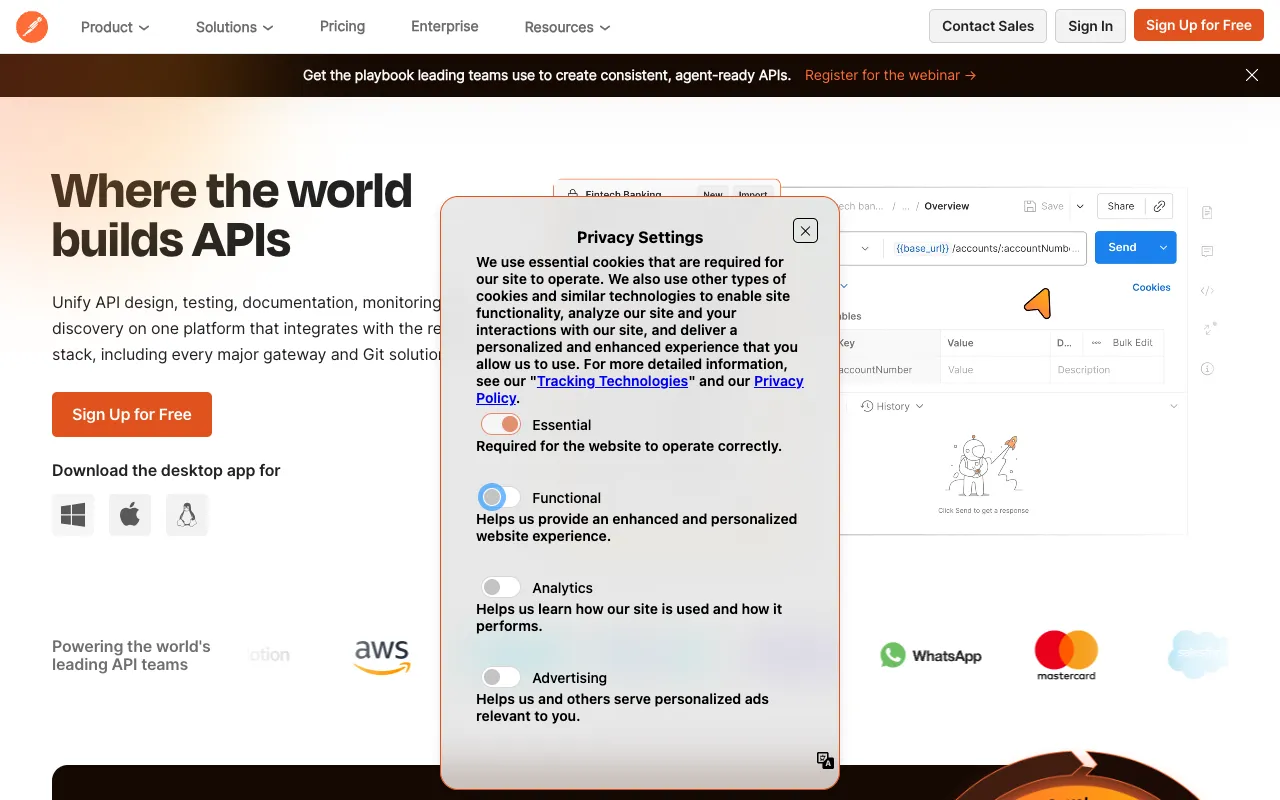
Postman – The Essential API Platform for Software Engineers
Postman has revolutionized how software engineers interact with APIs. More than just an API client, it's a complete collaborative platform that streamlines the entire API lifecycle—from design and testing to documentation and monitoring. Used by over 25 million developers worldwide, Postman eliminates friction in API workflows, enabling teams to build better software faster. Its intuitive interface and powerful feature set make it the undisputed leader for API development and integration.
What is Postman?
Postman is a comprehensive API platform designed specifically for the modern software development lifecycle. It provides a unified workspace where developers, testers, and product managers can design, mock, debug, test, document, and monitor APIs. Initially popular as a simple HTTP client for testing API endpoints, Postman has evolved into a full-featured ecosystem that supports API-first development, contract testing, and team collaboration at scale. It bridges the gap between frontend and backend development, ensuring APIs are reliable, well-documented, and easy to consume.
Key Features of Postman
API Client and Testing
The core of Postman is its powerful API client, allowing you to send HTTP requests (GET, POST, PUT, DELETE, etc.) with custom headers, authentication, and body data. It supports automated testing with JavaScript-based test scripts, enabling you to validate API responses, performance, and behavior. You can chain requests, use variables, and create complex testing scenarios for integration and regression testing.
API Documentation
Postman automatically generates beautiful, interactive, and up-to-date API documentation from your collections. This live documentation is synchronized with your API definitions, making it the single source of truth for both internal developers and external consumers. It includes code snippets in multiple languages, making integration straightforward.
Workspaces and Collaboration
Postman facilitates team collaboration through shared workspaces—personal, team, partner, and public. Teams can version control their API collections, monitor changes, and discuss APIs directly within the platform. This feature is crucial for maintaining consistency and knowledge sharing across distributed engineering teams.
API Monitoring and Mock Servers
Schedule automated checks to monitor your API's health, performance, and uptime from Postman's cloud. Create mock servers to simulate API endpoints before the backend is built, allowing frontend and mobile developers to work in parallel and accelerate development cycles.
Who Should Use Postman?
Postman is indispensable for a wide range of technical roles. Backend and full-stack engineers use it to develop and debug APIs. Frontend and mobile developers rely on it to integrate with backend services. QA engineers and SDETs utilize it for automated API testing. DevOps and SRE teams leverage its monitoring capabilities. Product managers and technical writers use the generated documentation. Essentially, any software professional involved in building, consuming, or maintaining modern web services will find immense value in Postman's unified platform.
Postman Pricing and Free Tier
Postman offers a generous and fully-featured Free plan, making it accessible to individual developers, students, and small teams. The free tier includes core features like the API client, collections, automated testing, mock servers, and monitoring (with limited calls). For advanced needs, Postman provides paid plans (Basic, Professional, Enterprise) that unlock features like advanced monitoring, custom domains for documentation, role-based access control, API governance, and increased collaboration limits for larger organizations.
Common Use Cases
- Automated API testing and continuous integration for DevOps pipelines
- Creating interactive API documentation for public or internal developer portals
- Debugging and troubleshooting microservices in a distributed architecture
- Mocking API responses for parallel frontend and backend development
Key Benefits
- Accelerates development velocity by streamlining the entire API lifecycle in one tool
- Improves software quality through automated testing, monitoring, and consistent documentation
- Enhances team collaboration and reduces silos between developers, testers, and product managers
Pros & Cons
Pros
- Industry-standard tool with an intuitive user interface and shallow learning curve
- Extremely powerful free tier suitable for most individual developers and small projects
- Excellent collaboration features that scale from small teams to large enterprises
- Vast ecosystem of public API collections and integrations
Cons
- Advanced features and higher usage limits require a paid subscription
- The desktop application can be resource-intensive on machines with limited RAM
- Very large collections with complex scripts can become difficult to manage without proper organization
Frequently Asked Questions
Is Postman free to use?
Yes, Postman offers a robust Free plan that includes the core API client, collections, automated testing, mock servers, and basic monitoring. This is sufficient for individual developers, students, and many small teams to build and test APIs effectively.
Is Postman good for API testing?
Absolutely. Postman is considered one of the best tools for API testing. It supports manual exploratory testing, automated test suites with JavaScript, performance testing, and contract testing. Its testing capabilities are integral to modern CI/CD pipelines for ensuring API reliability.
Can I use Postman for REST, GraphQL, and SOAP APIs?
Yes, Postman provides first-class support for REST APIs and has excellent built-in support for GraphQL, including schema introspection and query variables. It also supports testing SOAP APIs via WSDL imports, making it a versatile choice for various API architectures.
How does Postman help with team collaboration?
Postman enables collaboration through shared workspaces where teams can jointly work on API collections, environments, and documentation. Features include inline commenting, version history, change tracking, and role-based permissions, ensuring everyone stays aligned throughout the API development process.
Conclusion
For software engineers navigating the API-driven world of modern development, Postman is not just a tool—it's a foundational platform. Its seamless integration of design, testing, documentation, and monitoring into a single, collaborative environment addresses the core pain points of API development. Whether you're a solo developer prototyping a new service or part of a large enterprise managing hundreds of microservices, Postman's scalable approach and powerful free tier make it the unequivocal top choice. It empowers teams to build higher-quality software faster, making it an essential component of any professional software engineering toolkit.