Go back
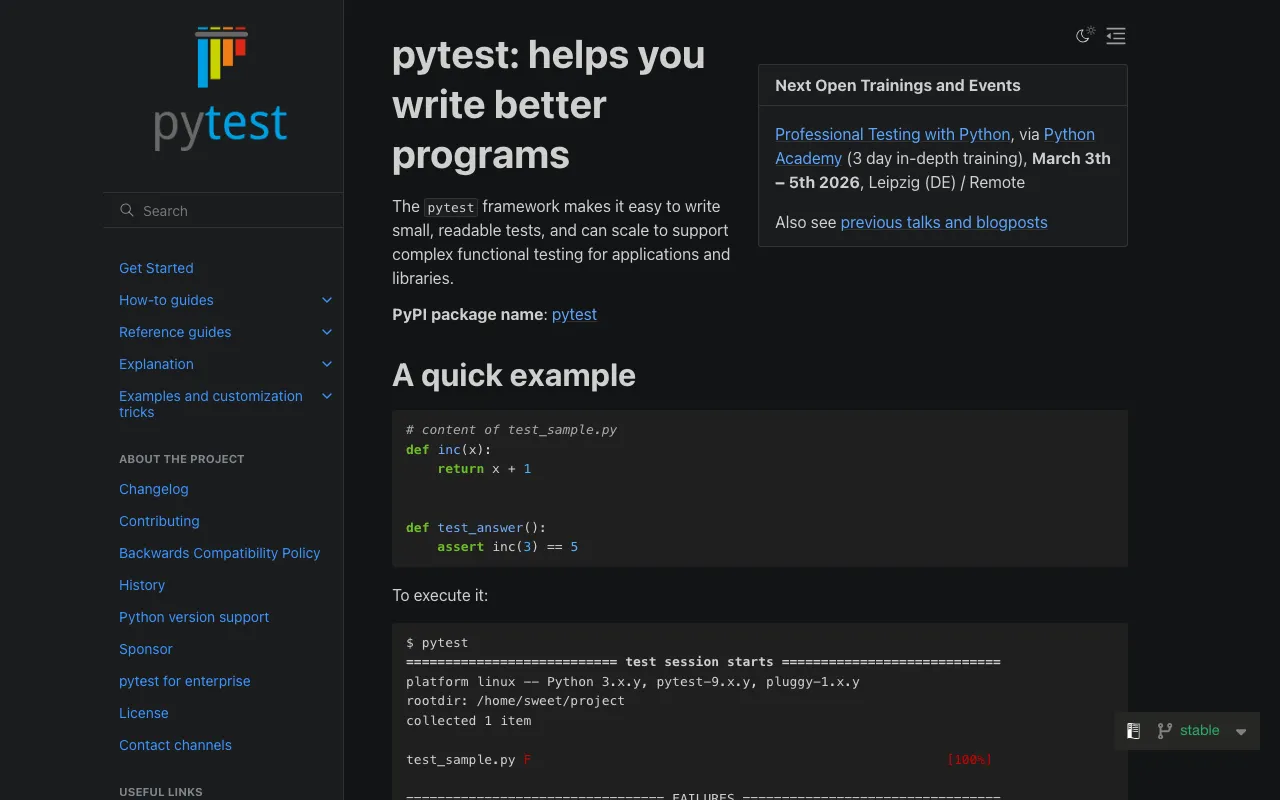
Image of pytest – The Best Python Testing Framework for Software Engineers

pytest – The Best Python Testing Framework for Software Engineers

pytest is the de facto standard testing framework for Python, trusted by developers worldwide to build robust and reliable software. It transforms the way you write tests by offering a clean, expressive syntax that reduces boilerplate code while providing powerful features for complex testing scenarios. Whether you're testing a simple script or a large-scale enterprise application, pytest scales effortlessly, making it an indispensable tool in every software engineer's toolkit.

What is pytest?

pytest is a mature, open-source testing framework designed specifically for Python. Its core philosophy is to make testing simple, scalable, and enjoyable. Unlike Python's built-in unittest module, pytest uses plain assert statements for assertions, leading to more readable and debuggable test failures. It automatically discovers and runs your test files and functions, supports powerful fixture management for test setup and teardown, and boasts a vast plugin architecture that extends its functionality for nearly any testing need. It's the go-to choice for developers prioritizing test quality, maintainability, and developer experience.

Key Features of pytest

Simple Assert Statements

Replace complex assertion methods with simple Python `assert` statements. pytest provides detailed introspection on failure, showing you the exact values that caused the test to fail, which dramatically speeds up debugging.

Powerful Fixture System

Manage test dependencies and state with a flexible fixture system. Fixtures provide reusable setup and teardown logic, allowing you to inject data, database connections, or API clients into your tests cleanly and efficiently, reducing code duplication.

Rich Plugin Ecosystem

Extend pytest's capabilities with hundreds of community-built plugins. Add code coverage reporting (pytest-cov), run tests in parallel (pytest-xdist), test Django or Flask applications, mock objects, and much more, tailoring the framework to your project's exact requirements.

Parameterized Testing

Run the same test logic with multiple different inputs using the `@pytest.mark.parametrize` decorator. This feature is essential for comprehensive testing of functions with various edge cases and data combinations, all from a single test function.

Who Should Use pytest?

pytest is essential for any Python developer or software engineering team focused on code quality. It is ideal for backend engineers building APIs and services, data scientists and engineers validating data pipelines and models, DevOps engineers writing integration tests, and QA automation specialists. Teams adopting Test-Driven Development (TDD) or Behavior-Driven Development (BDD) with tools like `pytest-bdd` will find it particularly powerful. From solo developers to large organizations, anyone writing Python code that needs to be reliable and maintainable should use pytest.

pytest Pricing and Free Tier

pytest is completely free and open-source software released under the MIT license. There is no paid tier, enterprise license, or subscription fee. All its core features, plugins, and the extensive documentation are available at no cost. This makes it an incredibly accessible and cost-effective testing solution for projects of all sizes, from personal open-source libraries to mission-critical commercial applications.

Common Use Cases

Key Benefits

Pros & Cons

Pros

  • Extremely readable test syntax that uses standard Python assert statements
  • Unmatched extensibility through a massive, actively maintained plugin ecosystem
  • Superior test output and failure reporting that speeds up debugging
  • Minimal boilerplate code, allowing developers to focus on test logic

Cons

  • New users familiar with `unittest` may face a slight learning curve for advanced features like fixtures
  • The abundance of plugins requires careful selection to maintain project dependency hygiene

Frequently Asked Questions

Is pytest free to use?

Yes, pytest is 100% free and open-source. It is released under the permissive MIT license, meaning you can use it for any purpose—personal, commercial, or open-source—without any cost or licensing restrictions.

Is pytest better than unittest for Python?

For most software engineering projects, yes. pytest is widely considered the superior choice due to its simpler syntax, powerful fixture system, rich plugin support, and more informative output. While unittest is part of the Python standard library, pytest requires a separate install but delivers a far more productive and scalable testing experience that saves development time.

How do I start using pytest in my project?

Getting started is straightforward. First, install pytest using pip (`pip install pytest`). Then, write test functions prefixed with `test_` in files named `test_*.py` or `*_test.py`. Finally, run `pytest` in your terminal from the project directory. pytest will automatically discover and execute all your tests.

Conclusion

pytest stands as the definitive testing framework for the Python ecosystem, offering an unparalleled combination of simplicity, power, and flexibility. Its ability to scale from basic unit tests to complex integration suites, coupled with a vibrant plugin community, makes it the most pragmatic choice for software engineers committed to building high-quality, reliable applications. For any Python project where code integrity matters, adopting pytest is not just a best practice—it's a strategic investment in your development workflow and product stability.