Go back
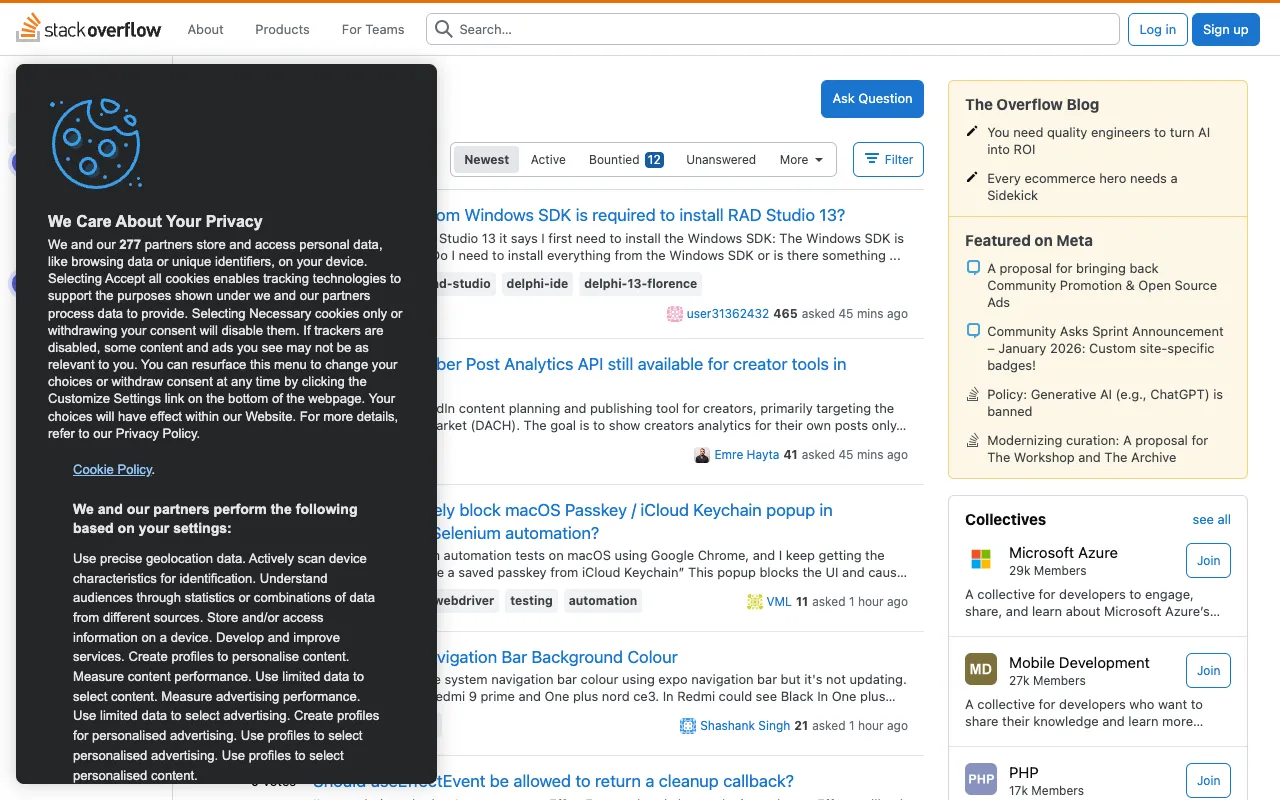
Image of Stack Overflow – The Essential Q&A Community for Software Engineers

Stack Overflow – The Essential Q&A Community for Software Engineers

Stack Overflow is the cornerstone of the modern developer ecosystem, a massive, community-driven Q&A platform where millions of software engineers find solutions, share knowledge, and collaborate on coding challenges. It's more than just a website; it's an indispensable tool for troubleshooting, learning new technologies, and validating best practices. For developers at all levels, from beginners to seasoned architects, Stack Overflow transforms individual problem-solving into a collective intelligence resource, dramatically reducing debugging time and accelerating project development.

What is Stack Overflow?

Stack Overflow is a specialized, community-moderated question-and-answer website focused on programming and software development. It operates on a reputation-based system where users earn points (reputation) for asking insightful questions, providing accurate answers, and suggesting helpful edits. This self-regulating model ensures high-quality, peer-reviewed content. The platform covers an exhaustive range of topics, including specific programming languages (Python, JavaScript, Java, C#), frameworks (React, .NET, Spring), databases, DevOps, system architecture, and software engineering methodologies. It serves as a real-time knowledge base, a learning resource, and a professional network for the global developer community.

Key Features of Stack Overflow

Vast, Searchable Knowledge Base

With tens of millions of answered questions, Stack Overflow functions as the internet's de facto technical manual. Its powerful, Google-indexed search allows developers to find solutions to common and obscure errors within seconds. The platform's structure ensures answers are ranked by community votes, pushing the most accurate and effective solutions to the top.

Community-Driven Quality Control

Content is curated by its users through upvotes, downvotes, edits, comments, and flagging. This collective moderation maintains technical accuracy, discourages low-quality posts, and ensures the information remains relevant and up-to-date. The reputation system incentivizes users to contribute valuable content.

Tags and Topic Organization

Questions are meticulously categorized using a robust tagging system. Developers can follow specific tags (like `reactjs`, `python-3.x`, or `docker`) to create a personalized feed of relevant problems and solutions, making it an excellent tool for continuous learning in a chosen tech stack.

Integrated Developer Tools

The platform includes features tailored for coders, such as syntax highlighting for over 100 languages, a built-in code snippet runner for certain languages, and direct integration with tools like GitHub. This creates a seamless environment for sharing and testing code within the Q&A context.

Who Should Use Stack Overflow?

Stack Overflow is fundamental for anyone involved in software creation. It is essential for junior developers learning to debug and understand new concepts, mid-level engineers optimizing code and exploring advanced patterns, and senior developers/architects researching edge cases or validating system design decisions. It's equally valuable for DevOps engineers, data scientists, QA automation specialists, and technical leads. Companies also leverage Stack Overflow for Teams, a private version, to build internal knowledge bases and streamline team collaboration, making it a versatile tool for both individual and organizational use.

Stack Overflow Pricing and Free Tier

The core public Q&A platform at StackOverflow.com is completely free to use for all users—asking questions, answering, searching, and learning incur no cost. This free tier is supported by advertising and is the primary resource for the global developer community. For businesses seeking a private, secure collaboration space, Stack Overflow offers 'Stack Overflow for Teams,' a paid SaaS product with tiered pricing (Basic, Business, Enterprise) that provides a dedicated, company-specific Q&A knowledge base, advanced analytics, and administrative controls.

Common Use Cases

Key Benefits

Pros & Cons

Pros

  • Unparalleled breadth and depth of solved programming problems, covering nearly every conceivable issue.
  • Community moderation ensures high-quality, accurate, and up-to-date technical answers.
  • Completely free for public use, making expert knowledge accessible to all developers.
  • Excellent search engine optimization (SEO), making solutions easily discoverable via Google.

Cons

  • Community can sometimes be unwelcoming to poorly-researched or duplicate questions from new users.
  • Information can become outdated if older, highly-voted answers are not revised for newer language/framework versions.
  • The public nature means proprietary or sensitive business logic cannot be discussed openly.

Frequently Asked Questions

Is Stack Overflow free to use?

Yes, the primary Stack Overflow public Q&A community is completely free. You can search, ask questions, answer, and participate without any cost. Stack Overflow generates revenue through advertising and its paid 'for Teams' enterprise product.

Is Stack Overflow good for beginner software engineers?

Absolutely. Stack Overflow is an invaluable learning tool for beginners. It's crucial, however, to learn how to use it effectively: search thoroughly before asking, learn to phrase questions clearly, and understand how to apply found solutions to your specific context. It's a masterclass in real-world problem-solving.

How does Stack Overflow's reputation system work?

Users earn reputation points by contributing positively to the community: receiving upvotes on questions or answers, having answers accepted, or suggesting helpful edits. Reputation unlocks privileges like voting, commenting, and moderation tools. It's a gamified system designed to reward and identify trusted, knowledgeable community members.

Conclusion

For over a decade, Stack Overflow has proven itself as the non-negotiable, foundational tool in a software engineer's toolkit. No other resource combines immediate problem-solving utility with continuous, community-powered learning at such scale. While mastering its etiquette is part of the journey, the payoff is immense: faster development cycles, higher-quality code, and direct access to the collective wisdom of millions of developers. Whether you're stuck on a cryptic error or researching the optimal architecture for a new microservice, Stack Overflow remains the first and most reliable port of call.