Swagger – Best API Development Tool for Software Engineers
Swagger is the industry-standard open-source toolkit that empowers software engineers and development teams to streamline the entire RESTful API lifecycle. From initial design and interactive documentation to automated testing and client SDK generation, Swagger provides a unified, human- and machine-readable specification (OpenAPI) that bridges the gap between planning and production. Trusted by millions, it's the foundational tool for building robust, well-documented, and easily consumable web services.
What is Swagger?
Swagger is a powerful suite of open-source tools built around the OpenAPI Specification (OAS), a standard, language-agnostic interface description for REST APIs. It transforms how teams approach API development by establishing a single source of truth for an API's structure. This specification-first approach enables developers to design APIs with precision, generate interactive documentation automatically, produce server stubs and client SDKs in numerous languages, and create comprehensive test suites—all before a single line of backend code is written. It’s the cornerstone of modern API-driven development, fostering collaboration between frontend, backend, and QA engineers.
Key Features of Swagger
OpenAPI Specification (OAS)
At its core, Swagger utilizes the OpenAPI Specification, a vendor-neutral, widely adopted standard for describing RESTful APIs. This machine-readable YAML or JSON file defines every endpoint, parameter, data model, authentication method, and response code, serving as the contract between API providers and consumers.
Swagger UI & Interactive Documentation
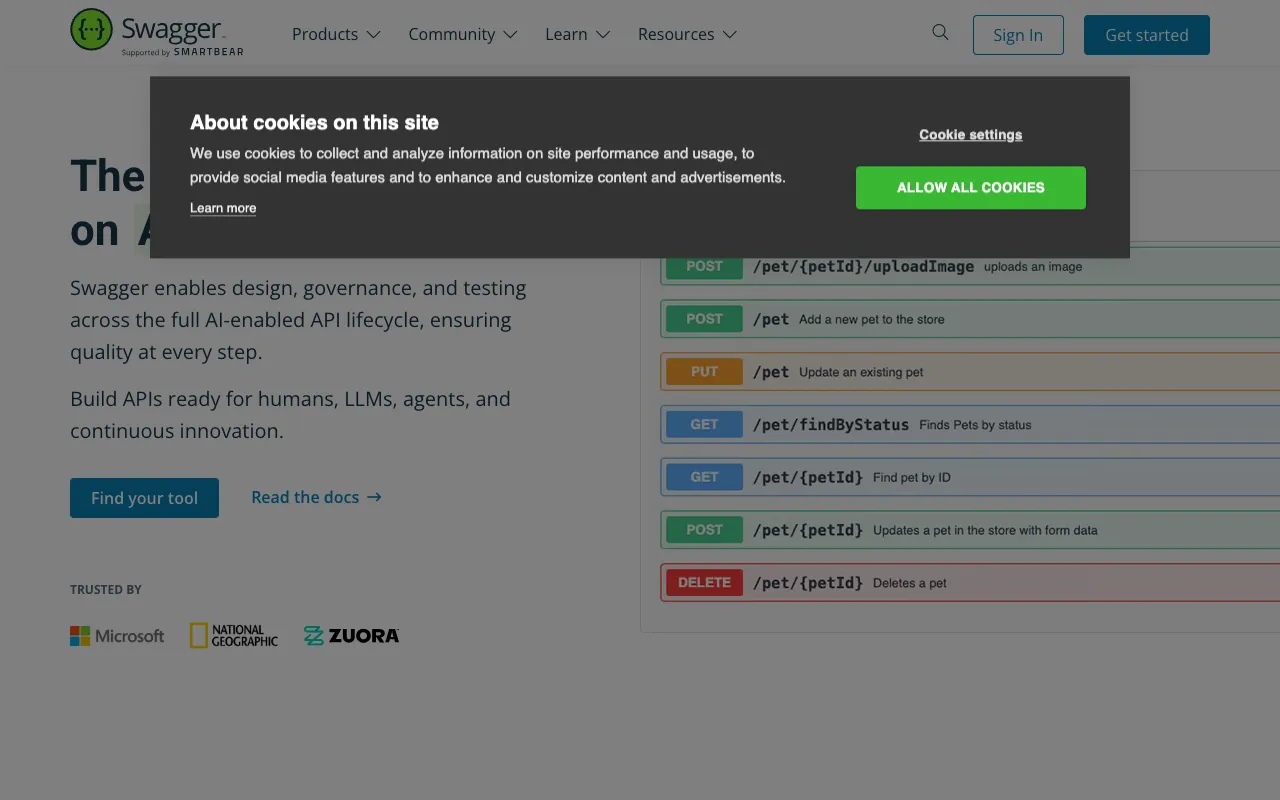
Automatically generate beautiful, interactive API documentation from any OpenAPI definition. Swagger UI allows developers and end-users to explore API endpoints directly in the browser, make live API calls with real data, and see formatted responses without any external client.
Swagger Editor & API Design
Design your API with real-time validation and preview using the Swagger Editor. This browser-based tool provides syntax highlighting, auto-completion, and instant visual feedback, enabling an efficient design-first workflow that catches errors early.
Swagger Codegen
Dramatically accelerate development by automatically generating server stubs in frameworks like Spring Boot, Node.js, or Flask, and client SDKs in languages including Python, Java, JavaScript, C#, and Go—all from your OpenAPI spec. Ensures consistency and reduces boilerplate code.
SwaggerHub Integration
For teams requiring advanced collaboration and hosting, SwaggerHub (the commercial platform) builds on the open-source tools, offering features like version control, centralized definitions, team workspaces, and API governance—seamlessly extending the Swagger ecosystem.
Who Should Use Swagger?
Swagger is indispensable for any software engineer, team, or organization building or consuming web APIs. It is particularly valuable for: API Developers designing and implementing backend services; Frontend and Mobile Engineers who need reliable client SDKs and clear API contracts; QA Engineers creating automated integration tests; Technical Writers producing accurate API documentation; and Architect/Team Leads enforcing API design standards and governance across large projects or microservices architectures.
Swagger Pricing and Free Tier
The core Swagger toolset—including Swagger UI, Swagger Editor, and Swagger Codegen—is completely open-source and free to use forever. You can download, modify, and deploy these tools without cost. Swagger.io also offers SwaggerHub, a commercial SaaS platform with advanced features for teams, which operates on a freemium model. The SwaggerHub Free plan supports individual users with basic design and documentation features, while paid tiers (Starting, Team, Enterprise) unlock collaboration, hosting, governance, and API lifecycle management tools for professional teams.
Common Use Cases
- Design-first API development for Spring Boot microservices
- Generating Python client SDKs for a public REST API
- Creating interactive documentation for a Node.js backend API
- Automating API contract testing between frontend and backend teams
Key Benefits
- Reduces development time and errors through specification-driven code generation
- Improves team collaboration and onboarding with a single, interactive API source of truth
- Enhances API adoption and developer experience with self-service, explorable documentation
- Ensures API consistency and quality across large-scale distributed systems
Pros & Cons
Pros
- Completely free and open-source core toolset
- Industry-standard OpenAPI Specification ensures wide compatibility
- Massively accelerates development with automated code generation
- Eliminates outdated documentation through auto-generated interactive docs
- Vast ecosystem and strong community support
Cons
- Learning curve for mastering the OpenAPI Specification syntax
- Advanced team features (hosting, governance) require paid SwaggerHub plan
- Initial setup and integration into CI/CD pipelines requires configuration
Frequently Asked Questions
Is Swagger free to use?
Yes, the fundamental Swagger tools (Swagger UI, Editor, Codegen) are 100% free and open-source. You can use them for personal and commercial projects without any licensing fees. The commercial platform, SwaggerHub, offers a free individual plan with paid upgrades for teams.
Is Swagger good for API documentation?
Swagger is arguably the best tool for API documentation. Swagger UI automatically generates interactive, live documentation from your OpenAPI spec, allowing users to test endpoints directly in their browser. This creates accurate, always-up-to-date docs that are far superior to static manuals, dramatically improving the developer experience for API consumers.
What is the difference between Swagger and OpenAPI?
OpenAPI is the specification standard (formerly known as Swagger Specification). Swagger is the family of open-source tools (like Swagger UI and Swagger Codegen) that implement and work with the OpenAPI Specification. Think of OpenAPI as the blueprint and Swagger as the tools to read, write, and build from that blueprint.
Can Swagger generate code?
Absolutely. Swagger Codegen is a core tool that can generate server stubs (boilerplate code for frameworks like Express, Flask, Spring) and client SDKs (libraries in languages like Python, JavaScript, Java) directly from your OpenAPI definition. This ensures your implementation matches your design contract perfectly.
Conclusion
For any software engineer serious about building professional, scalable, and well-documented RESTful APIs, Swagger is a non-negotiable addition to the toolkit. Its open-source foundation, centered on the universal OpenAPI standard, provides unparalleled value by unifying design, documentation, testing, and code generation into a cohesive workflow. By adopting a Swagger-driven, specification-first approach, teams can ship higher-quality APIs faster, reduce integration friction, and foster better collaboration. Whether you're a solo developer leveraging the free tools or an enterprise team on SwaggerHub, integrating Swagger is a strategic investment in modern API excellence.