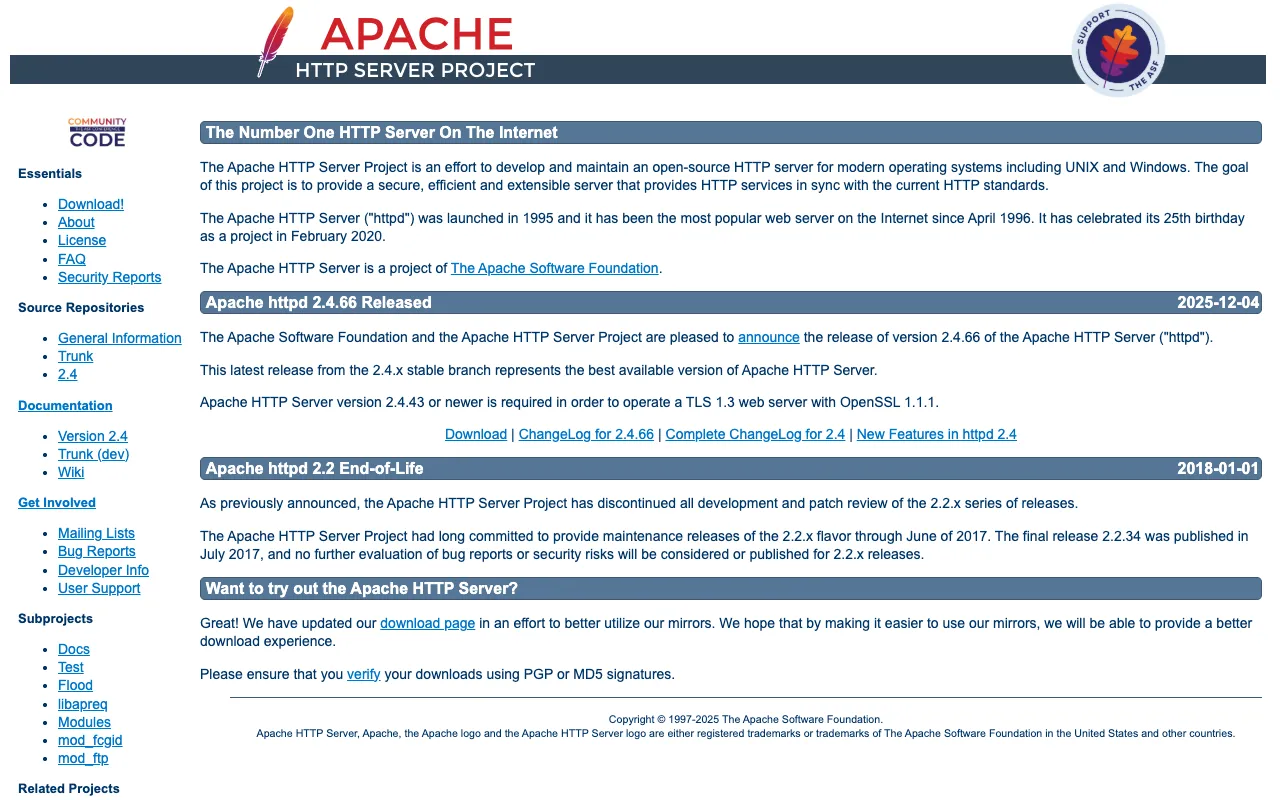
Apache HTTP Server – The World's Most Trusted Open-Source Web Server
Apache HTTP Server is the cornerstone of the modern web, powering millions of websites and applications worldwide. As a free, open-source, and cross-platform web server, Apache delivers unparalleled reliability, security, and extensibility for developers, system administrators, and businesses of all sizes. Whether you're deploying a simple static site, a complex dynamic application, or a high-traffic enterprise platform, Apache provides the robust, battle-tested foundation you need. Its modular architecture and active community support have made it the de facto standard for web serving for over two decades.
What is the Apache HTTP Server?
The Apache HTTP Server, commonly referred to as Apache, is a free and open-source web server software developed and maintained by the Apache Software Foundation. Released under the permissive Apache License 2.0, it runs on virtually all major operating systems including Linux, Windows, and macOS. Its primary function is to serve web content—like HTML pages, images, and API responses—to client browsers over the HTTP/HTTPS protocols. Apache's core strength lies in its modular design, which allows developers to extend its functionality with modules for security (mod_security), caching (mod_cache), URL rewriting (mod_rewrite), and more, tailoring it to any hosting need.
Key Features of Apache HTTP Server
Modular Architecture
Apache's power stems from its dynamic module system. Core functionalities like serving static files are built-in, while advanced features are loaded as modules. This allows for a lean, performant base installation that can be extended with modules for SSL/TLS (mod_ssl), compression (mod_deflate), authentication, load balancing, and custom scripting languages. You only enable what you need, optimizing both performance and security.
.htaccess File & URL Rewriting
Apache's .htaccess files give developers decentralized control over directory-level configuration without restarting the server. This is especially powerful when paired with mod_rewrite, which allows for sophisticated URL manipulation. Developers can create clean, user-friendly URLs, redirect traffic, implement security rules, and manage access controls directly through these configuration files, offering immense flexibility for shared hosting and application deployment.
Robust Security & Authentication
Security is a primary focus. Apache supports a wide range of authentication methods (Basic, Digest) and can integrate with databases and LDAP. Modules like mod_security act as a web application firewall (WAF) to protect against common attacks like SQL injection and cross-site scripting (XSS). Fine-grained access control can be configured per directory, IP address, or user agent.
Virtual Hosting
Apache excels at virtual hosting, allowing a single server to host multiple websites and domains from one machine. You can configure name-based or IP-based virtual hosts, each with its own document root, configuration, and SSL certificate. This makes Apache an extremely cost-effective solution for hosting providers and developers managing several projects.
Extensive Logging & Monitoring
Comprehensive and customizable logging is built-in. Apache provides detailed access and error logs, which can be formatted and directed as needed. This data is crucial for traffic analysis, debugging, security auditing, and monitoring server health. Tools can easily parse these logs for analytics and insights.
Who Should Use Apache HTTP Server?
Apache HTTP Server is the ideal choice for a broad spectrum of users. Web developers appreciate its .htaccess flexibility for framework deployment (like Laravel or WordPress). System administrators and DevOps engineers value its stability and deep configurability for enterprise environments. Shared hosting providers rely on its secure multi-tenant capabilities via virtual hosting. It's also perfect for students and hobbyists learning web server management due to its vast documentation and community support. Essentially, anyone needing a reliable, customizable, and free web server for static sites, dynamic applications, or API backends will find Apache up to the task.
Apache HTTP Server Pricing and Free Tier
The Apache HTTP Server is completely free and open-source software (FOSS). There is no cost for downloading, using, or modifying the software, in line with the Apache License 2.0. This includes all core features, security updates, and community support. There is no 'free tier' with limitations—the entire, fully-featured web server is available at no charge. Costs are typically associated with the server infrastructure (hardware, cloud VPS), domain names, and SSL certificates, not the Apache software itself.
Common Use Cases
- Hosting WordPress sites with optimized .htaccess rules for permalinks and security
- Serving static websites and single-page applications (SPAs) with efficient caching headers
- Setting up a reverse proxy or load balancer for backend application servers
- Creating a local development environment that mirrors production server configuration
Key Benefits
- Zero software licensing costs, reducing total cost of ownership for web projects
- Unmatched flexibility and control over server behavior through modular configuration
- Proven stability and reliability, capable of handling high-traffic enterprise workloads
- Strong security posture with regular updates and a vast ecosystem of security modules
Pros & Cons
Pros
- Completely free and open-source with a permissive license
- Extremely mature, stable, and trusted by a massive global community
- Highly flexible and configurable via modules and .htaccess files
- Excellent documentation and decades of collective troubleshooting knowledge online
- Native support for virtual hosting on a single server
Cons
- Can have higher memory usage per connection compared to newer event-driven servers like Nginx under extreme concurrent load
- Configuration syntax has a learning curve for complex setups
- .htaccess files, if overused, can impact performance due to directory-level parsing
Frequently Asked Questions
Is Apache HTTP Server free to use?
Yes, absolutely. Apache HTTP Server is 100% free and open-source software released under the Apache License 2.0. You can download, use, modify, and distribute it for both personal and commercial projects without any licensing fees.
Is Apache HTTP Server good for hosting WordPress?
Yes, Apache is an excellent and very common choice for hosting WordPress. Its mod_rewrite module is essential for WordPress's pretty permalink structure, and .htaccess files allow for easy configuration of caching, security headers, and redirects, which are crucial for WordPress performance and SEO.
What's the difference between Apache and Nginx?
Apache uses a process-driven or thread-driven architecture (MPM), which is very robust and flexible with per-directory (.htaccess) configuration. Nginx uses an asynchronous, event-driven architecture, often making it more efficient at serving static content under very high concurrent connections. Many modern setups use both: Nginx as a reverse proxy/static file server in front of Apache for dynamic content, combining the strengths of both.
How do I install and configure Apache?
Installation varies by OS. On Ubuntu/Debian, use `sudo apt install apache2`. On CentOS/RHEL, use `sudo yum install httpd`. Basic configuration files are located in `/etc/apache2/` (Debian) or `/etc/httpd/` (RHEL). The official Apache documentation provides comprehensive guides for initial setup, virtual hosts, and module enabling.
Conclusion
For over 25 years, the Apache HTTP Server has proven itself as the bedrock of the internet. Its combination of unwavering reliability, deep configurability, and strong security—all at zero cost—makes it an indispensable tool for any web developer's toolkit. While newer alternatives exist for specific high-concurrency scenarios, Apache's flexibility, particularly through .htaccess and modules, remains unmatched for general-purpose web serving, application hosting, and development work. For building a stable, secure, and fully-controlled web presence, Apache continues to be a top-tier, authoritative choice.