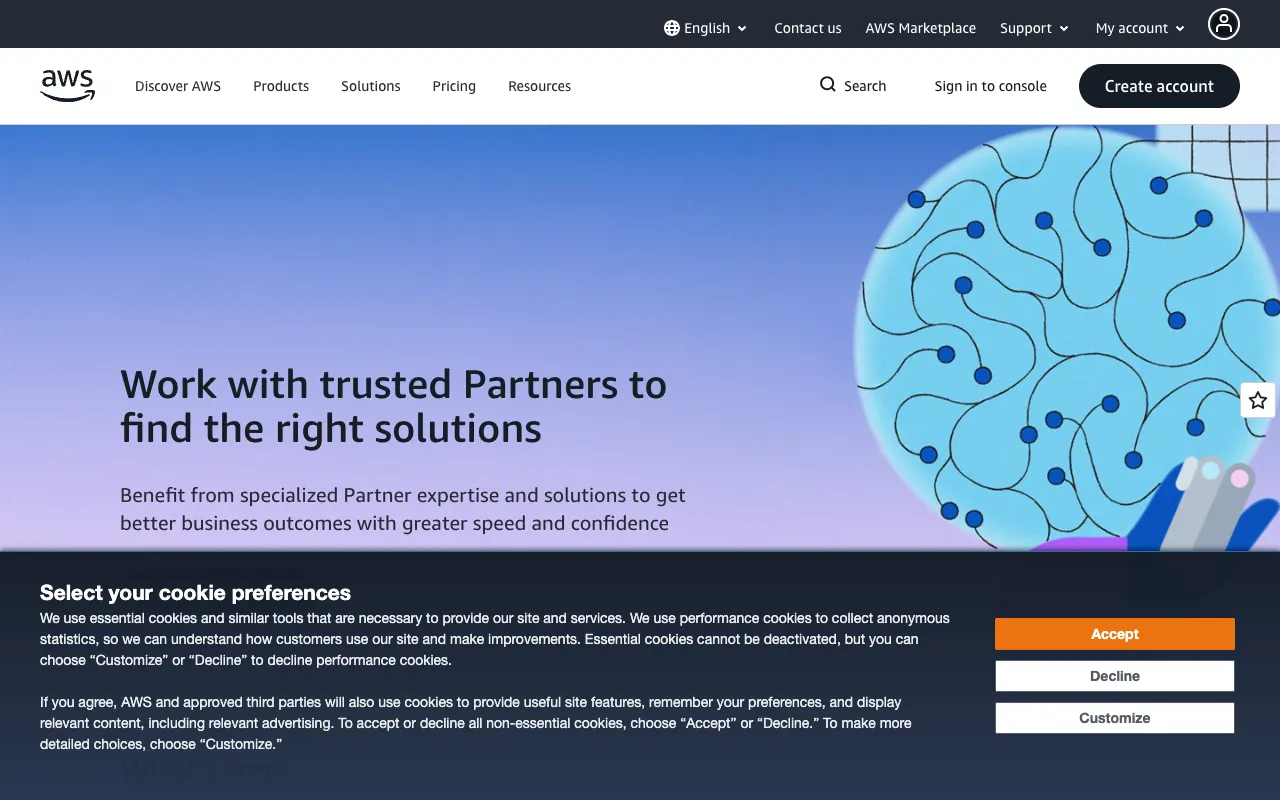
AWS (Amazon Web Services) – The Best Cloud Platform for Web Developers
Amazon Web Services (AWS) is the undisputed leader in cloud computing, providing web developers with an unparalleled suite of over 200 services to build, deploy, and scale any application imaginable. From simple static websites to complex, global microservices architectures, AWS offers the reliability, scalability, and developer tools needed to bring modern web projects to life. Its extensive free tier and pay-as-you-go pricing make it the most accessible and powerful cloud platform for developers at every level.
What is AWS (Amazon Web Services)?
Amazon Web Services is a comprehensive, on-demand cloud computing platform provided by Amazon. It delivers a massive array of infrastructure services like computing power, storage, and databases, alongside cutting-edge technologies like machine learning, IoT, and serverless computing. For web developers, AWS is more than just hosting; it's a complete ecosystem that removes the heavy lifting of managing physical servers, allowing you to focus purely on writing code and innovating. With data centers spread across the globe, AWS ensures your applications are fast, resilient, and available to users anywhere.
Key Features of AWS for Web Developers
Elastic Compute Cloud (EC2)
EC2 provides resizable virtual servers in the cloud, giving you complete control over your computing resources. You can launch instances with various operating systems, configure security and networking, and scale capacity up or down in minutes. It's the foundational service for hosting web applications, backend APIs, and development environments.
Simple Storage Service (S3)
Amazon S3 is object storage built to store and retrieve any amount of data from anywhere. It's the industry standard for hosting static websites, storing user uploads, application assets, and backup files. With 99.999999999% durability, your data is incredibly secure and always available.
Relational Database Service (RDS)
AWS RDS simplifies setting up, operating, and scaling relational databases like PostgreSQL, MySQL, and Aurora. It handles routine database tasks such as provisioning, patching, backup, and recovery, allowing developers to manage application data without becoming full-time database administrators.
AWS Lambda (Serverless)
Lambda lets you run code without provisioning or managing servers. You pay only for the compute time you consume. This is perfect for building scalable backend APIs, processing data, and automating tasks. It represents the future of cloud-native development, enabling incredible scalability with minimal operational overhead.
Amplify
AWS Amplify is a set of tools and services specifically designed to help frontend web and mobile developers build full-stack applications faster. It provides a CLI, libraries, and a console for features like authentication, APIs, hosting, and data storage, dramatically accelerating development cycles.
Who Should Use AWS?
AWS is ideal for a vast range of users. Startup founders and indie hackers can leverage the free tier to build MVPs with enterprise-grade infrastructure at zero cost. Enterprise development teams use it to host mission-critical applications with global reach and compliance certifications. DevOps engineers rely on its automation and infrastructure-as-code tools. Full-stack and frontend developers use services like Amplify and Lambda to build modern, serverless applications efficiently. Essentially, any web developer or team looking for scalable, reliable, and innovative cloud services should consider AWS.
AWS Pricing and Free Tier
AWS operates on a pay-as-you-go pricing model, meaning you only pay for the individual services you use, for as long as you use them, with no long-term contracts. Crucially, AWS offers a substantial Free Tier for 12 months, which includes 750 hours per month of EC2 Linux t2.micro instance usage, 5GB of S3 storage, and free usage tiers for Lambda, DynamoDB, and many other services. This makes it exceptionally cost-effective for learning, prototyping, and running small-scale applications. Beyond the free tier, costs scale transparently with your usage, providing flexibility for projects of any size.
Common Use Cases
- Hosting a high-traffic React or Vue.js application with AWS Amplify and S3
- Building a scalable REST API backend using AWS Lambda and API Gateway
- Deploying a containerized microservices architecture with Amazon ECS or EKS
Key Benefits
- Unmatched global scalability to handle traffic spikes from 10 to 10 million users seamlessly
- Reduced operational overhead by offloading server management, security, and maintenance to AWS
- Faster time-to-market with pre-built services for auth, databases, and machine learning, allowing developers to focus on core logic
Pros & Cons
Pros
- Largest selection of cloud services and continuous innovation
- Industry-leading reliability and global infrastructure with 99.99% uptime SLAs
- Robust free tier and flexible, pay-as-you-go pricing model
- Superior security and compliance certifications (SOC, ISO, PCI DSS)
- Extensive documentation, training resources, and large community support
Cons
- Pricing can become complex to estimate and manage at very large scales
- The vast array of services has a steep initial learning curve
- Some advanced enterprise features and support plans can be expensive
Frequently Asked Questions
Is AWS free to use for web developers?
Yes, AWS offers a generous 12-month Free Tier that is perfect for web developers. It includes 750 hours/month of EC2 compute, 5GB of S3 storage, and free usage of Lambda, DynamoDB, and many other core services. This allows developers to learn, build prototypes, and even run small production applications at no cost.
Is AWS good for beginner web developers?
Absolutely. While AWS is powerful, its Free Tier and services like AWS Amplify are specifically designed to lower the barrier to entry. Beginner developers can start by hosting static sites on S3, using Amplify for full-stack apps, and gradually explore more services. The extensive documentation and tutorials make it a fantastic learning platform.
What is the best AWS service to start with for web hosting?
For simple static websites (HTML, CSS, JS), Amazon S3 static website hosting is the easiest and most cost-effective starting point. For dynamic applications, begin with an EC2 instance or, for a more modern approach, use AWS Amplify Hosting which provides a CI/CD pipeline and serverless backend integration.
Conclusion
For web developers seeking a powerful, scalable, and future-proof cloud foundation, AWS remains the definitive choice. Its combination of breadth (over 200 services), depth (enterprise-grade features), and accessibility (a robust free tier) is unmatched. Whether you're building your first portfolio site or architecting a global SaaS platform, AWS provides the tools, reliability, and community to support your journey. Start with the free tier to explore its capabilities—it's the industry standard for a reason.