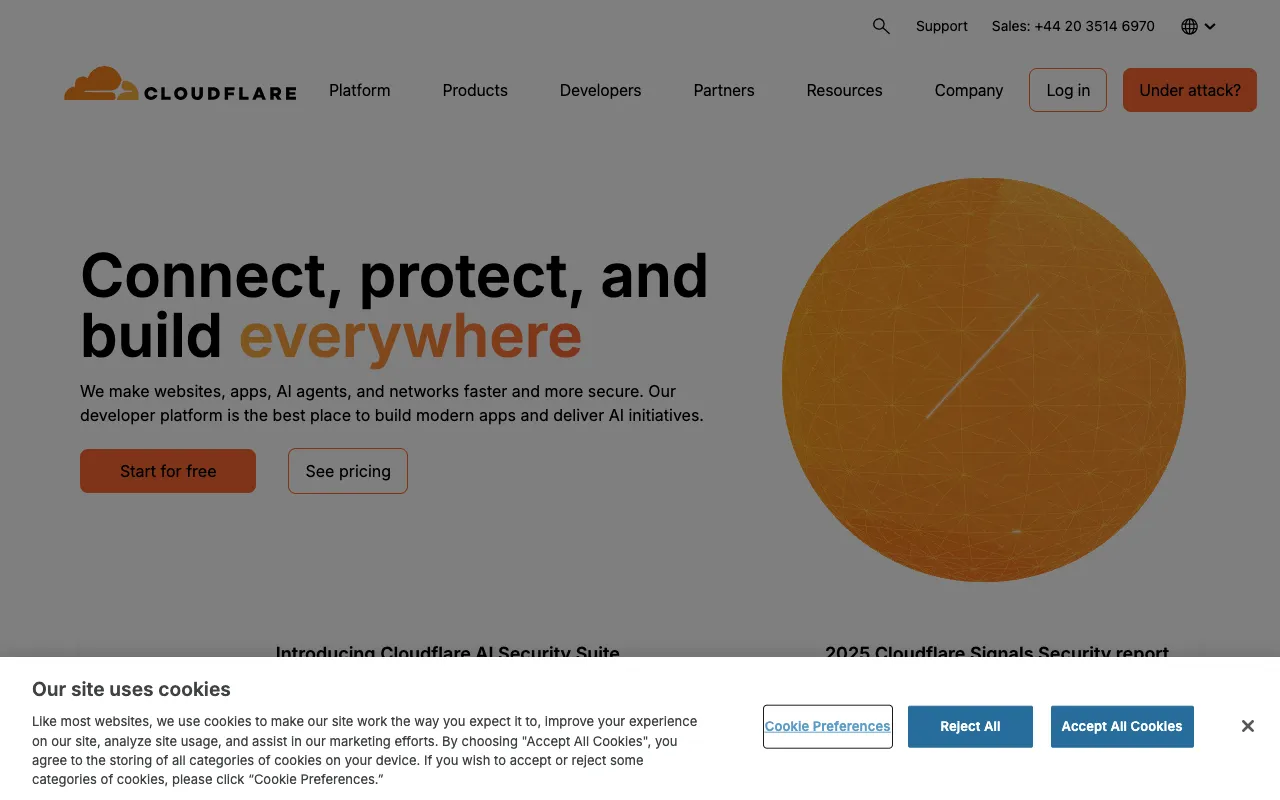
Cloudflare – The Essential Web Infrastructure & Security Platform for Developers
For modern web developers, Cloudflare is far more than just a CDN—it's a foundational layer for the internet. It sits between your visitors and your infrastructure, acting as a reverse proxy to dramatically speed up websites, block malicious traffic, and provide critical services like DNS and SSL/TLS encryption. With its generous free tier and powerful suite of developer tools, Cloudflare has become an indispensable part of the tech stack for startups, enterprises, and individual developers alike, simplifying complex infrastructure tasks and hardening application security.
What is Cloudflare?
Cloudflare is a global cloud platform that provides a comprehensive suite of services designed to make websites and applications faster, safer, and more reliable. At its core, it operates one of the world's largest networks, acting as an intelligent intermediary between your server and your users. By routing traffic through its optimized network, Cloudflare caches static content close to visitors, resolves DNS queries instantly, and filters out bots and attacks before they reach your origin server. This makes it a critical tool for any developer looking to improve performance, reduce server load, and implement robust security without managing complex hardware.
Key Features of Cloudflare for Web Developers
Global Content Delivery Network (CDN)
Cloudflare's massive CDN caches your static assets (images, CSS, JavaScript) across 300+ data centers worldwide. This reduces latency, accelerates page load times for global audiences, and significantly cuts bandwidth costs by serving content from the edge.
Enterprise-Grade DDoS Protection & Web Application Firewall (WAF)
Get automatic protection against distributed denial-of-service (DDoS) attacks of all sizes. The managed WAF ruleset helps block common web exploits like SQL injection and cross-site scripting (XSS), securing your applications with minimal configuration.
Free Automated SSL/TLS Certificates
Cloudflare provides and manages SSL certificates for all connected domains at no cost, enabling HTTPS by default. This ensures encrypted connections, improves SEO rankings, and builds user trust without the hassle of manual certificate renewal.
Cloudflare Workers (Serverless Platform)
Deploy JavaScript, Rust, C, or C++ code to Cloudflare's edge network with Workers. This allows developers to build API endpoints, A/B test features, modify responses, and create full-stack applications that run globally in milliseconds.
Smart DNS & DNSSEC
Cloudflare operates one of the fastest public DNS resolvers (1.1.1.1) and provides authoritative DNS with advanced features. It includes DNSSEC for added security, ensuring visitors reach your authentic site and aren't redirected by spoofed DNS records.
Who Should Use Cloudflare?
Cloudflare is essential for virtually any web professional. Front-end and full-stack developers use it to optimize site performance and security. DevOps and SRE teams rely on it for DDoS mitigation and traffic management. Startup founders leverage its free tier to launch secure, fast applications on a budget. E-commerce site managers depend on its WAF to protect customer data. Even bloggers and small business owners benefit from the speed and SSL benefits. If you have a website or web application, Cloudflare provides tangible improvements.
Cloudflare Pricing and Free Tier
Cloudflare's model is famously developer-friendly. Its robust Free plan includes the CDN, unlimited DDoS protection, the global WAF (with managed rules), free SSL, and access to Workers (with generous daily limits). Paid plans (Pro, Business, Enterprise) unlock advanced features like custom WAF rules, image optimization (Polish), Argo Smart Routing for faster tiered caching, higher rate limits for Workers, and 24/7 phone support. This tiered approach allows projects to start for free and scale seamlessly with their needs.
Common Use Cases
- Accelerating WordPress site speed and securing it from brute-force attacks
- Deploying a serverless API globally on Cloudflare Workers for low-latency responses
- Protecting a startup's web application from zero-day exploits with the managed WAF
- Implementing SSL and HTTPS for a portfolio website or blog at no cost
Key Benefits
- Dramatically improves Core Web Vitals (LCP, FID, CLS) for better SEO and user experience
- Reduces origin server load and hosting costs by caching content at the edge
- Provides a 'set-and-forget' security baseline against common web threats and large-scale DDoS attacks
- Enables modern JAMstack and edge-computing architectures without managing infrastructure
Pros & Cons
Pros
- Industry-leading free tier with core CDN, SSL, and DDoS protection
- Massive global network ensuring low latency and high reliability
- Unified dashboard for managing DNS, security, and performance settings
- Continuous innovation with edge computing (Workers, R2 storage, D1 database)
Cons
- Advanced security features and analytics require a paid plan
- Caching can sometimes be too aggressive, requiring careful rule configuration for dynamic content
- The sheer number of features and settings can be overwhelming for complete beginners
Frequently Asked Questions
Is Cloudflare really free?
Yes, Cloudflare offers a powerful Free plan that includes its global CDN, unlimited DDoS protection, a managed Web Application Firewall (WAF), free SSL certificates, and access to the Cloudflare Workers serverless platform with daily limits. This makes it one of the most generous free tiers in web infrastructure.
Is Cloudflare good for web developers?
Absolutely. Cloudflare is considered a must-have tool for web developers. It solves critical problems: it makes sites faster via its CDN, secures them with WAF and DDoS protection, provides free SSL, and offers a cutting-edge serverless platform (Workers) for building applications at the edge. It simplifies infrastructure, allowing developers to focus more on building features.
Does Cloudflare replace my web host?
No, Cloudflare does not replace your web hosting provider. It works in front of your host (origin server) as a reverse proxy. It caches content and filters traffic, but your actual website files and database still reside on your hosting server (like AWS, DigitalOcean, Vercel, or a traditional host). Think of it as a powerful performance and security layer for your existing hosting.
How does Cloudflare improve website SEO?
Cloudflare improves SEO indirectly but significantly. Faster page load times (via CDN caching) positively impact Google's Core Web Vitals, a key ranking factor. Free HTTPS/SSL is a baseline requirement for modern SEO. Furthermore, by preventing downtime from DDoS attacks and improving global accessibility, it ensures search engine crawlers and users can always access your site reliably.
Conclusion
Cloudflare has evolved from a simple CDN provider into the internet's most comprehensive developer platform for performance, security, and edge computing. Its unparalleled free tier removes the barrier to entry for implementing enterprise-grade web infrastructure. For any developer serious about building fast, secure, and resilient web applications, integrating Cloudflare is not just an optimization—it's a foundational best practice. Whether you're launching a new project or scaling an existing one, Cloudflare provides the tools to deliver a superior experience to every user, anywhere in the world.